A Quite Interesting Sunday Evening In A Television Studio, 26 January 2003

John Lloyd – with thanks to Amnesty International UK, CC BY 2.0 via Wikimedia

Since moving on from the parental home, in which television played a central part, I have not been much of a television viewer at all.

But I did once spend an evening in a television studio, along with Janie, watching a pilot for a show that eventually became QI (Quite Interesting). I remembered the evening in question while having lunch with John Lloyd (the producer of QI amongst other hit TV programmes), Brendan May and Michael Mainelli in December 2017.

My diary was not very helpful for this memory…

…but I’m pretty sure that the “@6:30” appointment that Sunday evening was the television studio on the South Bank for that pilot show.

As I recall it, Brendan May had suggested that Janie and I join him to form a supporting posse for the first pilot TV show as part of John’s “Quite Interesting” initiative, about which we had talked at some length with John over the preceding months.

The conceit of this pilot version of QI was a panel show in which members of the audience asked questions of the panel. The panellists would then try to answer the audience questions with interesting answers. A cross between a quiz show and Question Time.

Brendan was there, with his (then) girlfriend Caroline Woofenden, plus Caroline’s sister, Susie. Once Janie and I joined, we were a posse of five.

I’m sure John had rustled up some other friendly posses and in any case had plenty else to do that evening, but I recall him taking the time to greet us warmly and to ask if Janie and/or I wanted to ask a question of the panel. We both said no, but John made absolutely sure that we really didn’t want to participate before letting the matter go.

Brendan, on the other hand, had turned up with a tricky question for the panel, which I recall was a slightly obscure (or should I say quite interesting?) question about Mozart. Brendan might recall the exact details of his question.

Wolfgang Amadeus Mozart, a quite interesting man, public domain image, source:
https://commons.wikimedia.org/wiki/File:Wolfgang-amadeus-mozart_1.jpg

This pilot show was hosted by Peter Snow, best known (at least to us) as the face of the election results on election nights.

I recall that the show was to be titled Beat The Database rather than QI. The conceit of the show in that pilot form was the idea that the panellists were aiming to provide better answers than a database of facts. “Better answers”, in this context, meant being more interesting while avoiding common fallacies.

I remember all of our posse agreeing, after the pilot, that we thought the show should do well.

I recall watching the QI TV show when it was first broadcast, a few months later. I  was rather disappointed with the changes to the format, in particular the absence of audience questions and the switch from precise, game show scoring to “I’m Sorry I Haven’t a Clue”-style comedy scoring. Only the inclusion of Stephen Fry as host seemed, in my inexpert  opinion, like a good swap. Brendan agreed with me.

I remember Janie saying that there was no qualitative difference between the two formats to her eyes, while admitting that this is not really her sort of show anyway and that she hadn’t really enjoyed either format.

Caroline felt that that the QI format was much better than the Beat the Database pilot we had seen. I also remember Caroline gently berating me and Brendan for criticising the changes, reminding us that we are hardly typical TV audience. “If John Lloyd designed his programmes on your advice, he’d be producing programmes for an audience of two, neither of whom ever get round to watching TV anyway,” said Caroline, with words to that effect. She had a very good point.

But as this piece is about QI, I should record a couple of quite interesting things emerging from my process of writing this Ogblog piece.

The pilot we witnessed in January 2003 seems to have got lost in the recorded history of QI, certainly if Wikipedia at the time of writing is anything to go by.  Click here for a December 2017 scrape of the Wikipedia entry for QI. The existence of this Ogblog piece might itself lead to a Wikipedia correction of course – it wouldn’t be the first time – Ogblog has a social history function too, you know. QI elves should be crawling all over Ogblog like a rash by now, if they aren’t already.

A more serious reflection, though, emerging from our lunchtime conversation with John in December 2017, is that the idea of QI originally was much, much bigger than a single TV show.  The QI initiative set out to transform learning in society comprehensively. The idea was to take advantage of our additionally connected world of knowledge, exploding the “boring, encyclopaedic” approach to facts and teaching, not least rote learning, as  passé (no longer particularly useful) and insufficiently engaging for most human beings. Curiosity-based learning, arguably, is both much more fun and much more useful too.

Over lunch in December 2017, John bemoaned the fact that, nearly 15 years on, QI has not really progressed much beyond being a hugely successful TV programme. I recalled discussing the idea with John all those years ago; the TV show was intended to be the mere vanguard of this emerging curiosity-based learning movement. That thought also brought to mind the evening I spent at Brian Eno’s place a couple of weeks previously with the Economy team and ideas on how economics could be taught to youngsters using a vastly different approach from conventional neo-classical equations and simplistic “truths”.

Time for me to mix in a bit; the results might be quite interesting.

A Quite Interesting Postscript

On seeing the pilot for this Ogblog piece, John Lloyd kindly chimed in to correct my general ignorance about QI, Beat the Database and no doubt more besides:

Jane Root, then Controller of BBC2, commissioned THREE pilots from the QI project, to be co-produced with Talkback.


The first one we made (in 2002) was QI, which had a very similar feel to the present format, but without the closing ‘General Ignorance’ round with its forfeits.


We did have forfeits in the pilot, but they were dotted through the show randomly. And we did have a General Ignorance round, but it was the first of four rounds and involved things people didn’t know about generals.


It was Jane’s idea to conflate the two ideas and close the show with a ‘General Ignorance’ round, where most of the forfeits have ever since been clustered.


This was partly a brilliant insight – because she immediately grasped what the show’s signature idea would be – and partly a disaster – because if a question is flagged as ‘General Ignorance’, the panel realise at once that, if they ‘know’ the answer, they will be penalised. This has dogged us almost since the start.


The other two pilot programmes were called Beat The Database with Peter Snow, and Smartass, which would have been hosted by Jo Brand.


At the pilot of Beat The Database in 2003 (that you attended with Janie) Brendan was not a member of the audience, but actually on the panel as a ‘member of the public’ – the other two panellists being an ‘expert’ (the US philosophy Professor Steve Erickson (who was a friend of mine and Brendan’s) and a ‘celebrity’ in the form of Gyles Brandreth.


Unlike the preceding pilot of QI (which was indeed hosted by Stephen Fry, albeit as a last-minute stand-in for Michael Palin) and which we all thought was genuinely fresh, Beat The Database was not accounted a success by the production team.


Partly because Peter Snow didn’t get the idea until two-thirds of the way through (he thought the panel were lying), and partly because the QI Database that the panel had to ‘beat’ wasn’t then big enough to best them.


Still, at the time, we thought it was good enough (after what we had learned) to go to a series. However, after a three-month silence, I rang my BBC commissioner to ask if he’d watched the show.


“No”, he said, “Why would I? We’ve already commissioned one series about interesting information, why would we want another?”


That says it all, really.


And Smartass with Jo Brand (though it had been paid for) was never made.

Art Nouveau 1890-1914, Victoria & Albert Museum, 24 July 2000

crowded!

That’s all he wrote, folks.

Janie and I concluded our culture vulture odyssey day (we had already visited the British Museum & the Tate Modern)…at the V&A.

It was clearly a well received show, if the following “review of reviews” from The Guardian is anything to go by:

Art Nouveau Guardian Review of Reviews

Article from 14 Apr 2000 The Guardian (London, Greater London, England)

That might explain why it was crowded.

A First Visit To The (New) Tate Modern, “Between Cinema & A Hard Place”, 24 July 2000

This was the second part of a culture vulture odyssey day out with Janie, visiting the British Museum, the (then brand new) Tate Modern and then the V&A.

I recall that we were both taken with the new Tate Modern generally. I recall the sense of hugeness and we both especially remember the Louise Bourgeois giant spider piece in the Turbine Hall.

This Richard Holliday piece from The Standard pretty much sums it up.

Tate Modern Opening Standard

Article from 11 May 2000 Evening Standard (London, Greater London, England)

As for the specific exhibition I was keen to see – Between Cinema & A Hard Place – my verdict in the log was pretty short and clear:

weird crap.

I suspect that we moved swiftly on to the V&A.

Burma And The Art Of Lacquer, British Museum, 24 July 2000

Janie and I went on a bit of a culture vulture odyssey that day, visiting the British Museum, the (then brand new) Tate Modern and then the V&A.

Of the three visits, this was the one that got the top rating from me…I’m pretty sure from both of us, in my log:

Marvellous.

This write up by Sue Arnold in the Observer provides some additional words of praise.

Burma Arnold Observer

Article from 11 Jun 2000 The Observer (London, Greater London, England)

But words can’t do it for for this type of exhibition. You’d either need some sort of virtual reality, metaverse retrospective…or you had to be there.

An Attractive Young Note In Janie’s Diary, But Not In Mine, 14 November 1999…Or Do We Mean 12 November 1999

In Janie’s diary for Sunday 14 November, but not mine, the following reminder – presumably based on me saying to Janie, “let’s not forget to listen to…”

The Attractive Young Rabbi. Barry Grossman. 11:30 Radio 4.

Word must have reached me through the NewsRevue community that Barry Grossman’s radio series, The Attractive Young Rabbi, was about to broadcast.

What do you mean, you missed it at the time and now can’t get hold of it?

What do you mean, you heard it at the time but can’t remember it?

It’s there to be heard on the Internet Archive if you now where to look. Click this link, for example, and you’ll find the first series.

Tracy-Anne Oberman was also a NewsRevue (or more specifically, SportsRevue) alum, so this series was definitely a tribute to our NewsRevue “Class of ’92”.

There’s Barry in the Guinness World Record photo, with specs, holding the award.

I enjoyed listening to The Attractive Young Rabbi again. It is quintessentially BBC Radio Four comedy.

Postscript: Barry Grossman Writes…

Thanks Ian, except you and Janey [sic] must have missed it because it was actually on Friday, the 12th of November.

And there were no i-players, BBC Sounds or internet archives in those more innocent times. Perhaps you taped it on your reel-to-reel tape recorder the size of a house and listened to it on the Sunday.

I responded to Barry as follows:

Weird but clearly true that the broadcast was on the Friday not the Sunday, yet the note is unquestionably written in the Sunday section of Janie’s diary. 

My guess is that Janie wrote the note there because the Friday page was completely crammed with patient appointments.  The Saturday block is covered in notes about something completely different and unintelligible.  So the only space for an additional note on that page was the Sunday block. 

Quite right that there was no public domain technology to help us listen at an alternative time, but Janie did have a midi hi-fi thing in the maisonette that would enable you to record onto cassette from the radio.  I was out visiting clients that day, but she would have been able to press the record button on her midi gadget at the appointed hour.  My guess is that the note was a reminder to do that.

No gargantuan reel-to-reel tape recorder available at that time – that device lives in the flat and the flat was being refurbished that autumn.  Probably just as well – Janie was reluctant enough to press a “record” button on a bog-standard midi system.  My reel-to-reel would have seemed like something out of Mission Impossible to Janie…

… https://youtu.be/4y9NtHlJvbY …

…which would have made listening to the recording on the Saturday or Sunday…impossible.

Jackson Pollock, Tate Gallery, 13 May 1999

As part of a “week off” that Janie and I took in London to see exhibitions and shows, the centrepiece of our Thursday was a trip to the Tate to see the Jackson Pollock exhibition.

The exhibition had been much hyped in the media, with previews and reviews.

Here’s a smattering from the papers.

Bel Littlejohn in The Guardian with tongue firmly in cheek, I shouldn’t wonder:

Pollock Littlejohn GuardianPollock Littlejohn Guardian 19 Mar 1999, Fri The Guardian (London, Greater London, England) Newspapers.com

Laura Cumming in the Observer seemed more genuinely bowled over by the exhibition:

Pollock Cumming ObserverPollock Cumming Observer 14 Mar 1999, Sun The Observer (London, Greater London, England) Newspapers.com

The Weasel in the Indy used a strange mixture of reverence and irreverence to review this exhibition:

Pollock The Weasel IndyPollock The Weasel Indy 13 Mar 1999, Sat The Independent (London, Greater London, England) Newspapers.com

Brian Sewell gave it the usual “Sewage treatment” in the Standard, over two pages:

Pollock Sewell StandardPollock Sewell Standard 11 Mar 1999, Thu Evening Standard (London, Greater London, England) Newspapers.com Pollock Sewell Standard 2 of 2Pollock Sewell Standard 2 of 2 11 Mar 1999, Thu Evening Standard (London, Greater London, England) Newspapers.com

I gave it a one word review in my log:

Bollocks.

Janie remembers the exhibition more fondly than that and I have become reconciled with Pollock since, especially in the context of shirts and ties.

Three Exhibitions In One Day: Kandinsky Watercolours And Other Works On Paper, Birth Of The Cool, New Art – New Era, Royal Academy & Barbican, 12 May 1999

As part of a week off at home, we did a fair bit of cultural stuff. A rare visit to the theatre on the Monday did not work as well as the dinner afterwards…

…but this day going around galleries was memorably good.

We loved the Kandinsky watercolours, but the critics hadn’t been so keen on them, preferring Kandinsky for oils and criticising the way the exhibition had been curated. Richard Dorment in The Telegraph, for example.

Kandinsky Dorment TelegraphKandinsky Dorment Telegraph 21 Apr 1999, Wed The Daily Telegraph (London, Greater London, England) Newspapers.com

Brian Sewell in The Standard was even more waspish.

Kandinsky Sewell StandardKandinsky Sewell Standard 22 Apr 1999, Thu Evening Standard (London, Greater London, England) Newspapers.com Kandinsky Sewell Standard 2 of 2Kandinsky Sewell Standard 2 of 2 22 Apr 1999, Thu Evening Standard (London, Greater London, England) Newspapers.com

Still, Ogblog is not about what those expert geezers think but it is about what we felt. I recall Janie and I really liking that exhibition, so much so that we set off later than intended for the Barbican, where we had chosen to see two exhibitions – in particular David Bailey’s The Birth Of Cool Photographic Exhibition.

We loved these pictures. Who cares what the critics said. Well, actually I think the critics lined up in favour of this one.

Adam Edwards in The Standard celebrated the cool:

Bailey Edwards Standard 1 of 2Bailey Edwards Standard 1 of 2 07 Apr 1999, Wed Evening Standard (London, Greater London, England) Newspapers.com Bailey Edwards Standard 2 of 2Bailey Edwards Standard 2 of 2 07 Apr 1999, Wed Evening Standard (London, Greater London, England) Newspapers.com

Whereas Jonathan Green in The Standard fretted that The Swinging Sixties weren’t so swinging for all. Who knew?

Bailey Green GuardianBailey Green Guardian 17 Apr 1999, Sat The Guardian (London, Greater London, England) Newspapers.com

We also popped in to see New Art, New Era in the other hall at the Barbican

We didn’t spend too long on this sweeping exhibition, little being to our taste, but we did enjoy some of the exhibits.

John McEwen in the Telegraph gave it a comprehensive review:

New Art McEwen TelegraphNew Art McEwen Telegraph 02 May 1999, Sun Sunday Telegraph (London, Greater London, England) Newspapers.com

Brian Sewell in the Standard rubbished the exhibition even more comprehensively:

New Art Sewell Standard 1 of 2New Art Sewell Standard 1 of 2 13 May 1999, Thu Evening Standard (London, Greater London, England) Newspapers.com New Art Sewell Standard 2 of 2New Art Sewell Standard 2 of 2 13 May 1999, Thu Evening Standard (London, Greater London, England) Newspapers.com

Heck, but we’d had a great day. Yah boo.

Shakespeare In Love, A Cinema In Ealing, 27 February 1999

I hadn’t quite acquired my “Bard look” in 1999, but nevertheless we interrupted our brace of weekend visits to the Barbican to see large scale concerts with a visit to the local cinema in Ealing to see Shakespeare In Love.

It was one of those films that you had to see at that time because everyone was talking about it.

These days, he says writing 25 years later, we tend to avoid films that everyone is talking about.

Anyway, we enjoyed this one, even the silly bits. We did not imagine we were having a history lesson.

Here’s what IMDB says about it, including trailers and stuff.

No doubt we had a glass or two over a very pleasant meal at home afterwards.

The Day We Went To the Oriental Restaurant In The Dorchester Hotel And Later Ran Out Of Monet, 1 February 1999

Did you see what I did there?

Janie and I had a day off.

We went to the Dorcheter Hotel for lunch at the Oriental Restaurant. We had been dying to try the place and had been tipped off that the lunchtime offering was a much better deal than the evening meal.

We both remember it being excellent scoff.

Jay Rayner in The guardian wrote up the notion of going to the place for lunch a few years after we worked that out. I don’t recall our lunchtime meal revolving around dim sum – I think that was a later lunchtime innovation there.

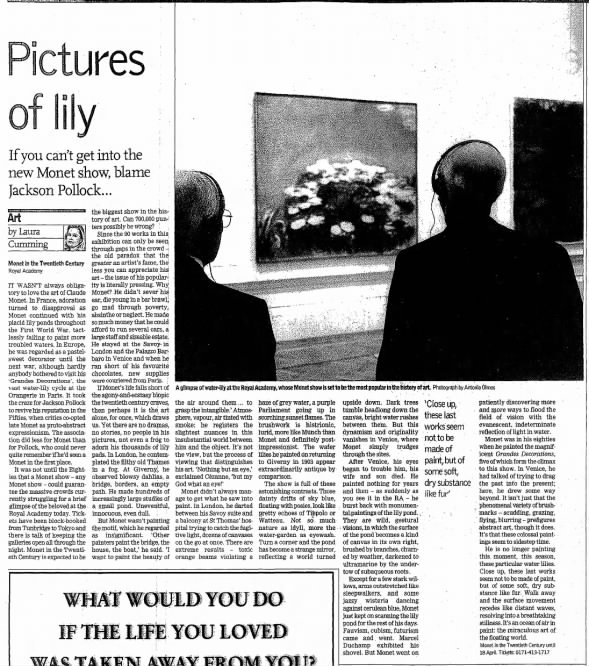
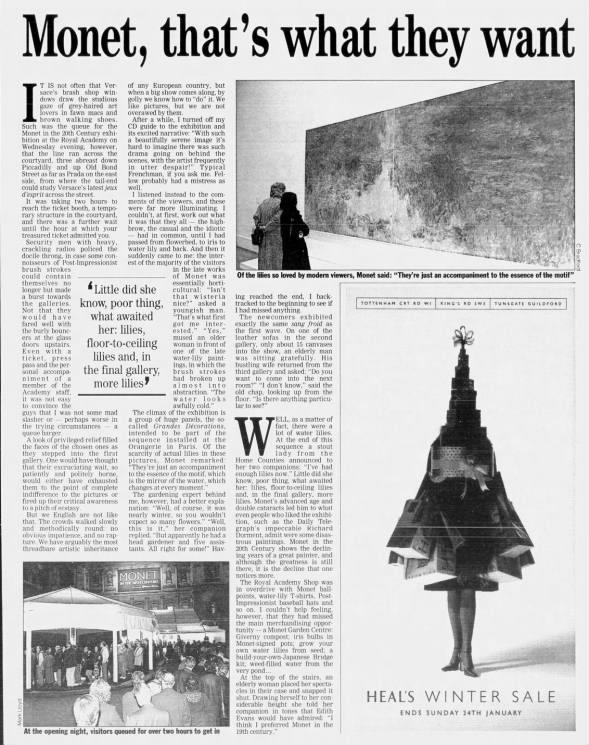
Then on to the Royal Academy to see Monet In The 20th Century, which was an excellent exhibition.

Big thumbs up from Laura Cumming in The Observer:

Monet Cumming ObserverMonet Cumming Observer 24 Jan 1999, Sun The Observer (London, Greater London, England) Newspapers.com

Sebastian Faulks in The Standard seemed less sure.

Monet Faulks StandardMonet Faulks Standard 22 Jan 1999, Fri Evening Standard (London, Greater London, England) Newspapers.com

International Festival Of Fine Wine & Food, Olympia, 10 October 1997

The Wine Festival by Albert Anker

OK, it wasn’t all that long ago and Olympia didn’t exactly look like the above picture when we went there for the food & wine fair.

I’m pretty sure Janie and I went more than once to this event, but 1997 might have been the first time.

The Standard gave it a short preview here:

Fine Wine & Food Olympia 10 October 1997Fine Wine & Food Olympia 10 October 1997 08 Oct 1997, Wed Evening Standard (London, Greater London, England) Newspapers.com

So there it is – a classy booze fest.

My then-mate-to-be, Alastair Little, doing the celebrity chef bit. I don’t think we went to that bit – Janie and I didn’t tend to go to the big showpiece parts of such events – we just liked going around, picking up ideas and sampling things..

Who’d have thought back then that I’d end up getting to know Al so well:

Janie barely remembers the event at all, other than the vague recollection of going to such things a couple of times.

It seems they still do something a bit like it at Olympia twenty-five years later, but in the spring…

…and also the late summer for posh grub.

I’m not sure whether it was this occasion or another visit to one of these fairs, but I recall a very beautiful “English rose” of a young woman marketing Kentish wines, persuading me to try her wares. At that time (or at least this particular wine) was very ordinary wine at an above ordinary price. I have a strong memory of trying to find kind, encouraging and positive words about the wine without seeming interested in actually purchasing the stuff. She smiled sweetly throughout the exchange, so I am quite sure I got away with it.

Trying to find the right words in 1997