No doubt about it – Bobbie joined me for this one. She was keen to see the Royal Liverpool Philharmonic under the auspices of the great Czech conductor Libor Pešek. I was keen to see how he would deal with one of my favourite works, Smetana’s Má Vlast.
Strangely, although the national papers promoted this concert widely in advance, none chose to review it by the looks of it. Typical.
Here’s one of the sea interludes performed by the very outfit we saw:
Here’s Stephen Hough with the BBC Symphony from the first night of the Proms 2013 with the Rachmaninov Paganini:
Here’s Libor Pesek and The Royal Liverpool mob playing their four movements of Ma Vlast in Libor Prom order:
Alternatively, if you want to hear that recording in full in Smetana sequence, I have made it available on this playlist – click here. Do not be put off if you see a seemingly erased link – you can hear it whether or not you have a YouTube Music account – you just get adverts of you don’t.
In truth I couldn’t bring to mind Skocná – Dance of the Comedians, but James Levine & the Vienna lot brought it all back to me:
I’m really not at all sure that Entry of the Gladiators belonged with this concert, but that’s what they did. The piece was originally written as a serious piece of military marching music, although how anyone with that moustache composing that piece expected to be taken seriously, even back then, I cannot imagine.
On reflection, I think the use of that piece as a second encore was a mistake. When Libor Pesek suggested that they play a second encore, one of the scouse musicians loudly expressed his discontent with the traditional local expletive, but unfortunately Pesek thought the fellow said:
“Everyone drives on the pavement in Rio de Janeiro” – picture produced in collaboration with DALL-E
We headed up to Oxford late afternoon Friday for an unforgettable 24 hours or so, centred around a superb concert of Handel performed by The Sixteen Choir and Orchestra under Harry Christophers.
When I say “we”, I mean “me and my workmates. This was my first of several Music At Oxford experiences with BDO Binder Hamlyn Management Consultants (as it was called at that time). In fact, I think this concert was the first that Binders sponsored and that Music At Oxford thereafter became a bit of a Binders fixture for several years.
I was thrilled and impressed when I discovered that my firm was sponsoring this concert. I had discovered The Sixteen a couple of years earlier by hearing their recordings broadcast on Radio 3 and had found their sound mighty impressive.
Even now, writing in February 2019, nearly 30 years after the event, Janie and I still consider The Sixteen to be one of the very best early music choir/orchestras we have ever heard – indeed we have booked to see them again at The Wigmore Hall quite soon. It’s been a while – can hardly wait.
Harry Christophers in 2012, from Wikimedia Commons
But back in 1989 I had not yet seen The Sixteen live and/but it transpired that pretty much nobody at work had heard of them at all, so I was designated to be the in-house expert to whom inquisitive clients attending the concert might be sent for more information…
…in true management consultancy style, my having heard the performers a couple of times on the radio became, shamelessly, “recent, relevant experience”, enabling me to advise the clients about all matters Sixteen, Handel and indeed Early Music generally. I should have charged fees.
I remember the Friday afternoon, especially the journey to Oxford, very clearly. I spent the day at the office. As I still hadn’t passed my driving test, William Casey, the managing partner of the consultancy, offered to take me with him from the office to Oxford. I suspect that part of his purpose was to suck what little I knew about the music and the performers from my brain, so he could say something vaguely meaningful to clients.
Of course, we ended up leaving Faringdon Within later than intended and of course the Friday afternoon traffic between London and Oxford in early July was pretty heavy.
I discovered that the seemingly unflappable William Casey was as flappable as the rest of us when under time pressure, as we really did need to get to the Randolph Hotel, get changed into our fancy-pants clobber and be at the Sheldonian Theatre in good time to meet and greet guests.
Once we got away from the main London traffic it seemed we still had plenty of time. William and I chatted about various things, including life aspirations (mostly his) and William’s prior experience living and working in Brazil.
But I don’t think William had accounted for the dreadful traffic into Oxford on a Friday. 1989 was pre-M40 beyond Oxford, of course, so a fair bit more local traffic needed to use the narrow roads around and through Oxford in those days. So the stress levels started to rise again once the A40 into Oxford became a traffic jam.
At one point, William cut off a rather jammed up corner by driving up onto the pavement and jumping the traffic queue at the turning. Probably spotting my disquiet at that manoeuvre (which had not come up in any of my driving lessons) William exclaimed…
…everyone drives on the pavement in Rio de Janeiro!…
…which is the most memorable single thing that William ever said to me.
Of course, it was all a bit of a rush once we got to Oxford. Of course, we weren’t really late – just a little later than intended – so we were able to do the meet and greet thing before the concert…
…which is just as well, because we really were the sponsors – look at this page from the festival brochure:
Within a few months, we had changed our name to BDO Consulting; the first of several subtle name changes in the five-and-a-half years I was at the firm.
The concert was lovely and the Sheldonian Theatre is a superb setting for baroque music.
First up, the small scale but very beautiful Nisi Dominus, a recording of which, by The Sixteen, recorded just a few months after our concert, is (at the time of writing) available for all to hear:
Next up was the Lord Is My Light – Chandos Anthem No 10. Currently a recording of this one by The Sixteen is also available for you to hear:
Then the interval, which we spent hoity-toitying with our client guests in the Bodleian Library:
Well Posh
The invite doesn’t use the term hoity-toitying but you can take my word for it, that’s what we did.
I cannot remember in detail who was there that evening. All of the consultancy partners and a great many of my immediate colleagues for sure. Possibly some of the accountancy partners too, although I have a feeling that this first sponsorship was very much a consultancy affair and that it was in future years that the sponsorship widened out to Binder Hamlyn more generally. Michael Mainelli might well remember and fill in some juicy details.
I don’t think I needed to attend to my own main clients that year – I don’t think they attended. But I had been involved to some small extent with several of the firms clients by then, so had a fair smattering of people I knew as well as the general entreaty to “walk the room”, be the designated in-house early music expert and pretend to look intelligent…or whatever.
The second half of the concert was the wonderful Handel Dixit Dominus. I cannot find The Sixteen recording on line, but there is a fine live performance under John Elliot Gardiner which you might enjoy enormously:
My log reminds me how I felt about the evening and what happened next:
Superb evening. Ended up back at the Randolph Hotel sing-songing with the clients etc.
I am trying to remember who the main ringleaders of the sing-songing were; my memory fixes on Jim Arnott, Dom Henry and Richard Sealey in particular, but I might be mixing up this event with another event or two. Again, Michael might remember these informal details more specifically than me. I’m pretty sure Michael also partook of the sing-songing.
I don’t think we were sing-songing Handel at all – I suspect our singing was more of the Hotel California/American Pie/Streets Of London variety.
I do remember that we went on singing and partying into the early hours of the morning.
I don’t remember how I got home – I think I took the train from Oxford to Paddington for the return journey.
For sure I was back in London for an evening of Theatre at the National – that’s another story for another Ogblog…
But for sure this first Binders/Music At Oxford event, in 1989, especially the thrill of seeing The Sixteen at the Sheldonian, was one of my most memorable and enjoyable work-related cultural experiences.
I don’t have great memories of seeing this opera, but I think my memories of it are more closely linked to my general mood that weekend than to any intrinsic issue with the opera/production…
…other than to say that this experience probably helped to kick off the view, which has become a prevailing one, that opera ain’t me.
Bobbie was there for this one, as was Ashley Fletcher – yes, my memory definitely serves me correctly for this one, as the diary makes clear that Ashley was down for the weekend and stayed in the tower – i.e. the annex to my flat in Clanricarde Gardens – so named, by Ashley, as he felt that the place would be suitable for the detention of a mad and/or elderly relative. That annex now serves as my office – renamed the ivory tower – a more liberal purpose and name.
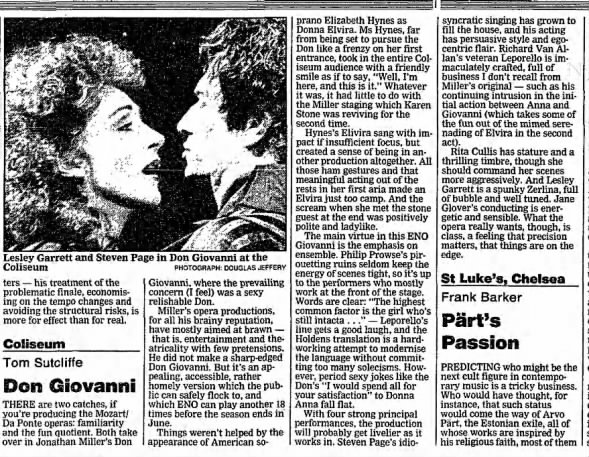
…a few days before I wrote up this piece, about Don Giovanni.
Postscript after seeing Ashley in April 2019: Ashley has no recollection of that weekend. So we must rely on Bobbie’s memory that I was tripping out on tiredness and rather freaked at the thought of going out to get some additional soap, as there was none for Ashley in the shower of the tower. If I really did say words to the effect:
I did not envisage this weekend as a soap buying weekend…
…that would have to be up there amongst my most autistic utterances ever. I have a dreadful feeling that Bobbie’e memory is going to be bang on regarding that point.
from The Spectator 2 July 1988 – subscribers can click through to the archive and read the whole article.
I don’t recall it seeming like a disaster. I do recall it feeling more like being at a rock concert than at a theatrical production. I think we had good seats but were still at some distance from the action. It was big, bold and in truth not really me.
I don’t think this one was really Bobbie either – she might remember how she felt about it.
Now I’m not one to point the finger or anything like that, but my guess is that it was primarily Bobbie’s idea to give opera a go, not least because so many of her law reporting pals were into opera.
I’m pretty sure my previous experience of opera would have been Carmen in the early 1970s; a semi-professional production by the Putney Operatic Society who chose to typecast me and several of my primary school mates as urchins.
But I digress.
Roll the clock forward some 15 years and, like buses, it’s not one but two that come along at more or less the same time – i.e. two opera visits during June 1988. That’s quite a lot of opera just a few week’s before my Accountancy finals. The Magic Flute was the first of them.
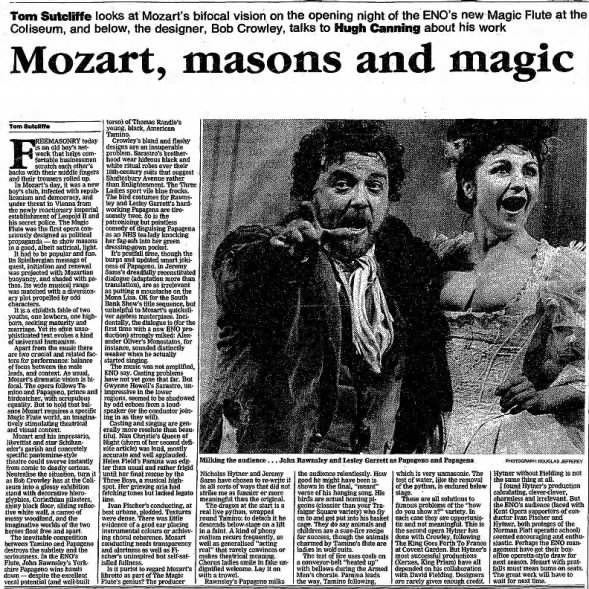
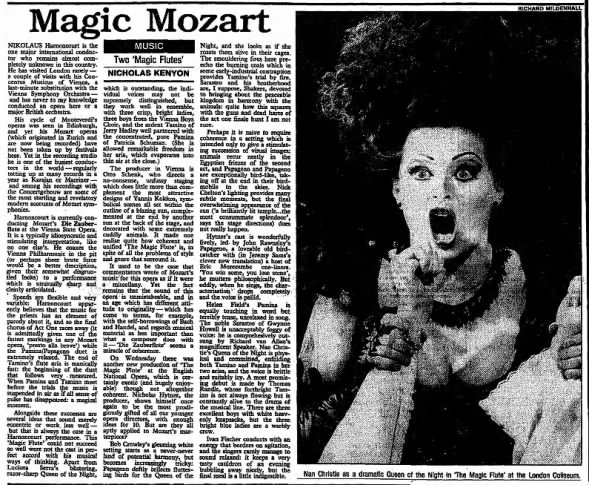
Jeremy Sams directed it – I have seen a great deal of his work in the theatre of course. Nicholas Hytner produced it – I’ve seen a lot of his theatre stuff too. The production was sort-of revived many years later and the trailer for the revival is embedded below, so that should give you a feel for it.
We went midweek – on a Tuesday – which will have been quite a late night. I was on study leave by then I think, so I suppose I felt that I was master of my own time management.
In truth I don’t remember all that much about this production, other than lots going on and rather liking the music because it’s Mozart and I rather like Mozart.
Bobbie might have more profound memories of it than me. I’ll ask her.
Sometimes people like me have a pivotal moment in their self-education about music. I discovered this week (writing in February 2018) that mine was on 31 October 1987.
You’ll need to roll with this one, dear reader, it is a somewhat convoluted tale but in the end it is riddled with strange coincidences twixt 2018 and 1987. I hope this piece has some interesting general insights too.
…and spotted that the William Byrd specific concert would include “Though Amaryllis Dance In Green”. I remembered that song fondly as one of the first Tudor period songs I had heard and liked. I could even recall the tune and many of the words. I sought and found a simplified transcription of the music for lute on-line and decided that it would be a good example for me to work on with Ian Pittaway to further transcribe for solo voice and Tudor guitar.
On the day of the Gresham lecture, my mind began to wander (during the journey home after work I hasten to add, not during the lecture or work) about that song. I knew I still had a recording of it and would have kept notes on who was performing it.
It is extraordinary what memory can do. My mind latched on to that late 1980’s period and I was pretty sure I heard the music while I was getting ready for some professional exams.
I enjoyed a Saturday morning Radio 3 programme back then which played new releases and gave some interesting background on the recordings. But I also wanted to get my homework out of the way, so I tended to spool the radio show onto the trusty reel-to-reel and listen to it later in the day.
One week there had been a morning dedicated to early music and I remembered that some of the music had blown me away…
…to such an extent that I had edited that spool and preserved the recordings…
…then digitised it some 20 years or more later.
In fact, the recording that had really blown me away from that morning’s show was Josquin Des Prez and my records tell me that it was the Hilliard Ensemble.
…and as I am promoting the material so flagrantly for the Hilliards…and have of course now bought a copy of the album for myself, assuaging my guilt for the home taping…I’ll guess they won’t mind that I have uploaded my rather worn-sounding track – the one that blew me away – Ave Maria:
It really is a lovely recording of the piece. I have heard several others since and (perhaps it’s me) but that Hilliard recording of it is something very special.
When I got home to find all this out, there was a really nice message waiting for me (us) on Facebook from Ros Elliot, an old friend of Janie’s who now lives in Turkey. I recalled that Ros’s brother Paul used to sing with the Hillard Ensemble and of course, it transpired with a little e-digging, is indeed singing on that very album of Josquin music.
Also on that same old tape of mine, as I expected, was Though Amaryllis…which was also a recording by the Hilliard Ensemble. The Byrd was released the same year as the Josquin; 1987. Now available as part of a double-album of Byrd and Dowland…yes of course I procured this one too. Only available in CD form for now – click here or below:
So, given that the Hilliards got a sale and an advert out of me for this album too, I’m going to guess that they’ll be OK with the worn-sounding Though Amaryllis file going up for you to sample:
So then all I needed was my diary and the trusty BBC Genome project to resolve exactly when this introduction to Early Music happened.
…which yielded the next coincidence. The same broadcast had included Christopher Page with Gothic Voices singing, amongst other things, Ian Pittaway’s favorites Westron wynde and Hey nony nonyno. Clearly those didn’t make the cut on my edited tape. Perhaps I missed the start of the show…or perhaps those songs were too alien for my ears at that time.
…but dad did like the secular Josquin tracks very much; and the Byrd. Mum didn’t get early music at all. Chopin, Strauss (the waltz ones) and Tchaikovsky for her.
Momentous stuff in late 1987 – it really was the day that early music found me – and some wonderful coincidences in early 2018 while I found that momentous day again.
Busy day at work – went to piano recital with Jilly in evening at QEH.
This one stumped me as I didn’t keep a programme and had no record of it on my other logs. Not even Gemini could help me, but I guessed correctly that the Queen Elizabeth Hall might advertise concerts through listings and found the atatched detailed one in The Daily Telegraph through my Newspapers.com subscription.
Kate Fricker: “Would you like me to drive, Professor?” Watson Fuller: “No. Why do you ask?”AI actors images provided by DeepAI.
One of my most memorable Keele days, right at the end of my time there. Kate (now Susan) Fricker and I were invited to join the University guest pack at the Lichfield Festival, courtesy of Peter Held of industrial textiles behemoth Marling Industries plc.
Ironically, Marling Industries was best known for seatbelt materials. Ironically, because Kate and I were treated to a rollercoaster ride from Keele to Lichfield with Professor Watson Fuller and Mrs Fuller.
I was very fond of Professor Fuller. And I think he was also fond of us. He’d certainly heaped praise on one of my least challenging pieces of research a few month’s earlier, in his capacity as Chair of Foundation Year Committee:
Professor Fuller was Professor of Physics, so he really should have had a profound grasp of the potential physical effects, were a large object travelling at speed – e.g. a car with four passengers doing 60 mph on a duel carriageway – go out of control and hit something. Yet, he did not seem to have a profound grasp of the steering wheel most of the time, nor did he seem to be paying much attention to the road when, frequently, he turned around to us, waxing lyrical about this, that, or the other.
I suppose, as Fuller was a biophysicist, credited with vital supporting work on X-Ray diffraction with Watson & Crick, that his head was always in far loftier thoughts than mere road safety. Or should I say that driving without paying fuller attention to the road was in Professor Fuller’s DNA.
Mrs Fuller did not look terrified. Perhaps she was used to it. But apparently, on arrival, Kate and I looked a little ruffled. I remember Professor Philip Boden and his good lady taking us aside before the lunchtime concert.
Has Watson offered to take you home after the evening concert? Thought so. Not many people want a second lift from Watson, bless him. Reputation precedes him. Would you like us to rescue you? Thought so. I’ll tell him we’ve invited you back to our place for coffee after the concert. Easiest that we take you back.
We were grateful. And Professor Boden was good to his word, not only giving us a lift home but also providing us with some warm hospitality and enjoyable chat at Chez Boden before taking us home.
To the concerts. First up was a lunchtime concert at St Chad’s Church, Lichfield.
Joseph Haydn – String Quartet No 3, Op 33 (“The Birds”)
Wolfgang Amadeus Mozart – String Quartet in G (K 387)
Very charming it was too. The setting. The fine quartet and the non-challenging nature of the music.
After plenty of hospitality in the afternoon and a migration to the Cathedral, we enjoyed a bigger deal concert in the evening. The Chamber Orchestra of Europe, under George Malcolm, supported by András Schiff, Yuuko Shiokawa and Heinz Holliger.
Wolfgang Amadeus Mozart – Wind Serenade in C Minor
Alban Berg – Chamber Concerto for Violin, Piano and Winds
George Frideric Handel – Concerto Grosso, Op 3 No 2 in B flat
George Frideric Handel – Music for the Royal Fireworks
I must confess to have struggled with the Alban Berg. Always have, probably always will. The rest was easy listening by serious music standards.
John White and I quite often did our sixties soul discos when DJ-ing at Keele. Those “happenings” are among our favourite memories of spinning the plates at Keele.
My diary entries didn’t always mention the style of disco involved, but my diary entry for 11 May 1985 was specific:
Saturday 11 May 1985 – Got up lunchtime and came into office to meet Ashley [Fletcher] etc. Went for walk with Petra [Wilson] in early evening – came to union and did 60’s disco [with John White].
John and I have stayed in touch ever since we left Keele. Indeed, as I write this up 40 years on (23 May 2025), we’ll be seeing each other tomorrow.
These past few weeks we have been liaising over the sounds that we played at those sixties soul discos. People sometimes referred to them as Northern Soul discos, but in truth most of the stuff we liked and played was not quite so rare as Northern Soul purists would like – mostly Motown and Atlantic/Stax. We were somewhat constrained by the content of Keele SU’s impressive but not all that unusual record collection.
Intriguingly (for us), we separately listed the stuff we remembered playing back then before pulling this playlist together – the overlap was extensive.
Anyway, dear readers and listeners. You can decide for yourselves what you think of this three-and-a-half hour marathon sixties soul disco. Janie (my wife) and I have been dancing around the living room to it – no doubt John & Mandy have too.
Comments from people who remember these discos, or from people who wish they had been there, or simply from people who love this kind of music will be most welcome.
While Students’ Union events, gigs and discos were my staple during my sabbatical year, I found myself increasingly listening to classical music on my rare evenings off in my micro-apartment in Horwood K Block.
The place was described as a resident tutor’s flat and I was very lucky to be allowed such space and comfort for my sabbatical year. In truth, the “flat” was two study bedrooms at the end of a corridor cobbled together with a small galley kitchen and a tiny en suite bathroom and toilet utilising the would-be corridor space and some of the would-be study bedrooms.
Still, I had a sitting room in which to eat, relax with friends and (surprisingly frequently) to act as a dossing floor at night for people who lacked the energy or ability to stagger home. John White, who lived off campus, was quite often such a guest.
Returning to the classical music, my tiny personal collection of classical recordings had not moved on since the early to mid 1970s. I have pretty much documented it all in one Ogblog posting – click here or below.
I had no record player at Keele; hence the couple of hundred cassettes I had accumulated during my Keele years.
I consolidated the fancied bits of that tiny classical record collection on to eight cassettes, which I have replicated through the following two YouTube playlists, which you can access despite even if you see off-putting strikethroughs:
Wherever possible I have found the exact same 1960s/1970s recordings for those playlists. I have rather enjoyed listening to them again after so many years. Of course I can hear more modern and technically much better recordings at the press of a button these days, but these are the performances and recordings I remember from back then.
I played bits of those eight cassettes quite a lot in 84/85.
My only sound system until the record player loan…excellent it was too.
While John White and I tended to trawl my far more copious collection of modern music, partly with a view to planning discos and the like…I’ll be writing more on that topic in a future piece…
… Kate (now Susan) Fricker used to like to hear classical music when she visited, while Petra also quite often requested a classical music backdrop on the increasingly frequent occasions that she was at the flat.
Indeed, it was through Petra, or more accurately one of Petra’s friends, I think probably Ruth, that a record player found its way into my flat. Petra’s friend had discovered, like many Keele students before her, that there was not much room for a turntable and stereo system in a study-bedroom.
The record player was lent to us for an unspecified period (I think it ended up at mine for the rest of the academic year), taking pride of place in my so-called living room. It looked rather grand in that setting, but for the inconvenient truth that I had no records at Keele. Not one.
Occasionally someone would come round with a record, and we could play it, but this seemed like underutilisation to me.
All this is a preamble to the one big thing I remember about visiting my old (as in long-term, not elderly) friend Jilly Black in Cardiff that first weekend of March 1985. Here’s all I wrote in the diary about it.
Friday 1 March 1985.– Very busy morning to get all out of way – left Keele early. Went to Cardiff – supper and drink – earlyish night.
Saturday 2 March 1985 – rose quite late – did some work – went to Cardiff Union -> shops -> back – went drink -> Chinese -> back for more drink – pleasant day.
Sunday, 3 March 1985 – got up quite late – had lunch – left Cardiff – long journey – went union – went Petra’s – [she] came over later.
Jilly was studying music at Cardiff. It was Jilly who had introduced me to Claudio Abbado at The Proms some 18 months earlier…
…and I recall that my visit to see her in Cardiff was long overdue.
My enduring memory of that particular visit was purchasing 10 classical records under Jilly’s “tutelage” on the Saturday. The only other things I remember about that visit were:
being reminded that everything in Wales, at that time, shut down ridiculously early on a Friday evening – hence the otherwise out of character “supper drink and early night”;
that Jilly’s “then but soon to be ex” boyfriend did something of a no show, so I didn’t get to meet him and this was a bit of a cloud over an otherwise very enjoyable weekend
an excellent Chinese meal in a restaurant on the Cardiff Riverside which I think might even have been named, suitably, Riverside Cantonese or some such.
But let us examine the 10 classical albums that I bought on the Saturday with Jilly’s help. Where I can identify the album I have added a Discogs link, which, for some obscure reason, tend to look struck through even though you can click them happily:
I vaguely remember a running gag in which Jilly and I imagined sequels with names such as “Sidney in Spain and “Monty in Bournemouth”. Perhaps you had to be there.
If you are reading this article, pining for that fine mini collection of ancient recordings of classics, brilliantly curated by Jilly, pine no more. This YouTube playlist has all but one of them (I have so far failed to trace the particular Vivaldi sonatas and concerti on the album so-named). Here is a link to the YouTube playlist that includes those classic albums. The usual “don’t worry if you see a strike through, you can click happily” rule applies.
I’ll be returning to the topic of Keele discos and playlists for those soon enough.


 Pesek Prom Leece Echo 24 Jul 1989, Mon Liverpool Echo (Liverpool, Merseyside, England) Newspapers.com