Janie and I were preparing to go to China, Hong Kong & Bali in the late summer of 1993. An element of prophylaxis was called for, including some vaccination. In particular, we both needed a typhoid jab; I hadn’t had one of those since 1979.
My track record with vaccination was not (and is not) a glorious one. I am a true believer and always take recommended vaccines, but I get irrationally nervous for jabs. One especially ignominious example from my infanthood (some time in the mid-1960s) is contained in the prelude to this (here or below) weird, other story:
For those who choose not to read the above, Dr Green ended up under the dining room table at Woodfield Avenue giving a terrified, bolting infant-version of me one of my childhood jabs in the buttock.
Further, my previous experience with typhoid vaccination, in 1979 ahead of my visit to Mauritius, had not been a great experience. It had left me feeling very sore and a bit poorly for a couple of days.
I therefore planned my typhoid jabs with precision, arranging a Friday end of the day appointment so I could drive straight over to Janie’s, where she had promised to look after me and help me convalesce from the jab.
I seem to recall that she made soup for the purpose. Chicken might have been involved as well. We’d been going out for over a year by then and in any case she had insight into the quintessential cultural mores.
Prophylactic, therapeutic, palliative…chicken soup has got the lot
While all that tender loving care was being prepared in my honour, a trembling version of me turned up at the Colville Health Centre to see Dr Rasheed at 17:40.
Dr Rasheed was a locum, I believe. My regular GP at that time was Dr Catherine Mok. I used to refer to my regular GP as “Mok The Afflicted”, but only because I was addicted to puns. She was a very good GP in my view.
Are you all right?…
…asked Dr Rasheed, perhaps concerned by this trembling wreck of a patient.
Sorry, doctor. I’m a total wimp when it comes to jabs.
Hmmm. Well, the really cowardly people don’t turn up for jabs at all. What are you afraid of?
It’s irrational, doctor, I realise that. But actually, in the matter of this typhoid vaccination, I get a bad reaction to it, so I am anticipating feeling very sore and a bit poorly this weekend.
Dr Rasheed looked puzzled.
When did you last have a typhoid vaccination?
1979, when I went to Mauritius.
Dr Rasheed laughed.
We don’t use those antiquated vaccines any more. You haven’t had Typhim before. You might get a little soreness at the site but side effects are all-but unheard of now.
Back when a jab was really a jab. You knew about it for days. That’s what I call a jab.
It was all over in the batting of an eyelid. I felt like a total fraud as I was driving to Janie’s place, anticipating some 24 hours of tender loving care, realising that my chances of actually feeling poorly were vanishingly small.
Cushions, plumped up pillows, gentle entreaties of the “how are you feeling now?” variety…
…so for how long did I milk that TLC situation before coming clean to Janie that I had been worrying about some obsolete vaccine from a bygone era and didn’t feel sore and poorly at all with this one?
I was reminded of this day in conversation with John Random in February 2021. I have just received a bundle of scripts and ephemera from Erica Stanton, Chris Stanton’s widow, including materials pertaining to the show, Swing Low Sweet Testicles.
John reflected on the show and mentioned a diary note about promoting the show on 15 December. I remembered seeing the show at that time, checked my diary and discovered that I saw the show on 17 December.
Below is the B-Side of the flyer for that show. The reviews must relate to an earlier Noel Christopher extravaganza, known simply as The Show, scripts for which also arrived in Erica’s bundle.
Swing Low Sweet Testicles itself mustered at least one decent review:
Can’t imagine where City Limits got that date range from – it ran from December 9th 1992 to January 17th 1993.
The cast and crew were NewsRevue stalwarts and most had been somewhat involved in my early successes with that mob.
I don’t think that Cliff Kelly had yet overlapped with my material in NewsRevue, but I might be mistaken.
Chloe Lucas had done a magnificent job of belting my Coal Digger song in the Autumn NewsRevue run preceding Swing Low Sweet Testicles. I’m pretty sure that the Coal Digger song, along with a couple of my others, was in the Christmas run of NewsRevue which I saw (for a second time) after Testicles.
Anyway, I rather enjoyed Swing Low Sweet Testicles. I was partial to Noel’s writing and was glad of the opportunity to see some of his less-topical, more-enduring material.
Below is the programme for the NewsRevue show that night, which I stayed on to see for a second time, having seen the opening night on 26 November.
Earlier That Day…Getting Into The Zone
My diary also records a memorable working day. Memorable for inadvertent, comedic reasons.
I was working as a management consultant for Binder Hamlyn at that time. On that day, I accompanied the National VAT Partner, Alan Buckett, to visit a large European Manufacturing Group, whose UK headquarters were out on the M4 corridor, to help them get their heads around something or other.
We were done with that by lunchtime and Alan suggested stopping for a bite to eat in Earls Court – a convenient stop on the way back to the City for him and a short hop to home for me, as I had an early-evening engagement with Testicles and didn’t want to go back to the City.
Alan parked his car and we walked down the Earls Court Road, in search of a wine bar/restaurant someone had recommended to him.
Ah, there it is…
…said Alan, striding towards the place he had been aiming towards.
But instead of walking down the stairs to, as I could see it, the entrance to the wine bar in question, Alan marched up the stairs and into…
Clonezone. I believe it is accurate to describe that particular store as a Gay fetishist fashion emporium.
I tried to stop him, but Alan had his stomp on and disappeared into the shop.
I waited outside for what seemed ages but was probably only a few seconds.
The tall, besuited Alan, who normally looked every inch a City gent, retreated from Clonezone rather sheepishly.
I smiled.
Alan and I went into the wine bar restaurant for a light lunch and a debrief.
Towards the end of the lunch, Alan said,
When you get back to the office, I’d just prefer it if you didn’t mention…
…I said that his Clonezone secret was safe with me. Alan is long-since retired now and I’m pretty sure, if he remembers the story at all, it’d be the funny side of it that has stuck in his mind.
Alan might well have shocked the clones within as much as they (and the place) shocked him.
I mentioned to John during that 2018 visit that I had attended (nay, even been part of the hosting group for) a concert in 1992, around the time, strangely, that John Random and I first met.
I did recall that I had seen Evelyn Glennie perform that evening and that it had been a BDO Binder Hamlyn event as part of my old firm’s sponsorship of Music at Oxford. But the rest I couldn’t recall and I felt a bit silly about that, because I knew that I would have kept the programme at least and that it was all lined up to be Ogblogged…eventually. I should have dug out the bumf before the 2018 visit.
Anyway, curiosity got the better of me a few days later and I dug out the programme. Indeed, not only the programme but, inside the programme, instructions from the BDO Binder Hamlyn marketing department telling me what to do.
Here’s the programme:
Below is a link to a pdf of the instruction pack for hosts. There is even a copy of the form you needed to fill in if you wanted to arrive in Greenwich by boat.
People who know me through Z/Yen and associate “me and boats” in the context of our many Lady Daphne boat trips over the years, might be surprised to realise that I chose not to arrive by boat…those who know me a bit better than that in the matter of boats will be far less surprised.
A common theme to all the elements of this story so far is Michael Mainelli, who was/is:
the BDO Binder Hamlyn partner who led on the Music at Oxford sponsorship/marketing events,
my business partner at Z/Yen who owned and led on the Lady Daphne boat trips thing,
someone who, coincidentally, visited Morgan’s Rock in Nicaragua with his family (though not Mukul, which didn’t exist back then) a few years before Janie and I went there.
Anyway, I got a chance to interview Michael about the Music at Oxford event yesterday (25 January 2018). His main regret was that he couldn’t recall who he took as his date that year to Music at Oxford. Our conversation then side-tracked onto the loony rule that Binder Hamlyn had (and many firms still have) prohibiting intra-firm romances. Michael was already going out with Elisabeth back then but it was a secret, closely guarded by several dozen of the several hundred Binder Hamlyn staff and partners. So Michael had to take a decoy date to events like this instead.
Once we got over that digression, Michael recalled that this particular event was rather a ground-breaking one. Certainly it was the first time that we had taken a Music at Oxford concert beyond Oxford. But Michael thinks it might have been the first (or certainly one of the first) commercially sponsored concerts to take place at the Old Royal Naval College Chapel.
Michael also recalls that Evelyn Glennie was very pleasant company over dinner after the concert.
Here is an interesting little vid about Evelyn Glennie:
Here is a little vid of the percussion and timpani cadenzas from the Panufnik Concertino that Glennie played that night in the chapel – but this is some other people playing. It is a bit noisy:
But the Old Royal Naval College Chapel is a Baroque building of great beauty, so you might want to imagine the sole baroque piece we heard that night, Bach’s Ricecare a 6 from A Musical Offering. Here is a sweet vid of the Croating Baroque Ensemble performing it:
But surely the last word should go to John Random. Because, strangely, that 1992 spring/summer was when John and I met – through NewsRevue. John was the first director to have my comedy material performed professionally – click here or below for one of the better examples from that season:
On spotting that we also heard a piece by Antonín Dvořák in the Old Royal Naval College that summer’s night in 1992, I was also reminded of one of John Random’s lyrics from that same summer. Because that was the summer that Czechoslovakia split into the Czech Republic and Slovakia. John wrote a superb lyric to the tune of Slow Hand by The Pointer Sisters, which included the wonderful couplet:
Not a compatriot of Dvořák,
I want a lover who’s a Slovak.
1992 was a seminal summer in so many ways.
A mere 25 years later…double-selfies hadn’t been invented in 1992
This was the second go that BDO Consulting (Binder Hamlyn’s management consultancy) had at sponsoring a Music At Oxford gig. I wrote up the frenetic first year of this exercise some while ago – click here and below:
Caroline [Freeman, now Curtis] came along… We all stayed at the Moat House which was less fun than the Randolf.
The programme summarises the musical element of the gig neatly on one page:
If you want to hear the music, I have saved The English Concert’s recording of the version they performed in that Oxford concert as a playlist on YouTube Music. Click here. Don’t be put off if the link is crossed out. You can hear the music regardless of whether you have a YouTube Music account or not. You’ll just get adverts if you don’t.
As for the event itself, one of my main memories of it is connected to my agonising back injury at the time, which had only slightly lessened in pain level in the weeks between the injury and this event. I was going through one of my “soldiering on” phases in July.
Caroline no doubt tolerated my pained mood with grace but I don’t suppose I was at my best in terms of being good company.
We stayed at the Moat House that year, as indeed we did in 1991 as well. It felt like a bit of a come down from the Randolph from 1989, not least because the Moat House seemed less accommodating to us partying for much of the night.
The other thing I remember about the corporate entertaining aspect of the event itself was feeling that I fell short in terms of being the in-house know-all in the matter of the work we were going to hear. Trevor Pinnock and The English Concert – no problem at all. I could talk about them without difficulty. But the piece itself, Belshazzar, which colleagues felt was, on the surface, a story from a bit of the Bible that I was supposed to know about…I remember drawing a near blank.
Belshazzar’s feast…writing on the wall…Book of Daniel I think…not really my thing, the Bible…
Or you can instruct an AI to produce a suitably amusing, entertaining synopsis of the story. Here’s ChatGPT’s excellent effort produced with 30 seconds of instruction from me and fewer than 30 seconds of word spew by the software:
Handel’s oratorio Belshazzar is a richly dramatic retelling of the biblical story of the doomed Babylonian king who meets his fate amidst a whirlwind of prophecy, divine intervention, and questionable party etiquette. With a libretto by Charles Jennens, this musical spectacle features a colorful cast of characters and explores themes of hubris, faith, and the consequences of bad decisions—all wrapped up in Handel’s glorious score.
The curtain rises, metaphorically speaking, on the city of Babylon, which is under siege by the Persian king Cyrus. But Belshazzar, the Babylonian king, isn’t the sort to let a little thing like a military crisis cramp his style. As the besieging armies gather outside the city walls, Belshazzar is busy inside indulging in a grand banquet. This isn’t just any feast; it’s a celebration of excess, arrogance, and a bold defiance of the gods—a recipe for disaster if ever there was one.
Belshazzar’s mother, Nitocris, is the voice of reason in the chaos. Wise, devout, and thoroughly unimpressed by her son’s antics, she tries to persuade him to temper his arrogance and take the threat of Cyrus seriously. Naturally, Belshazzar ignores her sage advice, because what’s a good tragedy without someone doubling down on their hubris?
Meanwhile, outside the city, Cyrus is not your average conqueror. He’s portrayed as a virtuous leader, guided by divine providence and a sense of justice. Alongside him is Gobrias, a Babylonian nobleman with a personal vendetta against Belshazzar, who had his son executed. Gobrias’s hatred burns hotter than the desert sun, and he’s all in on Cyrus’s plan to overthrow the Babylonian king.
Back in Babylon, Belshazzar’s party is in full swing, and things take a dramatic turn when he orders the sacred vessels plundered from the Jewish Temple in Jerusalem to be brought out and used as drinking cups. This act of sacrilege is the ancient equivalent of poking a very angry bear with a very short stick. As the wine flows and the revelry peaks, a mysterious, disembodied hand appears and begins writing on the wall. The text, cryptic and foreboding, sends the partygoers into a panic. Belshazzar, for all his bravado, is understandably shaken and calls for his wise men to interpret the writing.
Enter Daniel, the Hebrew prophet, who has a knack for decoding divine messages. He’s summoned to explain the ominous graffiti, and his interpretation is anything but reassuring. The writing—“Mene, Mene, Tekel, Upharsin”—translates to a grim prophecy: Belshazzar’s reign is over, his deeds have been weighed and found wanting, and his kingdom will be divided between the Medes and the Persians. Not exactly party talk, but it’s a showstopper nonetheless.
While Belshazzar processes this bad news (or rather, doesn’t), Cyrus and his forces execute a cunning plan to enter the supposedly impenetrable city. They divert the Euphrates River, lowering the water level and enabling the Persian army to sneak into Babylon under the cover of night. It’s a heist worthy of an action film, complete with suspense, strategy, and a dramatic payoff.
The climax comes swiftly. Cyrus and his troops storm the city, and Gobrias, fueled by vengeance, confronts Belshazzar. The once-mighty king meets his end, and Babylon falls into Persian hands. Cyrus, magnanimous in victory, proclaims freedom for the Jewish exiles, allowing them to return to their homeland and rebuild their temple in Jerusalem. It’s a triumphant conclusion for some and a dire cautionary tale for others.
Handel’s Belshazzar is a feast for the ears and the imagination. The music captures every nuance of the story, from the swaggering arrogance of Belshazzar to the solemn wisdom of Daniel and the heroic resolve of Cyrus. The choruses are particularly noteworthy, ranging from the jubilant praise of the Persians to the somber lament of the Babylonians. It’s a rollercoaster of emotions, with plenty of drama, divine justice, and a hint of schadenfreude as Belshazzar gets what’s coming to him.
In summary, Belshazzar is a tale of epic proportions, blending history, theology, and theatrical flair. It’s a story where the writing’s literally on the wall, hubris meets its match, and redemption shines through the rubble of a fallen empire. Handel’s music ensures that this timeless story continues to resonate, entertaining audiences with its grandeur, poignancy, and occasional moments of dark humor. So, the next time you’re tempted to throw a wild party in defiance of the gods, remember poor Belshazzar and perhaps reconsider the guest list.
That sounds well cool. I’ll give it another listen.
Trevor Pinnock and his gang did the show again at the Royal Albert Hall a couple of week’s later (Prom 3). Here are a few (mixed) reviews from that performance:
Fair Use of programme art for identification purposes – click here.
This was the third pf a trio of concert visits with “The West End Client” crowd. Again I am sure Rosemarie Whitely and Suan Yap would have been there – I think Rosemarie was a keen Anita fan. Stephen Lee probably organised it.
The other concerts we saw in that first half of 1990 were, in reverse sequence, Luther Vandross…
Anyway, I recall that this Anita Baker concert was very good indeed. Possibly, in truth, suffering from the same problem I nearly always felt at Wembley Arena – too big a venue for that act. I guess I got spoilt at Keele seeing great act in a venue for 1,000 people. Wembley Arena is more than 10 times that capacity.
Sadly this was the last concert I saw with that group, as I did my catastrophic back knack just a week later. But I wasn’t to know that while listening to the sweet tones of Anita Baker’s voice.
I cannot find any video of Anita performing live on that tour. But here is one of the tracks from her Compositions album which she did perform on that tour:
Here is a short clip of her performing live perhaps three or four years earlier:
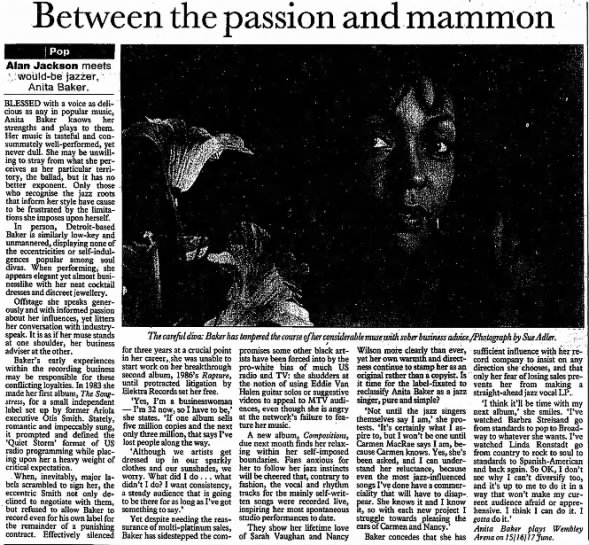
Here is an excellent piece about Anita from the Observer a few days before the show:
I got to know Wendy Jacobi through my workplace, BDO Consulting. We became pals. She was on some sort of placement/exchange thing with BDO, although I recall she stuck around in the UK for a few years and actually became quite good friends with Janie once Janie and I found each other a couple of years after this short trip.
Wendy wanted to see a bit more of England and I had a yearning to see the Derbyshire peaks again, not least because my largest client tended to name a lot of its subsidiaries and initiatives after Derbyshire towns, so I had constant reminders of the place. I had happy memories of that part of England from my Keele days.
My diary is booked out for the Friday and the only thing written in it is 9.30, so I suspect that was the hour at which I picked up Wendy from her temporary digs on Shroton Street in Marylebone, just across the way from The Seashell Of Lisson Grove. As I write 30 years after the event, June 2020, I’ll be doing a FoodCycle delivery run across the way from there tomorrow – small world.
On the Friday, we stopped off to look at the light peaks and in particular Chatsworth House along the way.
But our mission was to walk the dark peaks. I don’t think we had actually booked anywhere; we just ventured in hope. Indeed we ventured to Hope. We ended up basing ourselves in Hope, at Underleigh, where I ended up again with Janie about three years later:
Wendy and I really liked Underleigh and the walking we did around there. It was to be my last walking break for some time; just three weeks later I was struck down with my multipally prolapsed discs and was hardly able to walk again for quite some time.
But my most abiding memory of this short break was a cassette that Wendy brought with her for the drive. It contained (rather poor quality) recordings of a couple of Allan Sherman albums, which I enjoyed very much. I’m sure those recordings helped to inspire my NewsRevue lyric writing career when that burgeoned a year or two later.
The earworm that really stuck in my head for that whole trip was a parody of Harry Belafonte’s song Matilda Matilda, entitled My Zelda:
Wendy and I sang it most of the way up to the dark peaks…
…and pretty much all the way back again on the Monday.
My client was hugely apologetic. The only way they could arrange the three days of meetings in Amsterdam required at a delicate stage of the project I was managing was to schedule a Thursday, Friday and then Monday. They realised that this would be inconvenient for me and of course they were happy to fly me backwards and forwards to London if I wanted to spend the weekend at home or they were happy to put me up and feed me at their expense for the duration, including the weekend.
Young, free and single in September 1989, I was delighted to go for the “stay in Amsterdam at their expense” option.
Please stay at the Kras on our corporate account if you are going to stay that long…
…they said. It would have been rude to say no. I usually stayed for my short stopovers at a more modest place, the Rembrandt Classic I think, preferring the less formal and low key atmosphere.
Once work was done on the Friday evening, the weekend was my own. I didn’t keep a log of this visit but I remember most of the things I did:
an Indonesian rijsttafel meal on the Friday evening. A rijsttafel for one is a bit of an oxymoron, but the restaurant came highly recommended by my Dutch clients, for good reason;
Van Gogh Museum;
Rijksmuseum;
Rembrandt House;
Concertgebouw on Saturday evening (see below);
Anne Frank House (on the Sunday if I remember correctly);
Lots of strolling around the canals, sitting in coffee bars (the proper posh ones that serve coffee and play classical music), reading my book and feeling terribly sophisticated. I’m sure Mozart Violin Concertos weren’t playing all the time in every coffee shop, but I do remember hearing them more than once. I have, ever since, associated those concertos with this weekend in Amsterdam.
Concertgebouw, 23 September 1989
I was thrilled to be able to score a good ticket at the Concertgebouw “on a whim”. I guess it is that much easier to be lucky and get a single ticket at short notice. I liked the look of the concert and was not disappointed.
I heard/saw the house band (Royal Concertgebouw Orchestra aka Koninklijt Concertgebouworkest) conducted by Wolfgang Sawallisch, with
Ludwig van Beethoven – Overture “Leonora” Op 72a
Richard Strauss – Horn Concerto No 2 in E Flat Major
“Everyone drives on the pavement in Rio de Janeiro” – picture produced in collaboration with DALL-E
We headed up to Oxford late afternoon Friday for an unforgettable 24 hours or so, centred around a superb concert of Handel performed by The Sixteen Choir and Orchestra under Harry Christophers.
When I say “we”, I mean “me and my workmates. This was my first of several Music At Oxford experiences with BDO Binder Hamlyn Management Consultants (as it was called at that time). In fact, I think this concert was the first that Binders sponsored and that Music At Oxford thereafter became a bit of a Binders fixture for several years.
I was thrilled and impressed when I discovered that my firm was sponsoring this concert. I had discovered The Sixteen a couple of years earlier by hearing their recordings broadcast on Radio 3 and had found their sound mighty impressive.
Even now, writing in February 2019, nearly 30 years after the event, Janie and I still consider The Sixteen to be one of the very best early music choir/orchestras we have ever heard – indeed we have booked to see them again at The Wigmore Hall quite soon. It’s been a while – can hardly wait.
Harry Christophers in 2012, from Wikimedia Commons
But back in 1989 I had not yet seen The Sixteen live and/but it transpired that pretty much nobody at work had heard of them at all, so I was designated to be the in-house expert to whom inquisitive clients attending the concert might be sent for more information…
…in true management consultancy style, my having heard the performers a couple of times on the radio became, shamelessly, “recent, relevant experience”, enabling me to advise the clients about all matters Sixteen, Handel and indeed Early Music generally. I should have charged fees.
I remember the Friday afternoon, especially the journey to Oxford, very clearly. I spent the day at the office. As I still hadn’t passed my driving test, William Casey, the managing partner of the consultancy, offered to take me with him from the office to Oxford. I suspect that part of his purpose was to suck what little I knew about the music and the performers from my brain, so he could say something vaguely meaningful to clients.
Of course, we ended up leaving Faringdon Within later than intended and of course the Friday afternoon traffic between London and Oxford in early July was pretty heavy.
I discovered that the seemingly unflappable William Casey was as flappable as the rest of us when under time pressure, as we really did need to get to the Randolph Hotel, get changed into our fancy-pants clobber and be at the Sheldonian Theatre in good time to meet and greet guests.
Once we got away from the main London traffic it seemed we still had plenty of time. William and I chatted about various things, including life aspirations (mostly his) and William’s prior experience living and working in Brazil.
But I don’t think William had accounted for the dreadful traffic into Oxford on a Friday. 1989 was pre-M40 beyond Oxford, of course, so a fair bit more local traffic needed to use the narrow roads around and through Oxford in those days. So the stress levels started to rise again once the A40 into Oxford became a traffic jam.
At one point, William cut off a rather jammed up corner by driving up onto the pavement and jumping the traffic queue at the turning. Probably spotting my disquiet at that manoeuvre (which had not come up in any of my driving lessons) William exclaimed…
…everyone drives on the pavement in Rio de Janeiro!…
…which is the most memorable single thing that William ever said to me.
Of course, it was all a bit of a rush once we got to Oxford. Of course, we weren’t really late – just a little later than intended – so we were able to do the meet and greet thing before the concert…
…which is just as well, because we really were the sponsors – look at this page from the festival brochure:
Within a few months, we had changed our name to BDO Consulting; the first of several subtle name changes in the five-and-a-half years I was at the firm.
The concert was lovely and the Sheldonian Theatre is a superb setting for baroque music.
First up, the small scale but very beautiful Nisi Dominus, a recording of which, by The Sixteen, recorded just a few months after our concert, is (at the time of writing) available for all to hear:
Next up was the Lord Is My Light – Chandos Anthem No 10. Currently a recording of this one by The Sixteen is also available for you to hear:
Then the interval, which we spent hoity-toitying with our client guests in the Bodleian Library:
Well Posh
The invite doesn’t use the term hoity-toitying but you can take my word for it, that’s what we did.
I cannot remember in detail who was there that evening. All of the consultancy partners and a great many of my immediate colleagues for sure. Possibly some of the accountancy partners too, although I have a feeling that this first sponsorship was very much a consultancy affair and that it was in future years that the sponsorship widened out to Binder Hamlyn more generally. Michael Mainelli might well remember and fill in some juicy details.
I don’t think I needed to attend to my own main clients that year – I don’t think they attended. But I had been involved to some small extent with several of the firms clients by then, so had a fair smattering of people I knew as well as the general entreaty to “walk the room”, be the designated in-house early music expert and pretend to look intelligent…or whatever.
The second half of the concert was the wonderful Handel Dixit Dominus. I cannot find The Sixteen recording on line, but there is a fine live performance under John Elliot Gardiner which you might enjoy enormously:
My log reminds me how I felt about the evening and what happened next:
Superb evening. Ended up back at the Randolph Hotel sing-songing with the clients etc.
I am trying to remember who the main ringleaders of the sing-songing were; my memory fixes on Jim Arnott, Dom Henry and Richard Sealey in particular, but I might be mixing up this event with another event or two. Again, Michael might remember these informal details more specifically than me. I’m pretty sure Michael also partook of the sing-songing.
I don’t think we were sing-songing Handel at all – I suspect our singing was more of the Hotel California/American Pie/Streets Of London variety.
I do remember that we went on singing and partying into the early hours of the morning.
I don’t remember how I got home – I think I took the train from Oxford to Paddington for the return journey.
For sure I was back in London for an evening of Theatre at the National – that’s another story for another Ogblog…
But for sure this first Binders/Music At Oxford event, in 1989, especially the thrill of seeing The Sixteen at the Sheldonian, was one of my most memorable and enjoyable work-related cultural experiences.
No-one said it was going to be easy, switching from freshly qualified Chartered Accountant to hot shot management consultant as soon as I qualified.
But there was one low point towards the end of my first consultancy assignment for Binder Hamlyn, trying to resolve a seemingly irreconcilable problem for Save The Children Fund (SCF), thus named back then, when I spread all of my hand-written notes and attempted spaghetti-looking work flow and data flow diagrams all over the living room of my little then-rented flat in Clanricarde Gardens…
…and burst into tears.
Quite a lengthy burst if I remember correctly. Four minutes, possibly, which you might choose to time by listening to the following while reading on:
Why hadn’t I listened to the recruitment agent who said that I needed a lot more work experience before I’d be ready for management consultancy?
Why didn’t I walk out of the job on day one, when I learnt that I had been recruited as part of a turf war and that the person who was now to be my boss, Michael Mainelli, had been angered by other partners recruiting me while Michael was away on a short break?
And of all the tough “sink or swim” assignments Michael might have allocated me to at the very start of this seemingly-soon-to-be-foreshortened career, why did it have to be something my heart really was in – a project that might, if successful, substantially help SCF, one of the most important charities in the world?
Of course, you realise, the story has a happy enough ending. Michael and I are still working together thirty years later (as I write in January 2019) – for most of that time in the business we founded together in 1994: Z/ Yen:
I also met Ian Theodoreson, then a young, up-and-coming Finance Director at SCF. Ian continued to be a client on and off throughout the decades and we have remained in touch even since he gave up on major charity roles – e.g. this get together last year.
Yes, somehow the project did turn out to be a success. After the tears, I realised that I needed to focus the report on the evidence-based conclusions I had reached and the single bright idea I had come up with in the several weeks I had spent with SCF.
Little did I know back then that:
having even one bright idea during a 20 day assignment is a significant success if that idea is helpful/valuable enough and finds enough favour to be implemented;
the seemingly irreconcilable problem I encountered at SCF was an example of a perennial problem in all organisations that have potentially complex relationships with their customers, members or donors. If you can even partially solve or make progress despite that “natural fault line”, you’ve done well;
this single assignment would prove to be career-defining for me in so many ways. In part because it cemented my place at Binder Hamlyn working with Michael as well as other partners. In part because I still spend much of my working time with charities and membership organisations (albeit looking at wider issues). In part because many of the things I learnt on that challenging assignment stood me in good stead for later challenges in the subsequent decades.
Ogblog is primarily a “life” retroblog, not a “work” one, so this piece is a rarity – perhaps even a one-off – being more work than life. But this period was such a major change for me, not least in shifting my work-life balance substantially towards work for several decades, that I feel bound to write it up. I also spotted some intriguing notes on the diary pages for those first few weeks of January 1989.
Compared with late 1988, this is almost all work, not much life.That meeting with Ian Theodoreson on 10 January will have been my first formal meeting with Ian and possibly even the first time I met him at all, although we might have had a “canteen chat” in Mary Datchelor House (the SCF offices back then) before we met formally. I was making a point of being visible in the canteen for informal chats throughout the project; a technique I had leaned from my Student Union sabbatical experience just a few years earlier. I also note that I had spelt Ian’s surname incorrectly back in 1989, a mistake I was to repeat (differently) on the acknowledgements page of the hard cover edition of Price of Fish. Sorry, again, Ian. Again, lots of work, not all that much life there. A second meeting with Ian, now mis-spelling his name in the same way as The Price of Fish error – at least some sort of consistency set in. Hannah and Peter on the Thursday evening are my neighbours from downstairs. Peter is still downstairs – Hannah (Peter’s mum) returned to Germany some years ago and is spending her dotage there. I cannot remember the evening of 22 January 1989 with Caroline – I’ll guess that I cooked Caroline dinner at Clanricarde given the time and lack of other information in the diary. Caroline has reciprocated – most recently at the time of writing a week or so ago!The amusing entry on this page is the morning of 25 January. Someone suggested that I visit Barnardo’s by way of comparison with SCF. I’m not sure who provided the above assistance for my journey, but it reads:
Barkingside St. [Station] Church – beside it c60s US “Prison”
Anyone who has visited the Barnardo’s campus would recognise that “1960s US Prison” description and it should make them smile. It would be ironic if it had been Ian Theodoreson who provided that helpful description for my journey, as he subsequently spent many years as Director of Corporate Services there and I did several assignments at that Barnardo’s campus, in the late 1990s and early years of this century.
Please also note “G Jenny” in small writing for 26th evening and then again on the Saturday afternoon. I know that I deferred my visit to Grandma Jenny 26th because I had a report deadline looming…
…in fact the “evening of tears” might have been 26th not 27th…
…but I also know that the report deadline was really for the Monday morning, when I needed to go into the office with the report ready for review. So I also remember postponing Grandma Jenny again on the Saturday, while dinner with Jilly I think went ahead after I finished my draft report on the Saturday.
I put Grandma Jenny back into the book for the following Tuesday and I’m sure I will have gone that evening. She forgave me for the multiple rescheduling I’m sure, especially when she learnt that I was doing work for a charity in which she believed strongly. I also remember her imparting the following worldly advice to me several times during that era:
all work and no joy makes Jack a dull boy.
Well of course there was joy as well as work during those “hard yards” weeks and months at the start of my consultancy career. But I don’t suppose there was much joy inside my tears on that evening, when I thought it was all going horribly wrong.
Maybe I even cried for the six-and-a-half minutes it takes to listen to this Dowland-ish Stevie Wonder song.
A person with a watch knows the time. A person with two watches can never sure what the time is.
But the “two diaries” bit seems to work out OK in this instance, with the old diary showing my Christmas activities and the new one showing that I started my “work during Twixtmas” tradition long ago.
25 December 1988: Ma Pa and G Jenny for tea, Benjamins for dinner. Stayed Ma and Pas.
Thinking about the logistics of all this – I think mum and dad must have picked up Grandma Jenny in Surbiton, brought her to my flat for tea (possibly the first time they saw Clanricarde Gardens and in Grandma Jenny’s case quite possibly the only time). At Doreen and Stanley Benjamin’s in Putney we were possibly joined by Jane and Lisa and one or both of their respective beau’s/future husbands if they were around at that time. Also Doreen’s mum, Jessie Jackson, would have been there if she was still with us in 1988.
26 December 1988: Lunch at Ma and Pas returned home early evening
No record in either diary of what I did on the bank holiday Tuesday nor the Wednesday. Perhaps I was so knackered by the activities of the preceding few weeks that i simply took the opportunity to work soft and play soft.
The diary marking SCF for 29 and 30 December shows that I went to Save The Children Fund in Camberwell those two days.