Joan Didion wrote a memoir about her double-loss – first her husband and then her daughter. This is her one woman play based on that memoir. Vanessa Redgrave plays Joan.
We found it moving, although the critics tended to be equivocal in their praise and in their sense that the production moves as much as it should:
Janie and I both carry fond memories of this play/production, although it was a long play and is the sort of play that we sometimes dislike.
Howard Brenton has a tendency either to pull off this type of history/personality play with aplomb (as he did with this one and the Ai Wei Wei one) or leave us stone cold, as he did with his play about drawing lines across India at the time of Independence.
Jeremy Irons isn’t my favourite; he’s always sort-of Jeremy Irons. But Jeremy Irons is sort-of Harold Macmillan, so that aspect worked.
One element of the play that I recall really working for me was the notion of the young Harold, played by Pip Carter, moving the narrative on, even in the later years when Harold was becoming an old duffer.
We really enjoyed this play and production. It is a rare example of a Pinter comedy, which he wrote during his heyday in the mid 1950s but I don’t think it got produced until a fair bit later.
Being Pinter, the line between comedy and tense psychodrama is a thin one. Indeed, plays like The Caretaker, The Birthday Party and The Dumb Waiter are sinister yet have plenty of humour in them. The Hothouse has plenty of humour yet is sinister; it is set in an anonymous government run mental institution. Say no more.
This was a superb cast and production. Stephen Moore, Finbar Lynch, Leo Bill and Lia Williams the standouts. Here is a link to the Theatricalia entry. For once, the awkward depth/shape of the Lyttelton stage could be used to good effect for an institutional look.
It was pretty well received by the critics on the whole:
Again, we really wanted to like it. We had loved The Island when we saw the revival of that one. But Sizwe Banzi seemed an altogether lighter and more dated work. The play has some great lines and some excellent points to make, but didn’t move us as we felt it should.
Yes, we were glad to have seen it, but it was a bit like seeing a band of ageing rockers whom you wished you had seen “back in the day”. The point was back in the day.
We also both remeber it quite well, 25 years later. That might have a fair bit to do with the superb cast: Mark Rylance, Harriet Walter, Imelda Staunton and Oliver Cotton. The production was directed by Matthew Warchus. We didn’t recogognise his name then but we certainly do now. Here is the Theatricalia entry for this one.
Yasmina Reza (as translated by Christopher Hampton) was all the rage in the English speaking world back then. This was our fourth go at one of hers – Art having been the piece that kicked off the Reza fashion…
Anyway, apart from Art, with thought Life x 3 to be the most interesting and memorable of Reza’s works.
Again we went to a preview, so we were ahead of the critics. What did they think? Here’s Charles Spencer who seemed pretty impressed with it, at least as entertainment if not as profound drama:
Anyway, The National obviously felt the urge to have another go at Hamlet less than 12 years later, with Simon Russell Beale, Peter McEnery, Sara Kestleman and Denis Quilley to name but a few.
Janie remembers being impressed by the acting, but still not really relating to or engaging with Shakespeare. I remember feeling that I had probably previously seen the best production of Hamlet I was ever going to see, despite thinking that this was pretty darned good; especially Simon Russell Beale’s performance.
Very good indeed.
That’s what I wrote in my log.
But you don’t want to listen to us. Here are some reviews. First up – Nicholas de Jongh, who also liked Simon Russell Beale more than he liked the production
Similarly, our friend Michael Billington applauds SRB’s performance and John Caird’s directing of it, but feels that the production strips out the big picture political aspects of the play:
Janie noted in her diary that the play ran for 3 hours and fifteen minutes, so I’ll guess that she was grateful for John Caird’s cuts of the political elements – goodness knows how long the play would have taken in John Caird’s hands if we’d also had the Fortinbras sub-plot to deal with.
Still, to summarise the critics – they warmed to the production almost exclusively because of Simon Russell Beale’s quality. I’m surprised that no-one gave their review the headline, “Saved By the Beale”. They missed a trick there.
I had been a fan of Athol Fugard for many years by then and was very keen to see his long-time associates, John Kani & Winston Ntshona, perform. A set up that can lead to disappointment, but in this instance my enthusiasm was fully justified.
It was the play that lacked coherence. Janie couldn’t see past the fragile conceits of the play.
Our friend, Michael Billington, in The Guardian, seems to have shared our reservations. He says that the plot “has more holes than a second-hand colander”…
…(does a new colander have fewer holes than a second-hand one, Michael?)…
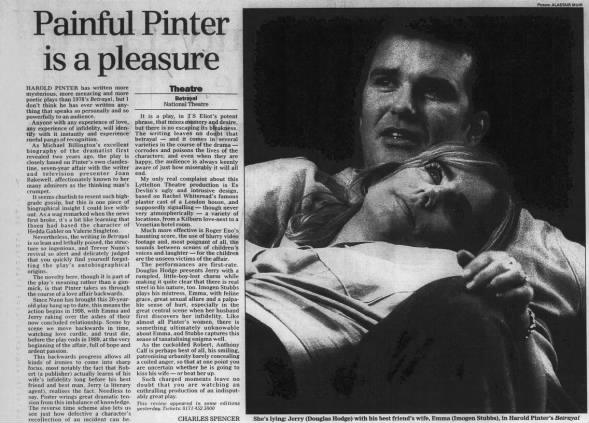
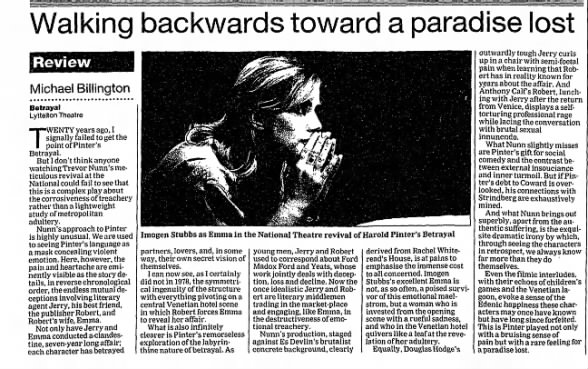
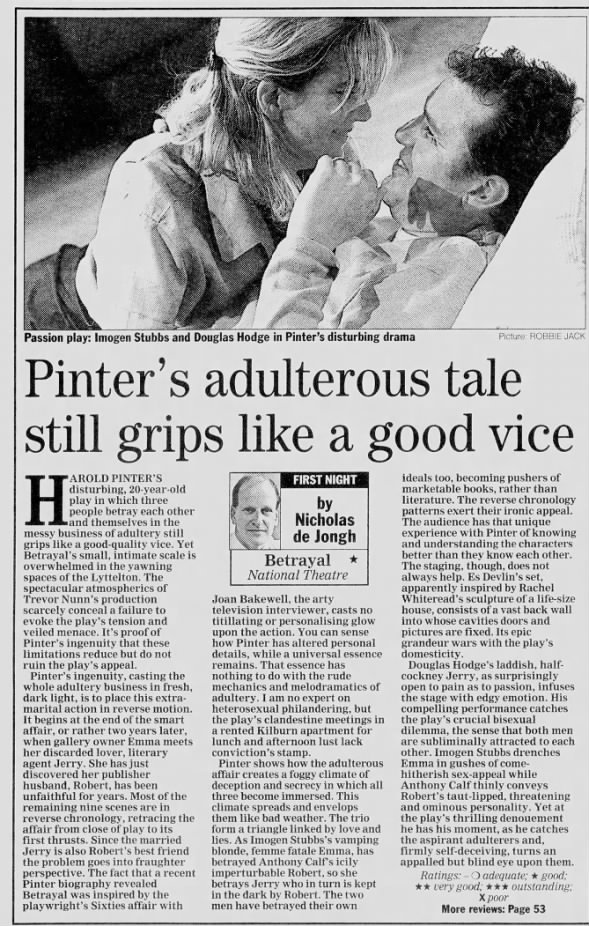
This was a major revival of Pinter’s classic, directed by Trevor Nunn with a cracking cast including Imogen Stubbs, Douglas Hodge, Anthony Calf and several other fine actors.
Unusually, we got to this one late – it had been running at the National for a while, since November 1998, by the time we saw it, towards the end of its run.
Charles Spencer had given it a rave review in The Telegraph: