Colin clinched the china after strivin’ for the Ivan, the beaker for the burlesque is the cup snuck by Chalice…
London Cricket Trust Dinner At Soutine, 9 December 2025
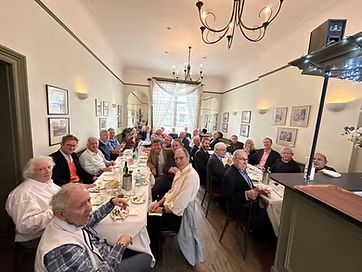
This is the second time we’ve had our London Cricket Trust Christmas dinner at Soutine after our last Board meeting of the year.
Smug and self-satisfied we are not, but we are now able to boast 118 non-turf pitch installations and 21 net system installations completed since we started seven years ago. “Way to go”, as our transatlantic friends might put it, but this is a transformational number of facilities in parks around London that would otherwise have been without.
Chris Whitaker, Ed Griffiths, Ian Moore, Sophie Kent and I enjoyed the meal and the company.
Dedanists’ Society Lunch, Lemonia, 11 December 2025
These images from the Dedanists’ Society website, depicting the lunch last year
Always a highlight of the festive season, this gathering of dedicated realists provided an opportunity to talk real tennis, in contrast with my activities earlier in the week which were about cricket.
Hard ball doesn’t get much harder than this. I tried to be suitably abstemious, or at least minimally lubricated, as I also had an evening engagement that evening…
The Ivan Shakespeare Memorial Dinner, Goodge Street Spaghetti House, 11 December 2025
A slightly depleted gang gathered for the traditional seasonal Ivan Shakespeare Memorial Dinner, which has, for decades now, included a form of quizzing for the Ivan Shakespeare Memorial Trophy. More recently, since the demise of NewsRevue founder and mentor Mike Hodd, we also play for a Mike Hodd memorial trophy. I won “the Hoddy” last year, which meant that it was my job to come up with a suitable game/quiz for this year’s contest.
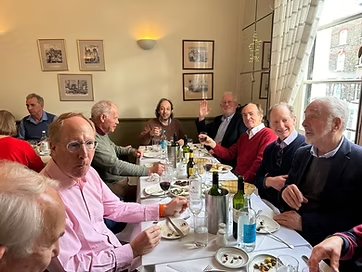
The gang for dinner this year comprised me, John Random, Barry Grossman, Hugh Ryecroft, Chalice Am Bergris, Mark Keegan and Colin Stutt.
Barry Grossman started the game proceedings with the Ivan Shakespeare Trophy quiz. I did rather badly and Colin Stutt did rather well.
Then it was my turn to curate a game/quiz for the Hoddy. Below is the game.
Any reader should feel free to write in, ianlharris@gmail.com, and I’ll gladly mark your questions. No pressure, but Chalice scored eight-and-a-half, which was a joint top score, winning by dint of the humour bonus on one of her questions.
It’s not all about quizzes and awards, of course. Heaven forbid. The chat at dinner was lively and witty as always.
Z/Yen Seasonal Lunch, Watermen’s Hall, 12 December 2025
After a hearty hit on the tennis court at Lord’s and an even stouter Board Meeting at King William Street, the Z/Yen throng retired to Watermen’s Hall for seasonal lunch and festivities.
Secret Santa did his best to liven up the post lunch activities, despite certain seemingly intelligent folk strangely finding the idea of Secret Santa hard to understand…not mentioning any names, Bob Pay.
Then quizzing and singing. As part of Z/Yen’s journey towards net zero…in this case zero effort more than necessary…the Z/Yen seasonal quiz bore more than a passing resemblance to the Hoddy one depicted above…apart from the title and Z/Yen logos where the pictures of Mike Hodd are shown above.
Readers are as welcome to have a go and send in your questions for the Z/Yen quiz as you were for the Mike Hodd one. No pressure, but the combined forces of Juliet and Charlotte managed a most impressive nine. Questions that were too clever for their own good did not find favour with the judge, which was a bit of a disadvantage for the more-propellor-headed attendees.
As a further lurch in the direction of net zero (excess effort), I also road tested the idea of getting a random bunch of people to sing Jacobean songs, which worked almost as well with Z/Yen as it seems to be working with the real tennis community on skills nights. But that’s another story. As (will be) the attempt to get Gresham Society people singing in that manner.
Suffice it to say that the Z/Yen community was so motivated by the “We Be Three Poor Mariners” song that they danced around the Watermen’s table while singing it. Apt, I suppose, at Watermen’s.
Horror is not normally a genre that would draw me and Janie into the theatre. But this piece sounded fascinating when it was announced many months ago and we trust Hampstead Downstairs to look after us…even though the tickets came through saying “main stage” rather than “downstairs” (see headline image).
We also trusted that Jamie Armitage would look after us, following a similarly genre-busting experience with his play, An Interrogation, earlier this year – in that instance the genre was police procedurals – a genre we would normally avoid even more emphatically than horror.
We were right to trust our hosts and our playwright. A Ghost In Your Ear, which we saw on the first preview performance, was an entertaining and interesting evening in the theatre. It held our attention and teased our senses throughout its 90+ minutes. If anything, we felt a little over-stimulated, especially aurally so, having earlier seen another performance:
What both performances had in common was the use of sound in fascinating ways to trigger the desired dramatic effect. Also, both pieces explored ideas around the notion that the past can haunt the present, be that through nostalgia, elements of our past that were hidden from us…or that we hide from ourselves…or ghosts.
A Ghost In Your Ear uses a technique called binaural sound, which is “beyond stereo”, requiring the wearing of headphones in order to get a more genuine three-dimensional effect from the sound. Ben and Max Ringham are, apparently, THE go to sound engineers for this sort of sound engineering – this production has gone to the go to people. Jamie Armitage explains it in a short vid:
Janie and I certainly both got the sensation that the sound was all around us, which added a fair bit to the horror experience. At one point during our preview, the binaural quality of the sound dropped away for two or three minutes. I don’t think deliberately. For sure the sensation was diminished and then reinstated, when the binaural sound was fully restored. Our contemporaries who are now a little hard of hearing might get less out of the binaural sound effects.
But the reasons for seeing this piece go way beyond the clever sound (and indeed some superb visual) effects. In particular, we were much taken with George Blagden’s acting. He was not only on stage but absolutely central to the action throughout. He must speak 95% of the lines, which he did quite brilliantly – a top notch performance, we both felt.
It is also a very thought-provoking piece, beyond what I had expected from a ghost story play. Without spoiling the effect by disclosing the twists, it dawned on me, as the play unfolded, that people are far more readily haunted by things that have happened to them and things that they have been told, than they are haunted by ghosts. This play, using the “story within a story” technique that has been used since the dawn of story-telling time, deliberately messes with the ghost story genre in that way. Are the characters haunted by a ghost, or are they haunted by a ghost story, or are they simply haunted by their own, natural fears?
Jamie Armitage not only writes but also directs his own pieces. I have oft said that I don’t really approve of playwrights directing their own pieces – it often leads to self-indulgence and missed opportunities. But in Jamie Armitage’s case, based now on two experiences, I am prepared to make an exception. His heavily genre-based pieces work because he is writing his plays while fully-imagining how that genre might work on the stage. Armitage therefore needs to be heavily involved in the production, not just the writing of the play.
Well done Hampstead Theatre Downstairs – another top notch production. This one runs until 31 January 2026. Highly recommended by me and Janie if you get to book it in time.
I have known Rohan Candappa since we were eleven. I met him on my first day at Alleyn’s School, the secondary school we both attended 1973-1980. There he is in my first year class, 1973/74:
This half-century-old remembering is relevant to Rohan’s show, not least because most of the musical material into which Rohan is delving relates to the years that he and I were still in full-time education – including the university years following school.
Also to say, although Rohan and I lost touch after school, we have very much been in touch with one another again for best part of the last 20 years.
When Rohan “shouted out” to ancient pals, like me, that he would be doing a free gig as part of the Hornsey Town Hall Arts Centre grand opening day, how could I possibly say no? Even though Janie and I had tickets to the theatre that evening – it seemed to me that the hike from Hornsey to Hampstead Theatre (by car) would easily be achievable – thus we agreed to do both events.
We thought Rohan might need the support. We needn’t have worried on that score:
Nor need we have worried on behalf of Hornsey Town Hall Arts Centre generally – the place was heaving with visitors on its opening day:
Rohan was performing in the former Council Chamber, which was mighty grand. Janie and I had a theory that it would be good to get into the chamber early, as there would be good seats and not such good seats in such a place. We were right.
There’s me, one of the first to get in. Indeed, only the lady in the red hat – whom you might have got from central casting to play the role of the enthusiastically-right-on elderly lady – beat us to it. Apart from Rohan and the technical dude, obvs.
The lady from central casting danced magnificently to Free Nelson Mandela at the end of the show
Rohan started the piece with a bit of Hornsey Town Hall history from January 1937 – when Oswald Mosely held a public meeting there and protesters bravely made a scene.
Article from 26 Jan 1937 Daily Herald (London, London, England)
Rohan thought that four gutsy protesters had embedded themselves in the hall and taken on the fascist mob, but the embedded Daily Herald article [did you see what I did there?] suggests that there were six brave hecklers.
Anyway, Rohan took us on a tour de horizon of political songs from the 1970s and early 1980s, including Part Of the Union by The Strawbs, The Killing Of Georgie by Rod Stewart, Ghost Town by The Specials…you’ll get the idea if you are of our generation. Actually, you’ll get the idea – if not the nostalgia fix – however old you might be.
Most of Rohan’s choices were items I might have expected…although he omitted the two tracks that I had mentally put on my list of essentials before we arrived – we’ll return to those…
…but he did choose some items that were refreshingly and interestingly unexpected to me. For example, I wasn’t expecting All Gone Away by the Style Council, but was glad to hear it again in this context.
Nor was I expecting quite so much emphasis on anti-apartheid politics, despite the fact that my own political awakening was much-triggered by that cause. Rohan played a short excerpt from Coal Train by Hugh Masekela before playing the whole of Peter Gabriel’s Biko…
So which two “essential” tracks (in Ian Harris terms) did Rohan omit?…
I hear all you inquisitive readers cry.
Stand Down Margaret by The Beat and (We Don’t Need This) Fascist Groove Thang by Heaven 17.
I had told Rohan (and his wife Jan) that I would demand all my money back if Rohan didn’t use both of my “essential” political songs and he used neither of them. Honourably, Rohan has promised to refund both me and Janie every penny I had forked out for those event tickets…
…what do you mean, the event was free?
I sense that this performance piece, which was excellent and suitably moving in parts, will serve as a pilot for one of Rohan’s more honed pieces in the fullness of time. I might have to pay for tickets to see the honed version.
As it was, the after show period between 5:30 and us needing to head off towards the Hampstead theatre gave us time for a very pleasant wine bar drink with Rohan, Jan and another of our pals from school, Steve “Peanut” Butterworth.
As Steve discreetly put it to Janie:
…a lot of people had far worse nicknames than mine…
Jacquie enjoying a brace of buff butlers, Janie & Kim’s party, 2016
I was so saddened to learn that Jacquie died on 27 November. She, and the Briegal family of which she was the matriarch, had been part of my family life for as long as I can remember…indeed, longer than I can remember.
Adam Green, Mark Briegal, Hilary Briegal, Michael Green & a very little me, c1963
Jacquie was my second cousin. Her mother, Sadie, was my mother’s first cousin. Thus I was, technically speaking, Jacquie’s generation in my family. Through one of those generation shift things that happens in some families, I am a similar age, indeed a bit younger than, my own generation’s children. Jacquie and Len were good pals with my parents. I am good pals with Mark and Hilary and Adam. Jacquie’s mother Sadie and my Grandpa Lew Marcus…well, that’s another story. Family legend has it that Jacquie’s lovely father, Josh Moliver, would patch up the frequent tiffs between Sadie and Lew, by visiting with a bottle of schnapps as a peace offering.
A gathering of Pizans & Molivers, late 1930s, at the Bledlow Ridge farm. Jacquie third child in line, I believe – from the front Hannah Pizan (latterly Green), Hazel & Jacquie Moliver, Sidney Pizan.
Just in case you think this flashback doesn’t go back far enough, my mother actually attributed the friction between her father Lew and Sadie to the previous generation; Jacquie’s grandmother Annie:
Auntie Annie [Kraika, nee Marcus] used to make big about Lew and Beatrice’s [my parents’] “premature baby” Harry!! Fell out over it at times. Sadie & Lew were always falling out and then making up!
As my Uncle Harry was “prematurely” born just after the first world war (and just a few months after my grandparents got married), I am resuscitating a broyges that dates back more than a century. You can thank me (or quarrel with me) afterwards for that.
Jacquie to Mum: “we’ve put that all behind us now, haven’t we, Renee? Mum: “more or less…”.
There are/were many branches to the Marcus family, from whence this connection comes, but somehow the Kraika/Moliver/Briegal connection (Jacquie’s) and the Pizan/Green connection, plus my own branch of the Marcus family remained solid despite various family upheavals over the last century or so.
Thus, perhaps unusually, these second cousin branches are amongst my closest relatives and people with whom I feel the closest familial ties. Janie takes pains to say that she hasn’t a clue who ANY of her second cousins might be and indeed has no contact even with her first cousins.
Anyway, this tribute is about Jacquie, not family trees, but my point is, my own memories of Jacquie, over many decades, are mostly associated with the sort of events which most of us enjoy with close family and close friends.
My diaries, covering the 1970s and 1980s, have many mentions of visiting the Briegals or the Briegals visiting us. In those days, this might be for second night of Pesach (Passover), sometimes breaking the fast at my parents’ place, sometimes around the Xmas seasonal holidays (I remember mum and dad doing New Years Eve with Jacquie and Len quite often) or random “no reason” get togethers.
My dad was a real “cobblers children” photographic man when it came to documenting family events with pictures – he tended not to do it. It wasn’t really the thing to photograph “regular” family gatherings back then.
On occasion, my mum and dad would go for short break holidays with Jacquie and Len. Jacquie was very tolerant of my mum, who could be awkward at times but basically had a good heart and Jacquie recognised that. Perhaps more importantly to Jacquie (or just as importantly), my Dad and Len enjoyed each other’s company and especially enjoyed having a few glasses of wine together.
Dad: “suits you, Jacquie!”. I’m guessing Spain in the 1990s
By the end of the 1990s, the Christmas tradition shifted from mum & dads, or Jacquie & Len’s place, to Janie’s place, as we always felt a desire to reciprocate the warm hospitality we had enjoyed at other times of the year.
Janie tended to do almost all of the catering role – the centrepiece very often being a roast goose, because Dad and Len were partial to goose. Jacquie could be encouraged to “go with the flow” and make sure that my mum didn’t fret. On the one occasion that Janie’s mum, The (now late) Duchess of Castlebar, also attended, Jacquie did a great job of preventing Len from throttling the Duchess. Jacquie was a great reconciler; by all accounts like her dad in that respect.
My job at Christmas was to devise games and miscellaneous entertainments for those days. I recently found an old box with index cards, post-it notes, dice and bundles of 5p pieces. I recognised the materials for charades and that type of game, but I cannot recall what we were doing with all of those dice and shilling-bits. Must have been part of one of the games, but I only remember us talking crap, not playing craps!
By the late noughties, though, dad and then, soon after, Len, died. The family gatherings for a heimische Christmas didn’t seem appropriate any more, so we started going to restaurants together instead.
Strangely, while rummaging for something completely different earlier today, I stumbled across some misfiled papers – our order at The Devonshire for Xmas 2010:
I can also authoritatively tell you from my markings on the wine list that we ordered the Pelorus Cloudy Bay fizz, Argentinian Chardonnay, Chianti (Len & Dad would have approved), and Californian Orange Muscat for pudding.
But really I should leave the last word to Jacquie herself. She really was very patient and kind with my mum, even towards the end for mum, when dementia was setting in and mum’s manner increasingly random.
The following short “vox pop” was filmed, I think by Kim, at the little party we threw for my mum at “Noddyland” (our house) when mum turned 90, in 2012.
Jacquie’s death really is the end of an era for our family. But she will live on in the hearts of all who knew her and loved her.
Two Men’s Singles Semi-Finals & The Women’s Singles Final At Queen’s, 22 November 2025
Janie and I warmed up for this event by having our regular hour of “lawn” at Boston Manor, albeit at 10:00 rather than our regular hour of 11:00. We then hot-footed it (if you can hot-foot by car) to the flat dropping off some old computer equipment headed for charity, then picked up Janie’s flashy new specs, then got to The Queen’s Club about 30 or 40 minutes into the first match.
Simon Talbot-Williams greeted us both warmly from his stewarding position, while simultaneously telling me off “for being late”, before helping organise our seating.
Just as well we warmed up for the event, as the dedans gallery had a real chill breeze feel to it, despite the nicely positioned radiator near our feet.
Must have felt even colder up there in the “makeshift media gallery”.
We caught the end of the match between Nicky Howell and Rob Fahey. Then saw all of the match between John Lumley and Bryn Sayers.
After taking some tea and chatting with the assembled real tennis glitterati, Janie and I saw Claire Fahey’s historic win in the final against Tara Lumley.
Our first sight of women’s tennis played at the highest level
Historic, in that the women’s final hadn’t been at Queen’s for decades. We both thought that the format including both men’s and women’s matches was an excellent idea.
More of this men’s and women’s tennis on the same day, please, Janie and I say.
On searching on-line for the results, Google’s AI Overview, for once, has not hallucinated. The following summarises matters expertly.
Men’s (Open) Singles Semi-finals
Two Men’s Singles semi-final matches were played during the afternoon.
Fixture: N. Howell bt R. Fahey
Score: 6/2 6/2 6/5
Start Time: 2:00 PM
Fixture: J. Lumley bt B. Sayers
Score: 6/5 6/3 6/2
Start Time: 4:00 PM (approx)
Women’s Singles Final
Claire Fahey defeated Tara Lumley in the final match, which began at 6:45 PM.
Fixture: C. Fahey bt T. Lumley
Score: 6/0 6/0
What the AI cannot do is express how much we enjoyed our afternoon and early evening at Queen’s, watching high grade tennis. It’s just a shame it was unseasonably cold!
Victory In Australia by Richard Whitehead, MCC Library Book Club, Lord’s, 26 November 2025
Janie and I very much enjoy these library book club supper evenings. This one, at which Richard Whitehead discussed his book about the 1954/55 Ashes tour, might not have attracted our attention, but for Alan Rees (head librarian) taking pains to let me know how much he had enjoyed that book and was thrilled to have secured an evening with Richard.
Save the date…
said Alan a good few weeks before the evening was announced. Hence, once it was announced…we pounced to get tickets.
We were very glad we did. The food and company is always good. On this occasion, as a bonus, we found ourselves next to my real tennis pal of old, Jim Chaudry. Jim has been “off games” for some while now, but I occasionally see him at cricket and have spotted him a few times at the library book club dinners, but until this time, not at my table.
Jim knows how to hold his knife and fork, whereas…
The food was, as always, excellent. Janie went into full tilt food porn photo mode this time.
Both courses depicted on arrival at her place. Thanks, Janie.
As usual, after the talk, the Q&A, and the book signing, Janie and I went home thoroughly pleased and satisfied. That’s some of my holiday reading for our next trip sorted out for sure.
It is with great sadness I find myself writing a tribute to Bobbie, who died a few weeks ago after a seemingly minor fall.
I first met Bobbie soon after she arrived at Keele University in the autumn of 1981, a year after my arrival there. My diary doesn’t mention her until we got it together a couple of years later…I’ll come to that.
I first noticed her just a few weeks after she arrived, as she was to be seen driving a massive Jaguar car around the campus; an unusual sight at Keele, to say the least.
I discovered later that her dad, Don, who was mostly working overseas in those days, had encouraged Bobbie to take the car to Keele while he was away, as he thought that vehicle was more at risk standing idle in Wallasey than it would be in use at Keele. Bobbie was very self-conscious about driving a Jag around the campus – if nothing else it was an incongruous mismatch of big car and small person.
Bobbie soon downscaled to a Citroen Dyane – a far more “Bobbie” car than her dad’s Jag.
In a way, this Jag story is a helpful analogy with Bobbie’s essence. Bobbie’s intellect and influence was huge, in contrast with her slight size, light-wearing of her intellect and general low-key demeanour.
Although we were both studying law…in Bobbie’s case with politics, in mine with economics…I don’t believe we ever crossed paths in tutorial groups. But Bobbie did “hang out” with people in my outer and latterly inner circles.
For example, I remember Bobbie going out with Jonathan (Jon) Rees in those earlier days, perhaps her first year, perhaps her second. Jon had been one of my first term pals, part of our Princess Margaret street theatre “rebel troupe”:
Ashley Fletcher’s name comes up around that time and I do remember that Bobbie was part of Ashley’s circle, as was I. I also remember Ashley saying to me, soon after Bobbie and I got together:
If I didn’t know you two better, I’d think that the two of you have got together…
…exactly the same words he’d used to fish for information on me and Liza getting together the year before!
Anyway, Ogblog is awash with pieces about stuff that Bobbie and I got up to – especially in that 83/84 year, but also a great deal subsequently. Prior to writing this piece, 85 pieces are tagged “Bobbie Scully” and there are many diary entries from the late 1980s that I haven’t yet excavated/Ogblooged.
My Machiavellian plan had been for Bobbie to run for sabbatical Education & Welfare Officer role once we knew that good people had been elected to the other sabbatical roles (Bobbie would have been brilliant at it). But Bobbie out-Machiavelli-ed me – who’d have thought that possible?:
We did a lot of studying together after those elections…which mostly comprised Bobbie studying for most of the night, and me staying awake long enough to do enough. We also had the odd break together. I was terrible at revision. This piece gives some insight, if anyone ever gets around to reading it:
Once the exams were done, we did a lot of eating, drinking and going to see music and theatre – all interests we threw ourselves into, both together and separately, in the decades that followed.
I recall that the local butcher took kindly to students who wanted to eat high-quality meat and gave him regular business, so it had become my habit during most of that academic year to get sirloin steaks and the like for Bobbie and I to eat at the weekends. I had been self-catering in Barnes for most of my time at Keele, whereas Bobbie remained in Lindsay Hall throughout her three years.
We also ate in the best restaurants around the Potteries (which at that time, on the whole, were not that special). The diary and resulting Ogblog pieces mention some.
Bobbie and I somewhat went our separate ways during my sabbatical year, but we did spend a few weekends together, one of which included an absolute theatrical highlight for both of us – for me especially – The Pope’s Wedding at The Royal Court.
At the time of writing this piece (a week after Bobbie’s funeral), there are very few Ogblog postings between 1985 and late 1988, as I have yet to read/process most of those elements of my diaries. I’ll be playing catch up on those years over the next few years.
This is a bit tough on Bobbie’s many friends from work, who entered her scene from the mid 1980s and some remain on her scene.
I have, however, already written up the period when I was between qualifying as a chartered accountant and starting my management consultancy career, from late 1988 onwards. This piece from mid November 1988 – covering Bobbie’s birthday, provides some insight into that gang:
A few days later, Bobbie helped to confirm my sense that the Clanricarde Gardens flat that I had been eyeing up was indeed the one for me. Bobbie’s viewing nearly didn’t happen, of course, because Bobbie was always late and we ended up pushing the “second viewing slot” that I had arranged to its very limits.
Between the mid 1980s and the latter part of 1992, there are a great many theatre, concert, opera, restaurant and dinner party visits with Bobbie written up, and quite a lot still to write up. Even after Bobbie and I split up at the end of the 1980s, and after I had my dreadful back-knack in mid 1990, we still saw quite a lot of each other.
… and we continued to do those social and arts activities together. But Bobbie was less keen on booking such events up well in advance than I was. So we had a deal, which basically meant that I would book stuff in advance knowing that Bobbie might excuse herself if the date became inconvenient. Her side of the deal was to give me as much notice as she could, which she reliably did.
Bobbie and Janie always got on well. Bobbie took pains to let me (and separately Janie) know that she thought we were a good fit for each other. Janie was especially struck by the way that Bobbie wore her immense intellect lightly.
I have very few photos of Bobbie – we didn’t much do photos in those days – but this one from our mutual Keele friend, Annalisa’s, wedding, in 1998, is a rather good one:
Very sadly, Stuart, Annalisa’s husband, standing next to Bobbie, also died suddenly and unexpectedly in 2025.
I didn’t see Bobbie all that often over the intervening years – neither Bobbie nor I were brilliant at keeping in touch, but Bobbie & Dave Holland certainly attended more than one of Janie’s famous house parties, before those parties became rarities. Here’s one example:
Other than that, I would occasionally run into Bobbie at The Great British Beer Festival in the Earls Court years of the noughties, when my firm, Z/Yen, tended to have “informal works outings” there most years.
Bobbie and I would also tend to arrange to meet at the occasional Keele alum sessions in London – events that neither of us would much fancy on our own but as part of an excuse to meet up and have a good meal after…that was different:
Latterly, along with Iain Sutherland, Bobbie became an enthusiast for the Gresham Society, within which I have played an active part for a great many years.
Although it wasn’t the last time I saw Bobbie, the 2023 event at the Royal Tennis Court, Hampton Court Palace, which I curated, was one of the last times and was a very special day:
Liz Scully’s sisterly tribute at the funeral was very moving and poignant. It didn’t so much focus on the arts and culture side of Bobbie’s being, which I hope my piece does. Instead, it focussed on Bobbie’s work, her involvement with CAMRA, her devotion to Everton FC and her love of her home town, Wallasey, all of which were, of course, major parts of her life.
Liz did also remind everyone that Bobbie was almost always late for appointments (unless it was a football match, a concert or a show). Ogblog is littered with oblique (and not so oblique) references to Bobbie’s tardiness.
Thus it seemed fitting at the funeral, after we all traipsed out into the freezing cold of the Wirral at Frankby Cemetery, that orders came from above – I think it was the local authority health and safety brigade, not Bobbie in excelsis – that there was a delay. We were all kept waiting on the path for some 20 minutes before the graveside ceremony could begin. It seemed fitting.
So there you have it: the late Bobbie Scully, rest in peace.
To the Wigmore Hall for an evening of Jazz. We hadn’t yet seen jazz pianist/arranger/composer Emmet Cohen, although I think he has been curating the jazz at Wigmore Hall for a while now. Emmet’s previous dates/gigs hadn’t worked for us.
This was a good chance to see him with a couple of his regular buddies as a trio: Joey Ranieri on bass and Joe Farnsworth on percussion.
Calm before the storm
We heard:
Frederick Loewe – I’ve grown accustomed to her face
Bud Powell – Budo
Ernesto Lecuona – La Comparsa
Ralph Blane & Hugh Martin – The Trolley Song
Tadd Dameron – If You Could See Me Now
Ray Brown – Lined With a Groove
Emmet Cohen – Universal Truth Suite: I. Compassion, II. Eternal Glimpse, III. Universal truth
Scott Joplin – Original Rags (arranged by Emmet Cohen)
Harold Mabern – Rakin’ and Scrapin’ (arranged by Emmet Cohen)
Here’s a YouTube of the three of them playing together in Switzerland a couple of years ago – but not playing one of the pieces we heard:
They look a bit less joyous in Switzerland – possibly they were on “stronger meds” when at The Wig. The audience for sure were well “medicated” – the bar was heaving with people before the concert…as were the loos. Very few familiar faces – not many of us Wigmore Hall Mafia dig early music and jazz.
Here is a link to the entire gig that those three did in Amsterdam a few days before they arrived at The Wig – there will be many similarities and overlaps:
I’m guessing that the Dutch do better meds than Swiss.
Of course, this is incredibly accomplished stuff and Janie and I enjoyed ourselves very much.
Some of the music choices are not quite to our taste – tunes from musicals of the 40s and 50s tend to sound corny to our ears and, to some extent, even more so when syncopated into cool jazz. The Trolley Song, in particular, could, for me, only conjure up a vision of Judy Garland dressed in Edwardian finery.
The only other issue we have with this style of jazz concert is the “mutual admiration society” style chat, about each other and about jazz masters past and present with whom they have worked. I realise that there is a type of jazz maven who likes to hear all that stuff, but we prefer to let the music speak for itself. There’s also something “not quite our style” about self-aggrandisement.
But this nit-picking does not detract from a thoroughly enjoyable evening of top quality jazz musicianship, for which we are grateful. We think the acoustics of the Wigmore Hall work brilliantly for small jazz combos such as this trio, although Emmet suggested at one point that he finds the acoustics of the hall “a bit weird”.
Anyway, as Janie and I have said repeatedly to the powers that be at The Wigmore Hall over the years with regard to jazz – more of this please.
When John booked Cavita for this get together, conveniently choosing a location that suited me coming on from tennis at Lord’s, I hadn’t realised that I would be more or less returning to the scene of my hip op nine month’s earlier, at the Fortius Clinic, two doors down in Wigmore Street.
Hence the headline photo.
I resolved, before looking at the Cavita menu, that I would abstain from ordering any dishes such as knuckle of veal or pork. I guess I am too steeped in penny dreadful London melodrama of the Sweeney Todd variety.
Anyway, I needn’t have worried – Cavita’s menu was suitably elegant, magnificent and certainly oriented away from dishes where you wrestle with your food and/or end up wondering which species you might be eating.
Cavita is one of those “sharing plates” restaurants, which I must say rather appeal to me these days, as you can regulate the amount of food you eat as long as you are well advised by your waiting staff.
The young woman who looked after us at Cavita provided good advice on portion sizes, sharing and the like. John & I tried:
TLAYUDA VEGETARIANA – an Oaxacan mushroom concoction on a corn bread base – to share;
QUESABIRRIA – a beef shin stuffed tortilla which was seriously gooey – one each;
G R I N G A – a flour tortilla with Iberico pork – well yummy – one each;
PESCADO ZARANDEADO – line caught sea bass prepared (half and half) with two marinations – to share;
FRIJOLITOS (refried beans) – side order to share – because you cannot judge a Mexican restaurant without judging the refried beans. These were excellent.
We drank some pleasant wine by the glass – I went for a Chilean Chardonnay – Clos des Fous, whereas John opted for an Izadi Rioja Blanco.
The whole meal was excellent, but the fish was undoubtedly the eye-catching highlight. At one point I sensed that we were being watched form the next table and spotted that the gentleman from the couple next to us seemed to be staring at our table as he was rising to leave. Perhaps he spotted that I had noticed him, as he came up to us before he left and said,
That fish looks amazing – is it as delicious as it looks?
We told him that it was.
Unlike the manner in which the fish caught, John and I caught up on things socially speaking. It’s been a while since our last dinner catch up together and was most pleasurable. But all too soon realised that John has a long hike back to Saffron Walden and that we both had an early start workwise the next day, despite the fact that we are both, theoretically, working less now.
We were enjoying ourselves sop much that we didn’t get around to taking food porn photos. Still. there are enough of those available on the Cavita website and on-line reviews.
John & I will try not to leave it so long between dinner meet ups next time. If I can keep away from places like the Fortius Clinic and stick to spending time in more enjoyable places, such as Cavita Restaurant, John & I should be able to attain that goal.
This excellent production, which Janie and I saw on the second preview evening, made us feel uncomfortable in many ways. The central subject matter – addiction to violent on-line pornography – is a deliberately discomforting topic. Playwright Sophia Chetin-Leuner takes this topic on in an unflinching yet surprisingly nuanced manner in this play.
It is really a play about addiction taking hold of a bright individual and destroying their life. It just so happens that violent porn is the addiction in this case.
The acting was universally excellent. Ambika Mod, as the victim of the addiction, is, understandably, getting most of the plaudits. She is on stage almost throughout the play and what a challenging role it must be. Will Close, Lizzy Connolly and Asif Khan provide excellent support, playing multiple parts each and doing so convincingly.
Josie Rourke is a superb director. This is the first time we have seen her work since she returned from her career break. She’s certainly still got what it takes.
I said the production made us feel uncomfortable in many ways. Apart from our discomfort with the subject matter…not least the topicality of questions around abusive and violent sex…we were also visually and physically discomforted by the set/seating.
The carpeted set looked like seedy living space from the 1970s or 1980s – deliberately I’m sure. The audience is asked to put shoe covers on when entering, as if to symbolise a need for personal protection…but also perhaps for practical reasons to protect the set.
But most discomforting of all was the seating on those “carpeted steps” doubling as seats. No back support and 100 minutes of tense drama. We walked out of the theatre like John Wayne having just dismounted from his horse…or…[insert your own unsubtle and unsuitable metaphor here]. Still, it was worth it.
The 50 Most Ridiculous Ashes Moments, Dan Liebke & Alex Bowden, Affirm Press, 2025, EAN/UPC: 9781923135697, & In the Eye of the Typhoon: The Inside Story of the MCC Tour of Australia and New Zealand 1954/55, Frank Tyson, Parrs Wood Press, 2004, ISBN-13 : 978-1903158579
There is something faintly ridiculous about cricket books generally. I say that as a cricket lover, a book lover and, indeed, a cricket book lover. Most cricket books go into excruciating detail about something or another. Cricket loving, book loving folk don’t mind wallowing in such details, but that doesn’t detract from the intrinsic absurdity of cricket books.
One In The Eye
To be perfectly Frank with you…
For example, “In the Eye Of The Typhoon” by Frank ‘Typhoon’ Tyson. It is a first-hand, blow-by-blow account & photo-diary of the 1954/55 Ashes series. We get Tyson’s perspective on the tour; his activities and thoughts on and off the field. The book is neatly crafted and is a thoroughly enjoyable wallow.
One entertaining Tyson subplot is his tour romance, which he writes about in an unwittingly amusing, melodramatic style.
Thursday October 7th 1954…I have become very attached to a good-looking Sydney girl called Margaret, whom I met on our second day out of Tilbury. Our parting on the last evening on board was very emotional…I am looking forward, perhaps more eagerly than normal, to seeing her again in Sydney…
Thursday March 3rd 1955…Margaret was my first great love; indeed she was my first real girlfriend. In matters of the heart I was naïve until I met her…We agreed to keep in touch – but could we guarantee that some influence would not intervene? God knew!…Shall I see her again? I must.
Yet Tyson’s emotional parting with Margaret at Sydney airport did not prevent The Typhoon from making the lives of New Zealand cricketers hell for the rest of March 1955.
My favourite page in the whole book is the glossary of tour party nicknames on P259. The Boil, Kipper, Scrubs, The Whippet, Godders, and Woozer, to name but a few. Worth the price of admission alone, that page.
50 Most Ridiculous
“The 50 Most Ridiculous Ashes Moments” is an antidote to cricket book wallowing, much as Alex Bowden’s irreverent King Cricket website is an antidote to typical cricket journalism. Each of the 50 stories stands alone, giving the book a dipping rather than wallowing quality. I shall ration myself on these stories over the coming weeks, to help sustain my spirits during the inevitable emotional upheaval that the 2025/26 Ashes will bring.
The Ridiculous Ashes book pleases me more than the podcast for reasons beyond my preference for books over podcasts as a medium. The conceit of the podcast is to assess the most ridiculous moments in each Ashes test match from a particular Ashes series, eventually to award Ridiculous Ashes to the most ridiculous side. It is a fun idea but at times the structure of the “parlour game” detracts from the interesting, amusing and acerbic stories that Dan and Alex are discussing.
The book format liberates the prickly pair [did you see what I did there?] from game show style banter, combining their natural writing abilities to produce 50 well-crafted stories about bizarre happenings in the Ashes during the last 50 years. The book formula also enables Liebke & Bowden to broaden their coverage beyond that covered by the podcast, hence covering 50 years and covering both men’s and women’s Ashes.
I especially enjoyed the way they described the demise of the dozy England wicketkeeper-batsman who inadvertently strayed out of his ground to be run out in bizarre circumstances (Chapter 49). And no, that story is not the Jonny Bairstow crease-gate story, although that Jonny Bairstow story inevitably gets an outing in the book: Chapter 8.
I also like the fact that some of the chapters are not really moments, such as Chapter 10, which is a tour d’horizon of Ellyse Perry’s ridiculous Ashes career. That chapter, like several others, has an “Activity Corner” vignette which made me smile out loud.
Ridiculous Coincidence Corner
By complete coincidence, I took possession of both books at almost the exact same moment. Tom Carew Hunt very kindly handed me his father’s copy of “In the Eye Of The Typhoon” as I arrived at The Queen’s Club on 6 November for the Tennis & Rackets Association dinner we were both attending. 18:30 that was. When I got home, I picked up a message from Daisy, sent at that exact same time, to let me know that Alex Bowden’s ridiculous book had arrived.
Both books are enjoyable, albeit in such different ways. What a happy coincidence.
Oh, and 70 years ago to that very day, my parents got married, in the Empire Rooms, Tottenham Court Road – latterly a strip club named Spearmint Rhino. Now THAT coincidence really is platty joobs ridiculous.