I don’t recall much about this one and the diary is a mess for it. I suspect that the mention of Bobbie on the Friday and The Wonder on the Saturday ended up being one and the same evening. So I’m guessing that I saw this production with Bobbie on one of those evenings.
There’s the diary page for that week. If any of my friends can help me to unpick all of that, may I just thank you profoundly in advance.
The Wonder. To the extent that I remember it, I think the production and acting was very good but that we didn’t much like the play.
An interesting but now rarely performed playwright from the late Restoration/early Hanoverian period, I’m not sure that Susanna Centilivre‘s plays have dated well. But that’s not her fault. I don’t suppose she even faintly imagined The Wonder being revived in 1989 when she dedicated it to the new king, George I, in 1714.
The Escapade Theatre Company (confusingly not the company that now bears that name) was a group dedicated to reviving plays written by or mostly about women.
Anna Mazzotti played the female lead role Isabella, with great poise and confidence I recall. I managed to track her down in 2019 as someone who did/does many Italian language programmes for the BBC and theatre in Rome -still listing The Wonder on her theatrical cv. Strangely (as she only lists two), she also lists Dealing With Clair at the Orange Tree, which Janie and I saw when the Orange Tree revived it (recently at the time of writing):
The male lead, Don Felix, was played by a young Christopher Eccleston – possibly only his second professional gig. His cv is no longer talking about this one, but it does still mention, amongst many other things, Dr Who.
Any further intelligence on this one will need to come from others, e.g. Bobbie!…
…or Michael Billington! Good old Billy – he reviewed the production in The Guardian:
Another CBSO with Simon Rattle concert and another note in my diary wondering who joined me for this one. My prime suspect this time is Bobbie. For sure she was around again by then, as she had been away for most of August that year but for sure was back by the end of the month when we saw the Merchant Of Venice:
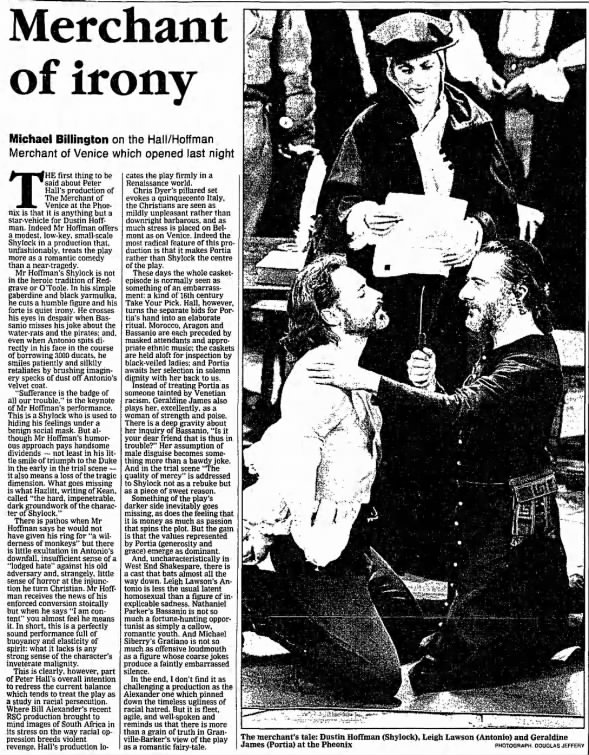
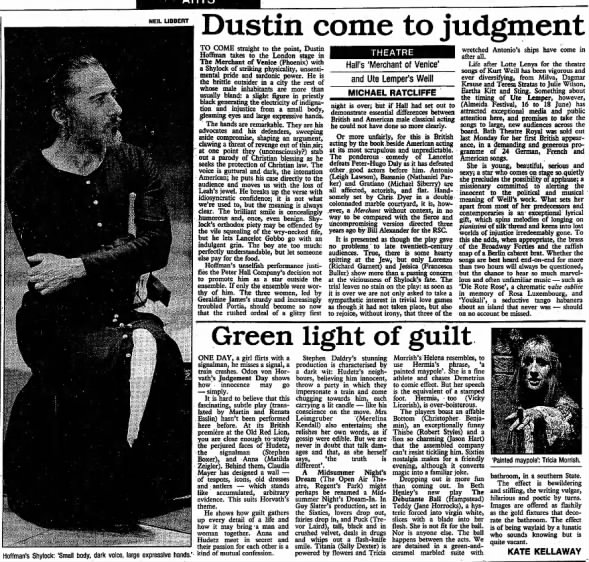
I saw this production of The Merchant Of Venice with Bobbie. I don’t think either of us was overly enamoured of it. I registered “quite good” in my log, which is faint praise from me.
There was a lot of hype about this production because Dustin Hoffman was playing Shylock. I recall that Bobbie’s friend May Lamb referred to that actor as “Dustbin Hoffman” – I must admit that I have never been able to process his name the same way since.
There were other good folk in this production; Geraldine James as Portia for a start. Michael Sibbery as Gratiano, Ian Lavender as Solanio, Leigh Lawson as Antonio, Peter-Hugo Daly as Launcelot Gobbo and many other good names. Peter Hall directed it.
Sometimes a collection of big names is not, in itself, enough.
Also, I have a feeling that this is not really a great play; that’s my opinion anyway. Technically it is a comedy in the Shakespeare canon, but well short of laughs for the modern audience, even by Shakespeare comedy standards.
Jilly is listed as having joined me for this one. Her work telephone number is strategically placed in my diary on the preceding day, so she might struggle to deny this one.
I’m not entirely sure why I chose it other than the fact that I was certainly into Richard Strauss and Sibelius at that time, so two pieces by those dudes that I hadn’t heard live before probably sealed the deal. It might have been Jilly saying “you’ve GOT to see this Heinz Holliger fellow”, as that was the sort of thing that Jilly would say.
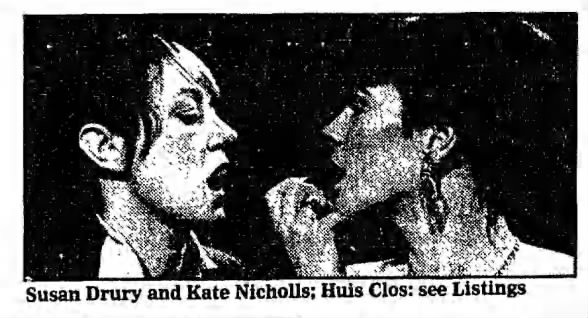
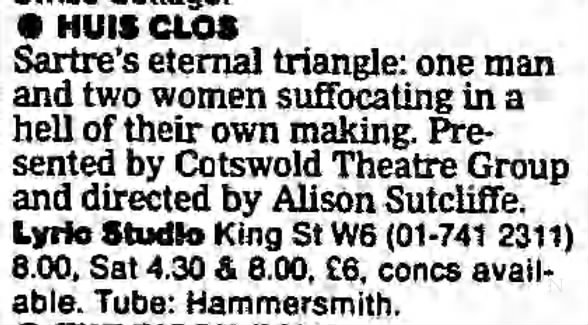
John White loves a bit of existential angst, so what could be a better choice for a Saturday night out than Huis Clos? Mandy was up for it. Annalisa was up for it. Off we went to the Lyric Hammersmith – the small Studio theatre there.
The play is set in hell, which is said to be a hot place.
It really was o-t ‘ot that evening. Clammy August and naturally the air conditioning system in the Studio wasn’t working.
Here’s my database/diary note for this evening:
The air conditioning had broken down on one of the hottest days of the year. The Lyric gave us all free squash in the interval because it was so bad. It did make the play about hell truly multi-sensory. The line “it’s so hot in here” had the whole audience in stitches.
I seem to remember the Rose Bruford mob doing a decent job of Andorra although in truth I remember little about this production.
I’m sure I secretly felt that my school production was just as good if not better but would have been far too polite to say so…
…actually that’s nonsense. I probably secretly realised that our school production was properly “kids amateur” whereas the Rose Bruford production would have been close to professional quality.
The diary is silent about what we did afterwards – I suspect that some eating and drinking was involved, quite possibly with some of the cast.
No doubt about it – Bobbie joined me for this one. She was keen to see the Royal Liverpool Philharmonic under the auspices of the great Czech conductor Libor Pešek. I was keen to see how he would deal with one of my favourite works, Smetana’s Má Vlast.
Strangely, although the national papers promoted this concert widely in advance, none chose to review it by the looks of it. Typical.
Here’s one of the sea interludes performed by the very outfit we saw:
Here’s Stephen Hough with the BBC Symphony from the first night of the Proms 2013 with the Rachmaninov Paganini:
Here’s Libor Pesek and The Royal Liverpool mob playing their four movements of Ma Vlast in Libor Prom order:
Alternatively, if you want to hear that recording in full in Smetana sequence, I have made it available on this playlist – click here. Do not be put off if you see a seemingly erased link – you can hear it whether or not you have a YouTube Music account – you just get adverts of you don’t.
In truth I couldn’t bring to mind Skocná – Dance of the Comedians, but James Levine & the Vienna lot brought it all back to me:
I’m really not at all sure that Entry of the Gladiators belonged with this concert, but that’s what they did. The piece was originally written as a serious piece of military marching music, although how anyone with that moustache composing that piece expected to be taken seriously, even back then, I cannot imagine.
On reflection, I think the use of that piece as a second encore was a mistake. When Libor Pesek suggested that they play a second encore, one of the scouse musicians loudly expressed his discontent with the traditional local expletive, but unfortunately Pesek thought the fellow said:
…but for sure I got back to London in time to see this preview at the Cottesloe.
Bobbie might say, “more’s the pity”, as my log notes that Bobbie absolutely hated it. I merely found it long and hard to follow. That’s how I remember it and that is exactly what I wrote in my log.
Super cast – Tilda Swinton is always very watchable but does often do weird stuff. Also Aidan Gillen, latterly very well known indeed. David Bamber was in it too – thirty years on I tend to watch his son, Ethan, bowling for Middlesex instead.
The play is described as a dramatic poem in the English language text and/but it was basically a family drama.
I wrote the above piece on 14 February 2019, basically because it had been on my mind after writing up Music At Oxford a few days earlier. By strange coincidence, Bobbie Scully turned up at the Gresham Society Dinner that evening, as Iain Sutherland’s guest.
I mentioned the coincidence. Bobbie started to quiver with indignation:
I’d forgotten the name of that darned thing, but it was surely the very worst thing I have ever seen at the theatre…I think we walked out at half time…
…she said. Actually I don’t think we did walk out at half time. I’m sure I would have recorded that fact in my log whereas instead I recorded that the play was long and impenetrable.
I think we stuck it out tho the bitter end…
…I said. I also volunteered to dig deeper into the programme to see if there were in fact two halves.
Yes, there were two halves and they added up to a whopping three hours of hurt for Bobbie.
I’m not sure why we did stick it out. Perhaps I was still wet enough behind the ears to imagine t hat such a piece might yield in the second half all the answers it withheld in the first. I know not to do that now. Perhaps I was so tired and hungover from the joys of Oxford the night before I was reluctant to move on yet.
More likely, we had booked a late night eatery and jointly thought we might as well see the thing through rather than kick our heels somewhere.
Anyway, the whole experience clearly had a profound effect on Bobbie who was shaking with the trauma of recalling that evening and remembered it so well she even said…
…I seem to recall it was only on for a short run…
…which indeed it was.
Nearly 30 years on, Bobbie might wish to read the short essay from the programme too. The least I can do, upload the material, after all I put poor Bobbie through with regard to this play/production.
Postscript Two: Bobbie Chimes In With A Recovered Memory
An e-mail from Bobbie 24 hours after our encounter at the Gresham Society:
I was casting my mind back to that dreadful so-called play (it wasn’t, it was a string of tedious monologues) and had a recollection of being there after the interval in a (suddenly) half empty theatre. So I reckon that, although we did not leave at half time, about half the audience did.
And, indeed, I think that is why we stayed. We came out at the interval, intending to leave, but had pre-booked interval drinks to consume. As we did so, we watched more than half the audience exit the building. I think we went back out of sympathy/solidarity/courtesy towards the cast.
Does this ring any bells with you? Did we really watch the second half because we felt sorry for the actors? Personally, I can think of no other reason …
My response to Bobbie’s considered recollection was as follows:
Yes, we were young and foolish back then. We might well have stayed on for compassionate reasons. There’d be no such snowflake nonsense from this quarter these days. I do recall the second half seeming to drag to an even greater extent than the first half. I also remember an incredible sense of relief when the ordeal ended.
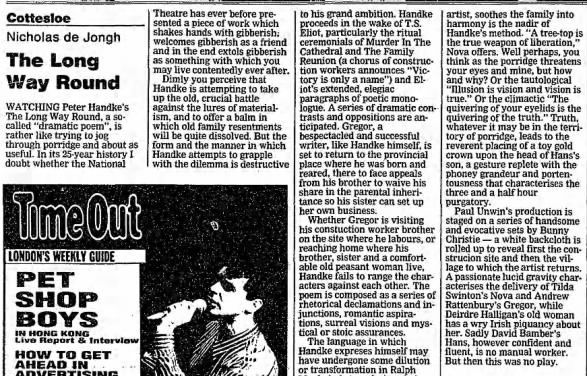
Postscript Three: Here’s a professional view…I don’t think Nicholas de Jongh in the Guardian exactly liked it either:
“Everyone drives on the pavement in Rio de Janeiro” – picture produced in collaboration with DALL-E
We headed up to Oxford late afternoon Friday for an unforgettable 24 hours or so, centred around a superb concert of Handel performed by The Sixteen Choir and Orchestra under Harry Christophers.
When I say “we”, I mean “me and my workmates. This was my first of several Music At Oxford experiences with BDO Binder Hamlyn Management Consultants (as it was called at that time). In fact, I think this concert was the first that Binders sponsored and that Music At Oxford thereafter became a bit of a Binders fixture for several years.
I was thrilled and impressed when I discovered that my firm was sponsoring this concert. I had discovered The Sixteen a couple of years earlier by hearing their recordings broadcast on Radio 3 and had found their sound mighty impressive.
Even now, writing in February 2019, nearly 30 years after the event, Janie and I still consider The Sixteen to be one of the very best early music choir/orchestras we have ever heard – indeed we have booked to see them again at The Wigmore Hall quite soon. It’s been a while – can hardly wait.
Harry Christophers in 2012, from Wikimedia Commons
But back in 1989 I had not yet seen The Sixteen live and/but it transpired that pretty much nobody at work had heard of them at all, so I was designated to be the in-house expert to whom inquisitive clients attending the concert might be sent for more information…
…in true management consultancy style, my having heard the performers a couple of times on the radio became, shamelessly, “recent, relevant experience”, enabling me to advise the clients about all matters Sixteen, Handel and indeed Early Music generally. I should have charged fees.
I remember the Friday afternoon, especially the journey to Oxford, very clearly. I spent the day at the office. As I still hadn’t passed my driving test, William Casey, the managing partner of the consultancy, offered to take me with him from the office to Oxford. I suspect that part of his purpose was to suck what little I knew about the music and the performers from my brain, so he could say something vaguely meaningful to clients.
Of course, we ended up leaving Faringdon Within later than intended and of course the Friday afternoon traffic between London and Oxford in early July was pretty heavy.
I discovered that the seemingly unflappable William Casey was as flappable as the rest of us when under time pressure, as we really did need to get to the Randolph Hotel, get changed into our fancy-pants clobber and be at the Sheldonian Theatre in good time to meet and greet guests.
Once we got away from the main London traffic it seemed we still had plenty of time. William and I chatted about various things, including life aspirations (mostly his) and William’s prior experience living and working in Brazil.
But I don’t think William had accounted for the dreadful traffic into Oxford on a Friday. 1989 was pre-M40 beyond Oxford, of course, so a fair bit more local traffic needed to use the narrow roads around and through Oxford in those days. So the stress levels started to rise again once the A40 into Oxford became a traffic jam.
At one point, William cut off a rather jammed up corner by driving up onto the pavement and jumping the traffic queue at the turning. Probably spotting my disquiet at that manoeuvre (which had not come up in any of my driving lessons) William exclaimed…
…everyone drives on the pavement in Rio de Janeiro!…
…which is the most memorable single thing that William ever said to me.
Of course, it was all a bit of a rush once we got to Oxford. Of course, we weren’t really late – just a little later than intended – so we were able to do the meet and greet thing before the concert…
…which is just as well, because we really were the sponsors – look at this page from the festival brochure:
Within a few months, we had changed our name to BDO Consulting; the first of several subtle name changes in the five-and-a-half years I was at the firm.
The concert was lovely and the Sheldonian Theatre is a superb setting for baroque music.
First up, the small scale but very beautiful Nisi Dominus, a recording of which, by The Sixteen, recorded just a few months after our concert, is (at the time of writing) available for all to hear:
Next up was the Lord Is My Light – Chandos Anthem No 10. Currently a recording of this one by The Sixteen is also available for you to hear:
Then the interval, which we spent hoity-toitying with our client guests in the Bodleian Library:
Well Posh
The invite doesn’t use the term hoity-toitying but you can take my word for it, that’s what we did.
I cannot remember in detail who was there that evening. All of the consultancy partners and a great many of my immediate colleagues for sure. Possibly some of the accountancy partners too, although I have a feeling that this first sponsorship was very much a consultancy affair and that it was in future years that the sponsorship widened out to Binder Hamlyn more generally. Michael Mainelli might well remember and fill in some juicy details.
I don’t think I needed to attend to my own main clients that year – I don’t think they attended. But I had been involved to some small extent with several of the firms clients by then, so had a fair smattering of people I knew as well as the general entreaty to “walk the room”, be the designated in-house early music expert and pretend to look intelligent…or whatever.
The second half of the concert was the wonderful Handel Dixit Dominus. I cannot find The Sixteen recording on line, but there is a fine live performance under John Elliot Gardiner which you might enjoy enormously:
My log reminds me how I felt about the evening and what happened next:
Superb evening. Ended up back at the Randolph Hotel sing-songing with the clients etc.
I am trying to remember who the main ringleaders of the sing-songing were; my memory fixes on Jim Arnott, Dom Henry and Richard Sealey in particular, but I might be mixing up this event with another event or two. Again, Michael might remember these informal details more specifically than me. I’m pretty sure Michael also partook of the sing-songing.
I don’t think we were sing-songing Handel at all – I suspect our singing was more of the Hotel California/American Pie/Streets Of London variety.
I do remember that we went on singing and partying into the early hours of the morning.
I don’t remember how I got home – I think I took the train from Oxford to Paddington for the return journey.
For sure I was back in London for an evening of Theatre at the National – that’s another story for another Ogblog…
But for sure this first Binders/Music At Oxford event, in 1989, especially the thrill of seeing The Sixteen at the Sheldonian, was one of my most memorable and enjoyable work-related cultural experiences.


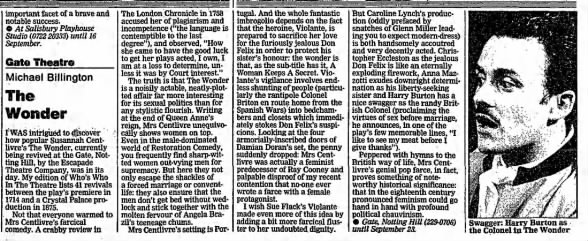 Billington on The Wonder Sat, Sep 2, 1989 – 20 · The Guardian (London, Greater London, England) · Newspapers.com