…so made a bee-line for Zinnie Harris’s next play – this time at the Royal Court.
The subject matter of Nightingale and Chase – a woman being released from prison, was very interesting. I’m not sure this one quite worked as theatre, though.
Not many actual reviews, but you can trust our friend Michael Billington to give such a production the full works and to remind me why we wanted to like this one more than we actually did:
Another weekend, another preview. I’m not sure what drew us to this one. Coincidentally we had seen some of Leo Butler’s work just a few week’s earlier in the young writers’ fest Cutting Through the Carnival…
…but I’m pretty sure we must have booked Redundant prior to seeing Carnival.
Anyway, Redundant was our first sighting of Leo Butler’s full length plays and we were mighty impressed if I remember correctly. Lyndsey Marshal starred and Dominic Cooke directed. It was grim, in many ways, yet tinged with humour and hope. Very Royal Court. Dominic Cooke must have rated Butler and this piece to put it on downstairs – a rare 21st century example of a debut on the main stage of the Royal Court. There is a coup de theatre in the play that required it, I suppose. Risky writing.
The Standard previewed it (after we had seen it) thusly:
We didn’t see the shocking, late addition of an Osama Bin Laden mention, which dominated the press afterwards, by dint of seeing a preview prior to 11 September.
Patrick Marmion was seduced by the production, if not the character:
It certainly didn’t displease us in that way – we noted Leo Butler as one to watch and watch him we did as he matured into a top notch playwright. Possibly if we saw this one again, we’d spot the youthful writing in it. A bit like Chekhov’s Platonov the week before.
The Royal Court is really good at finding ways to showcase the work of young writers who are working with their various programmes. In truth, Janie and I are not so good at turning up to see those showcase performances; we do so rarely, although we were going through a bit of a phase of it at the turn of the century.
On this occasion, we braved Sloane Square on a Friday evening to see this miscellany of pieces connected with the Notting Hill Carnival. Timely, fewer than 10 days before carnival.
As you might expect, it was a mixed bag.
This will have been our first sighting of Leo Butler’s writing. In truth I don’t recall making a mental note about his material based on this showcase. We went to see his play Redundant a few weeks later, but I suspect that I had already booked that before 17 August!
Both of us had really busy weeks in the run up to this Friday night at the theatre, with Janie taking patients early and late that week. In my case, as well as many client meetings, a very late night for me the previous evening due to the traditional Children’s Society v Z/Yen cricket match in Regents Park:
I had seen Mountain Language before – a most memorable production in 1988 with Michael Gambon, Eileen Atkins, Tony Haygarth and Miranda Richardson, directed by Harold himself..
Returning to 2001, our friend Michael Billington reviewed Alive From Palestine, but not the triple bill, giving me the sense that the piece might have had a greater effect on us had it not been preceded by the two Pinter pieces.
To be fair, she reviewed the Pinter double bill ahead of the short late night run of the third play started. And at least The Standard had the good manners to trail the Alive From Palestine one:
Our friend, Michael Billington, suggested that this play was not as good as Roy Williams earlier material and that he needed to branch out a bit. I think he was probably right, as we really went for some of William’s later plays even more than this one, but it was good enough to get us hooked:
…so thoroughly expected to enjoy Kevin Elyot’s next play, Mouth To Mouth, which indeed we did. Not quite to the same extent as The Day I Stood Still – Mouth to Mouth was quite dark – but still we liked it a lot. Fine acting and thought provoking writing.
Here is the Theatricalia entry. Michael Maloney, Lindsay Duncan, Adam Godley, Peter Wight, Andrew McKay, Lucy Whybrow and Barnaby Kay, directed by Ian Rickson. What’s not to like?
Apart from the quintessentially US nature of the production and the left field approach to tackling racism through performance, it’s hard to see much similarity between the evenings.
Rebecca Gilman’s play was memorable through its “warts ‘n’ all” approach to anti-racism and political correctness on campus. Also memorable was a superb performance by Emma Fielding in the lead role. The supporting cast were also “Royal Court good”, as was Dominic Cooke’s directing.
Our friends David and Rachel found it interesting and we had plenty to discuss over grub after the play.
Our other friend, Michael Billington, gave it a very good review in the Guardian:
Janie’s diary reminds me that we had dinner the night before with Jamil and Suad Amyuni at Home House, which was also a very memorable evening in its own way.
Janie’s diary also notes, beside Far Away
1/2 hour.
It was short, but not quite that short. I know we saw a preview, but I trust my memory and the reviews that, even the preview, ran to more than 45 minutes, but probably less than an hour.
Fabulous cast – not only Linda Bassett but also Kevin McKidd and Katherine Tozer, directed by Stephen Daldry. I only realise now what a hot ticket this must have been and how privileged we are/were, as Royal Court members, to grab hot tickets like this before they all got grabbed.
Predictably, Charles Spencer didn’t think much of it – he didn’t tend to get Caryl Churchill:
Even giving the casting vote to our friend Michael Billington doesn’t really help, as Billy-o gives the production four stars but his review is somewhat equivocal.
Strangely, the productions that tend to float our boats the most tend to split the reviewer jury. I guess Janie and I like controversial stuff. And as the now late (25 years on) Jamil Amyuni once famously put it in a different context:
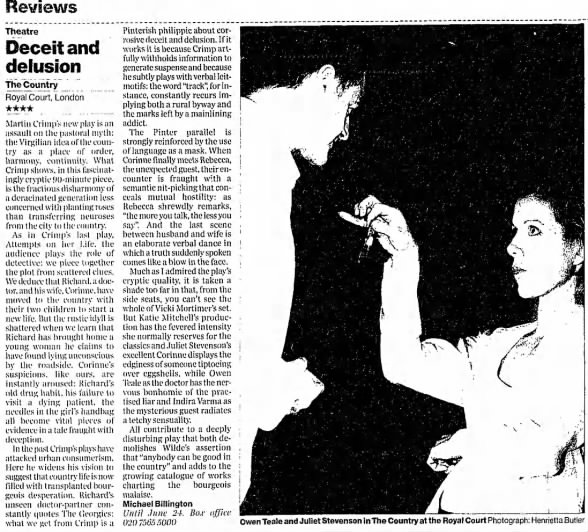
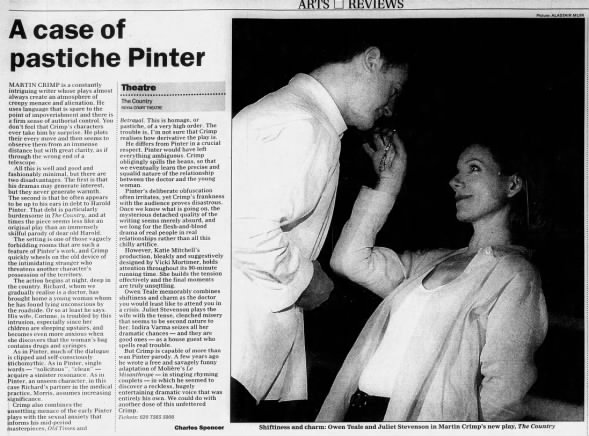
Janie and I were very taken with this creepy three-hander at the Royal Court. I remember us agreeing that it was Pinteresque at the time – without the influence of reviews I hasten to add.
I think this was our first sighting of a Martin Crimp play and for sure we were intrigued enough to seek out his work several times subsequently.
Owen Teale, Juliet Stevenson and Indira Varma, directed by Katie Mitchell. All people who had impressed us before and/or since.
My friend Michael Billington in the Guardian shared our fascination with this piece and also saw the Pinter parallels: