What a cast! Daniel Craig, Susan Engel, Clare Holman, Stephen Dillane, Harry Towd…directed by Declan Donnellan too.
I insisted that Janie go alone to see Perestroika and she told me at the time that it was not as good as Millenium Approaches. But was she saying that just to be kind or was she saying that because she got less enjoyment without me or was she saying that because actually the first part is the better part?
These days (he says, writing more than 25 years later), I do most of the running with regard to booking theatre. But back then, Janie was more proactive.
There are notes in her diary from weeks before, working out when this was going to open and when we might be available. Then, for the day itself (as one might now find in my diary) notes on exactly which seats she’d booked (Row J) and how long the play might be (8:00 to 10:10).
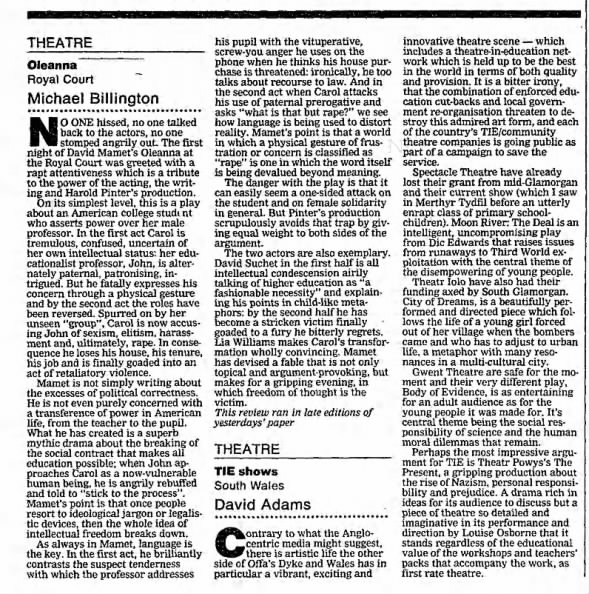
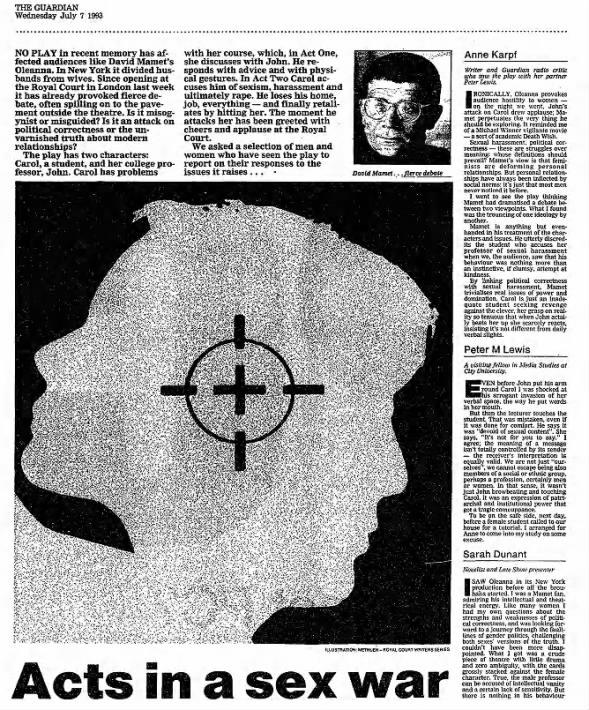
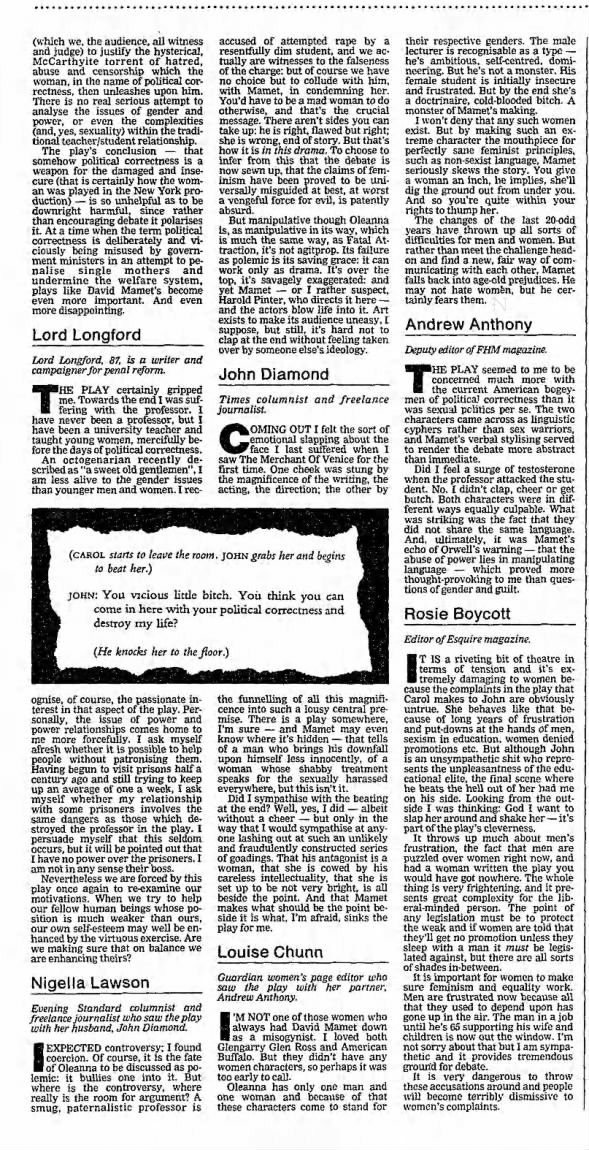
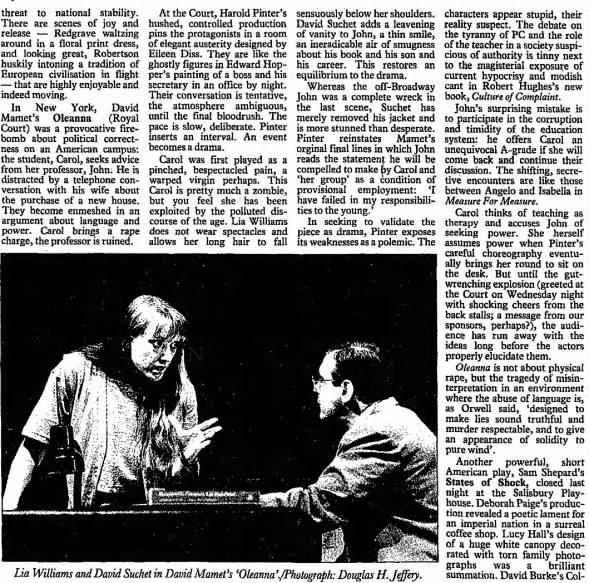
For sure I would have been a willing participant in seeing the latest Mamet – I had been a bit of a Mamet fan for years by 1993. David Suchet and Lia Williams? yes please. Harold Pinter directing? just tell me where I need to go and when. Here is a link to the Theatricalia entry.
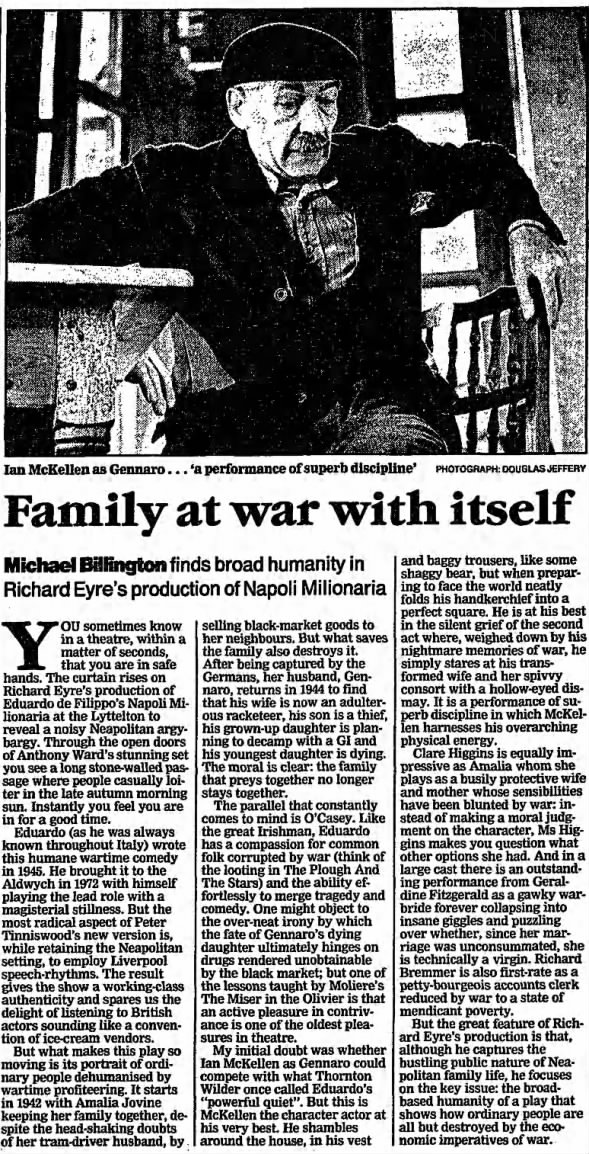
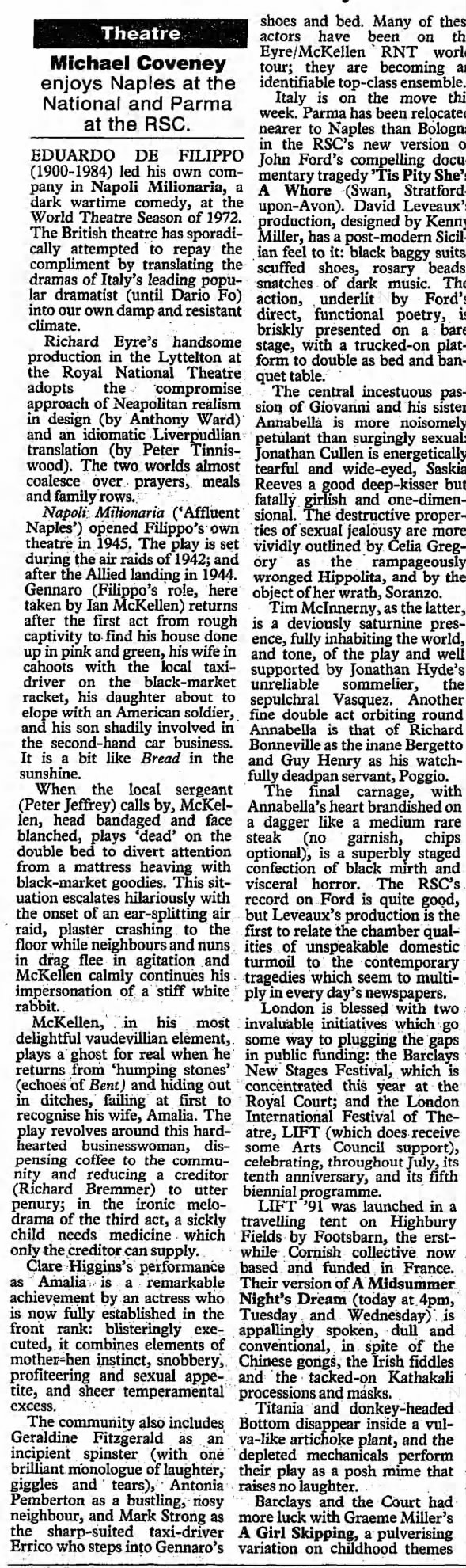
Very good. Performed in scouse accents if I remember correctly.
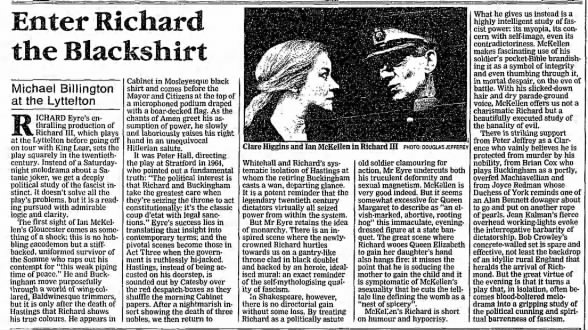
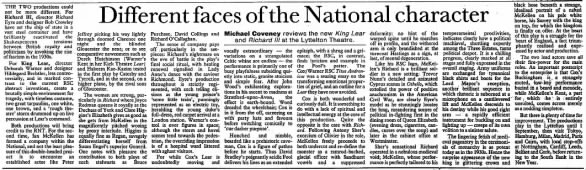
I suspect that the second note had something to do with a little Bobbie annoyance at the use of scouse accents to depict Neapolitans. Ian McKellen as scouser seemed a little strange to our ears too, but of course the bloke can act. Clare Higgins as his missus, Richard Eyre directing, fine supporting cast…what’s not to like?
I don’t really remember much about this one, which suggests it was not so memorable an evening at the theatre.
Bobbie might remember it better, but I doubt it.
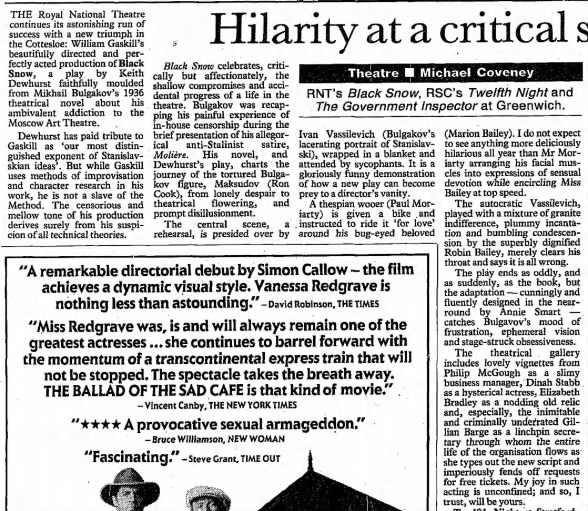
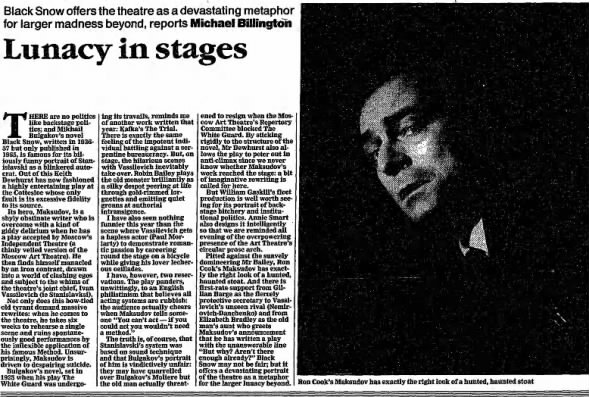
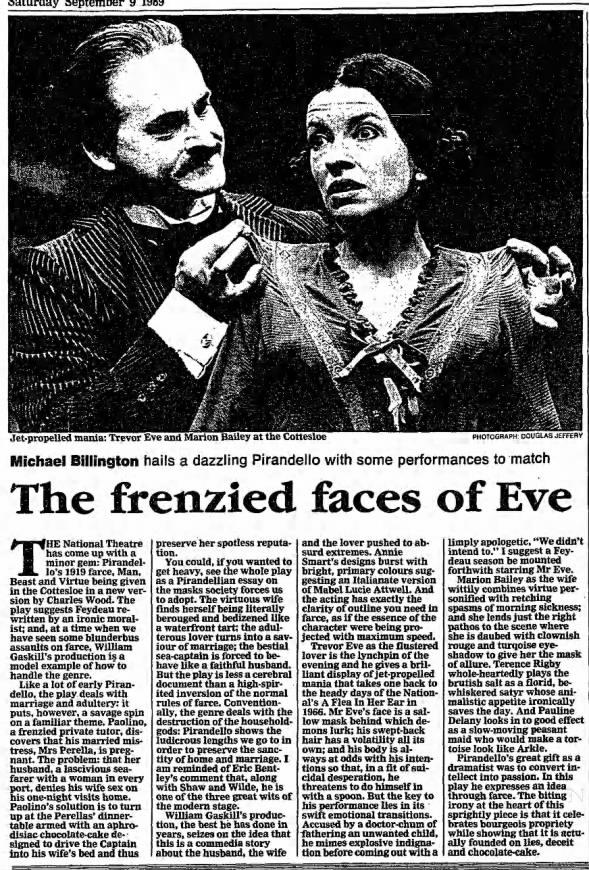
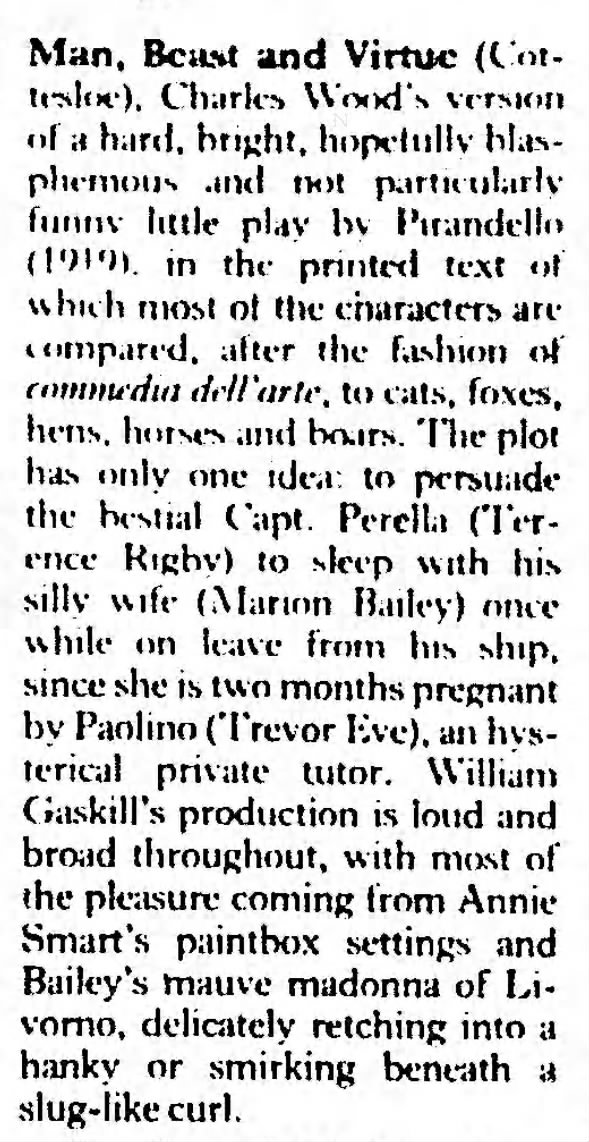
Excellent cast of National Theatre usual suspects. Ron Cook, Marion Bailey, Sally Rogers, Paul Moriarty, Peter Wight, Gillian Barge, Karl Johnson and many others. William Gaskill directed. The Theatricalia entry for this one can be found here.
Michael Coveney absolutely loved it in The Observer:
Bobbie & I were both very keen to see this one – hence our appearance on the first Saturday after press night, booking the tickets long before.
We weren’t disappointed. My log reads:
Superb. The setting was 1930’s style and they made a movie based on this production.
Below is a link to a National Theatre clip:
While below is a clip from the 1995 movie:
Janie would have got less out of this than Bobbie and I did – she is not so keen on Shakespeare, Sir Ian McKellen nor Dame Maggie. (The latter was not in the National Theatre stage production – Susan Engel played Queen Margaret.)
My log says “little recollection” for this one, so I guess it didn’t make a big impression. Bobbie was with me.
Pirandello is one of those playwrights whose work I want to like more than actually do like. Or perhaps it is more accurate to say that I tend to enjoy reading his plays, because the ideas are fascinating, but many of them are difficult to produce in an entertaining way – at least to the eyes of the modern audience.
Man, Beast And Virtue is an early Pirandello, written in 1919 (100 years ago as I write in 2019), about two years before his breakthrough play, Six Characters In Search Of An Author.
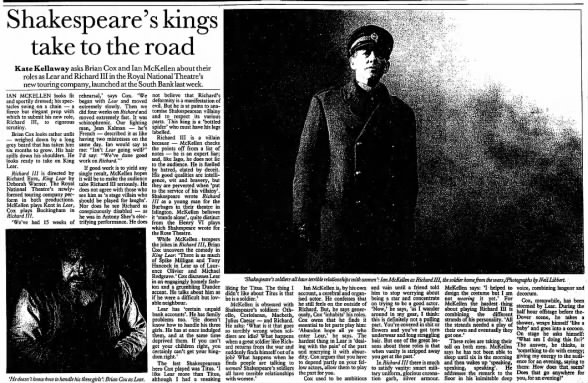
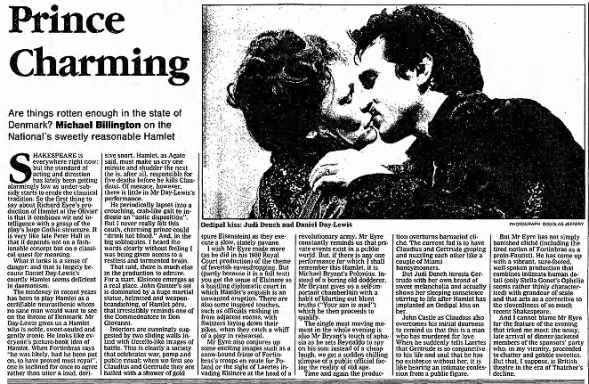
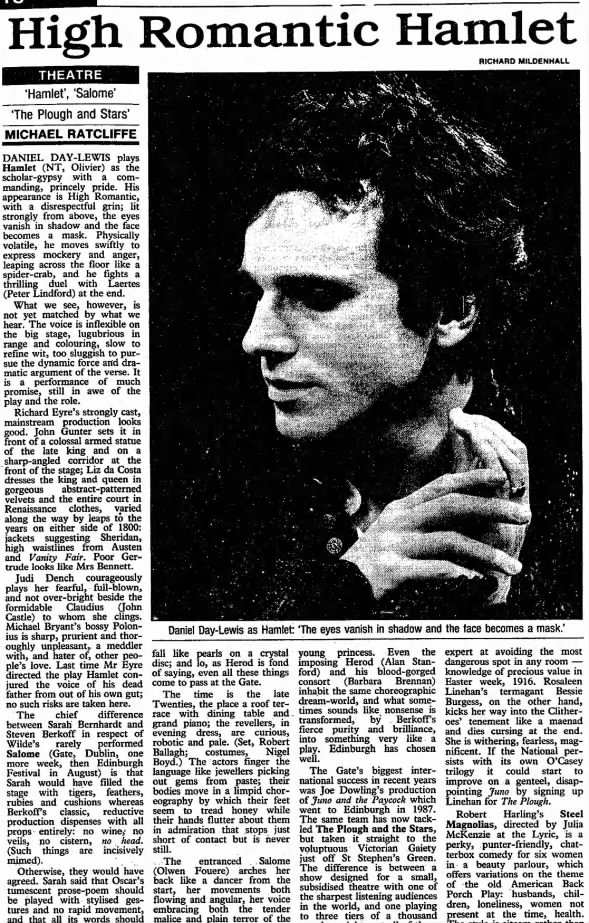
This was the famous (or perhaps infamous) National Theatre production of Hamlet which took Daniel Day-Lewis to the very edge of reason and from which he quit part way through the run.
I went very early in the run – in fact it might even have been a preview – with Annalisa. I suspect that I had booked the thing with Bobbie in mind, but so long before the appointed date that Bobbie could no longer make it.
Let’s just say that, back then, I thought of Shakespeare as more Bobbie’s thing than Annalisa’s thing. Annalisa has latterly assured me that theatre, including Shakespeare, was very much her thing.
Anyway, I recall that we sat right at the front of one of those side wedges in the Olivier – you are very close to the action there, especially when the action is on your side of the stage.
I also recall that Daniel Day Lewis was a very wet Hamlet – by which I mean sweating and spitting his lines. Annalisa remarked afterwards that we should have taken umbrellas with us had we known.
It was a superb production, with a great many big names and several names that weren’t big then but went on to be big. National productions were a bit like that in those days – some still are I suspect.
I was motivated to write up this theatre visit while sitting at Lord’s in September 2018 watching, for the first time, Ethan Bamber bowl live. His father, David, was Horatio in this Hamlet production, nearly 30 years earlier.
Other big names/fine performances included Judi Dench, John Castle, Michael Bryant, Oliver Ford Davies & Stella Gonet. A young Jeremy Northam had a small part in the version we saw but stepped up to the plate when Daniel Day-Lewis walked out. Later in the run, Ian Charleson took on the role to much acclaim, just before he died.
I think this was still quite early in Richard Eyre’s tenure at the National and he directed this one himself, extremely well.
My only other recollection is a quote that Annalisa picked up from an American visitor to the National, who told his wife that he didn’t think all that much of the play – “too many of the lines were clichés”. I guess you can’t please everybody.
Postscript: An Enthusiast From Across The Pond Sought Help…
…in March 2024 I received some unusual correspondence from a gentleman in the USA, wondering whether I still had the programme (or playbill in his terms) as he was keen to see Daniel Day-Lewis’s biography notes from that production.
I have mentioned before that Ogblog serves as a fifth emergency service on occasions and this felt like such an occasion. No sirens or speeding vehicles through the streets of London needed, but I fortuitously was able to lay my hands on this particular programme with relative ease, having not yet returned that batch to deep storage.
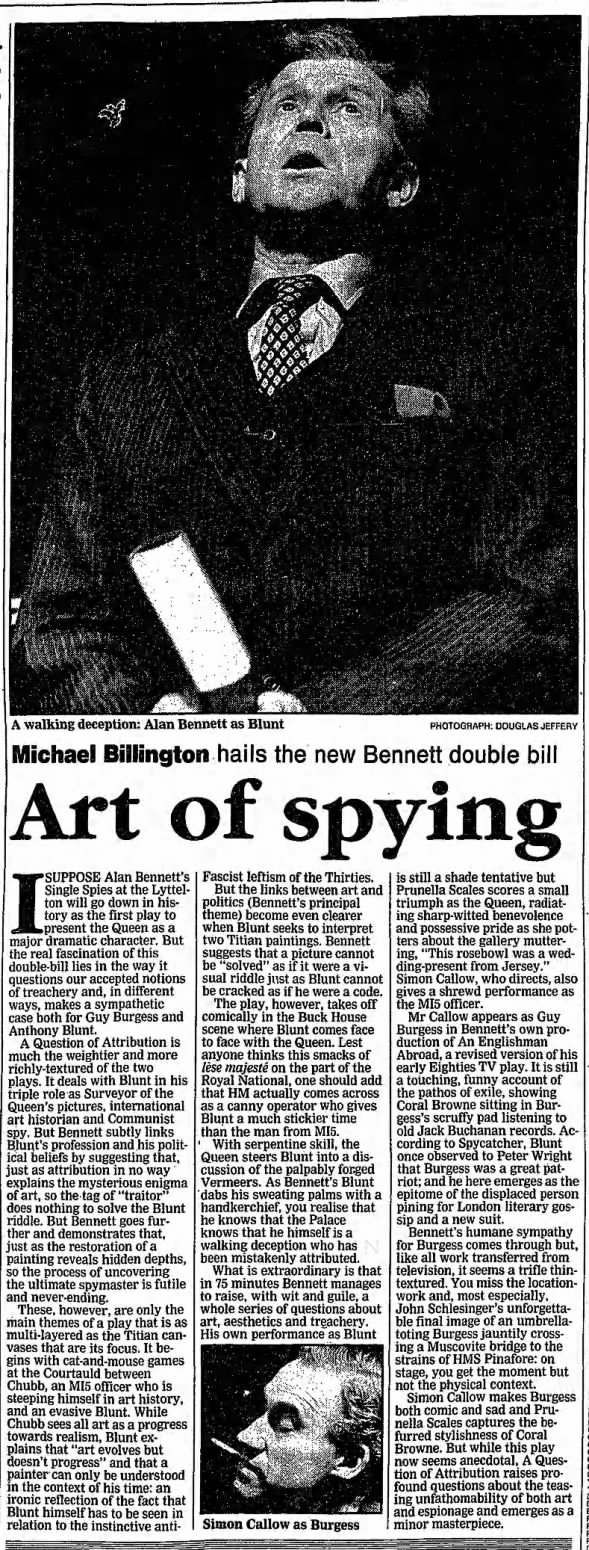
Saturday 3 December: Much sorting to do re flat – went to see Single Spies in eve – B came back to mine
My appointments diary informs me that my Zanussi washing machine was delivered to the flat that morning. I remember going for my first local shopping expedition after the machine arrived.
I am fairly sure that it was on that very first Saturday’s shopping spree that I found myself face-to-face with Van Morrison on the traffic island which divides the north from the south side of the Bayswater Road. We exchanged glances. I nodded, in as much of a “cool, nodding acquaintance” manner as I could muster.
I remember thinking that the Van encounter proved that I had really arrived in a hip, happening place – I was going to be rubbing shoulders with Van Morrison and people of that sort all the time from now on. Well, to some extent I suppose I have got to meet quite a lot of such media folk in the neighbourhood since, but that traffic island encounter with Van the Man was, sadly, a one-off. “No Van is an island”, I suppose.
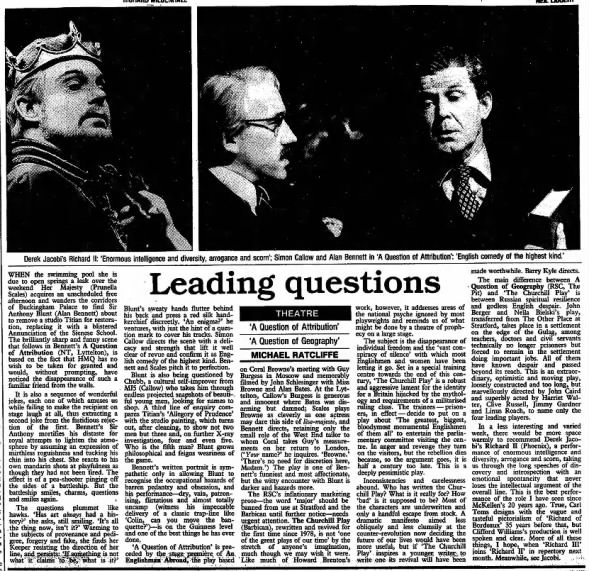
Single Spies is actually two Alan Bennett plays: An Englishman Abroad and A Question Of Attribution. Both are about the Cambridge Spy Ring. The first of the two plays had been knocking around for a few years before this production – it is primarily about actress Coral Browne’s encounters with Guy Burgess. The second play was about Anthony Blunt’s role as art advisor to the Queen.
I thought the production (Single Spies, I mean, not Twelfth Night) was very good and said so in my notes. I’m pretty sure Bobbie liked the production too. I think we might have eaten at the National that evening – I can’t believe that I was geared up to cook yet at Clanricarde.
Sunday 4 December: Went to Pam & Michael’s in eve for dinner and bridge
I wonder who made the fourth for bridge that evening? It was before my irregular social group had emerged, so it wouldn’t have been Andrea on that occasion. I’ll guess it was a friend of Pam & Michael’s – perhaps one of the Setty/Gareh family or possibly it was Ralph Glasser. The diary is silent on such details – never mind.
I’ll have walked there and back, learning that Clanricarde Gardens to Pam & Michael’s place only takes around 15 minutes on foot. Cool.
The diary is silent on what we did afterwards. For some reason, is think that we ate at the National that evening. It is quite a long play and I think the restaurant there was doing arrangements to eat part of your meal during and part after show at that time. But I could be mistaken.
Bobbie and I were on a bit of a roll, theatre-wise, at the start of that year, seeing some great productions. This was certainly one of them.
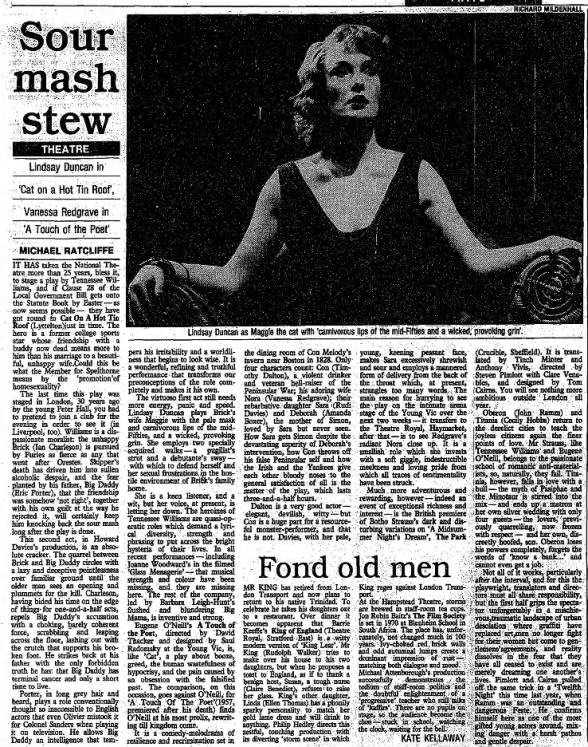
Lindsay Duncan was a most memorable Maggie The Cat and Ian Charleson was superb as Brick; tragically Charleson died just a couple of years after this production. The cast also included Eric Porter, Alison Steadman, Henry Goodman…plus many other fine performers. Howard Davies directed.
The Lyttelton is not my favourite place for this sort of play, but somehow this one seemed to work in that space. I seem to recall it received superb notices and for good reason.
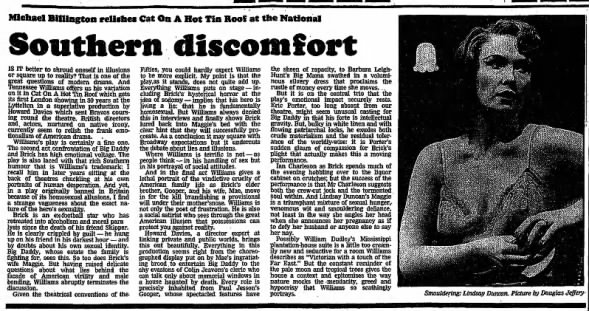
Michael Billington loved this production – his review clipped below:
There’s little on-line about this particular production, given its antiquity, but if you have no idea even what the piece looks/feels like, here is a clip of Paul Newman and Elisabeth Taylor from the 1950’s film version:
…while the following clip is from a subsequent National theatre production of Cat:
Anyway, the Lindsay Duncan & Ian Charleson version will live long in my memory. Bobbie’s too, I’ll guess. I’d better ask her.


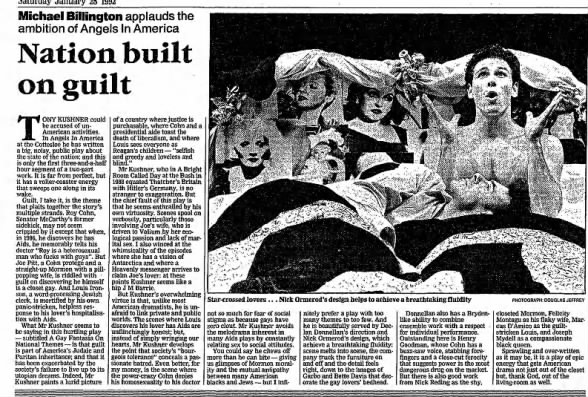 Billington On Angels Kushner Sat, Jan 25, 1992 – 21 · The Guardian (London, Greater London, England) · Newspapers.com