There are some crossings out in my diary, which might have led to the note:
?? Who came with me.
Again, lining up the usual suspects means Jilly, Annalisa and Bobbie. Again, the prime suspect is Bobbie. I think I had queried the name of my companion, because I thought I had crossed out the word “Bobs?”. But my now more sophisticated forensics (use of a magnifying glass) tells me that I crossed out the word “Box?” instead.
Whether or not we sat in a box for this one is another part of the mystery. I do recall occasionally grabbing a brace of box seats back then, although I did soon settle for preferring frontish stalls for Proms concerts.
Anyway…
…this one was a good, solid concert as I recall. We heard:
Carl Nielsen – Overture ‘Helios’
Sergey Rachmaninov – Piano Concerto No. 3 in D minor
Jean Sibelius – Symphony No. 2 in D major
Stephen Hough tinkling the ivories, with the BBC Symphony Orchestra under Andrew Davis doing the rest.
If you don’t know what the Helios overture looks and sounds like, dig this version by the Danish National Orchestra:
Malcolm Hayes in The Telegraph spent about 60% of his word allocation slagging off perceived compositional flaws in Nielsen’s little Helios piece, while praising to the hilt the evening’s performances of monumental Rachmaninov and Sibelius pieces, which comprised some 85% of the concert. A wasted opportunity to write an incisive review of the Prom by Mr Hayes, in my view.
Bobbie & I were both very keen to see this one – hence our appearance on the first Saturday after press night, booking the tickets long before.
We weren’t disappointed. My log reads:
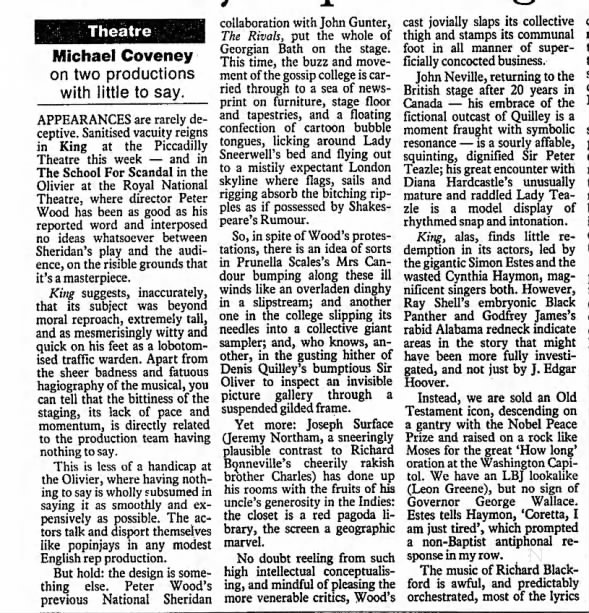
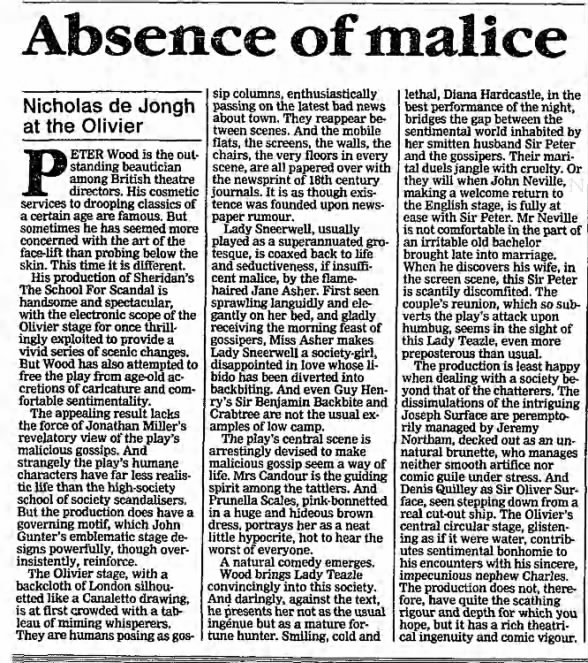
Superb. The setting was 1930’s style and they made a movie based on this production.
Below is a link to a National Theatre clip:
While below is a clip from the 1995 movie:
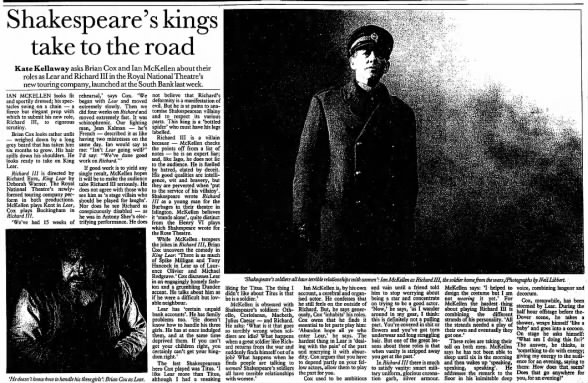
Janie would have got less out of this than Bobbie and I did – she is not so keen on Shakespeare, Sir Ian McKellen nor Dame Maggie. (The latter was not in the National Theatre stage production – Susan Engel played Queen Margaret.)
This was the second go that BDO Consulting (Binder Hamlyn’s management consultancy) had at sponsoring a Music At Oxford gig. I wrote up the frenetic first year of this exercise some while ago – click here and below:
Caroline [Freeman, now Curtis] came along… We all stayed at the Moat House which was less fun than the Randolf.
The programme summarises the musical element of the gig neatly on one page:
If you want to hear the music, I have saved The English Concert’s recording of the version they performed in that Oxford concert as a playlist on YouTube Music. Click here. Don’t be put off if the link is crossed out. You can hear the music regardless of whether you have a YouTube Music account or not. You’ll just get adverts if you don’t.
As for the event itself, one of my main memories of it is connected to my agonising back injury at the time, which had only slightly lessened in pain level in the weeks between the injury and this event. I was going through one of my “soldiering on” phases in July.
Caroline no doubt tolerated my pained mood with grace but I don’t suppose I was at my best in terms of being good company.
We stayed at the Moat House that year, as indeed we did in 1991 as well. It felt like a bit of a come down from the Randolph from 1989, not least because the Moat House seemed less accommodating to us partying for much of the night.
The other thing I remember about the corporate entertaining aspect of the event itself was feeling that I fell short in terms of being the in-house know-all in the matter of the work we were going to hear. Trevor Pinnock and The English Concert – no problem at all. I could talk about them without difficulty. But the piece itself, Belshazzar, which colleagues felt was, on the surface, a story from a bit of the Bible that I was supposed to know about…I remember drawing a near blank.
Belshazzar’s feast…writing on the wall…Book of Daniel I think…not really my thing, the Bible…
Or you can instruct an AI to produce a suitably amusing, entertaining synopsis of the story. Here’s ChatGPT’s excellent effort produced with 30 seconds of instruction from me and fewer than 30 seconds of word spew by the software:
Handel’s oratorio Belshazzar is a richly dramatic retelling of the biblical story of the doomed Babylonian king who meets his fate amidst a whirlwind of prophecy, divine intervention, and questionable party etiquette. With a libretto by Charles Jennens, this musical spectacle features a colorful cast of characters and explores themes of hubris, faith, and the consequences of bad decisions—all wrapped up in Handel’s glorious score.
The curtain rises, metaphorically speaking, on the city of Babylon, which is under siege by the Persian king Cyrus. But Belshazzar, the Babylonian king, isn’t the sort to let a little thing like a military crisis cramp his style. As the besieging armies gather outside the city walls, Belshazzar is busy inside indulging in a grand banquet. This isn’t just any feast; it’s a celebration of excess, arrogance, and a bold defiance of the gods—a recipe for disaster if ever there was one.
Belshazzar’s mother, Nitocris, is the voice of reason in the chaos. Wise, devout, and thoroughly unimpressed by her son’s antics, she tries to persuade him to temper his arrogance and take the threat of Cyrus seriously. Naturally, Belshazzar ignores her sage advice, because what’s a good tragedy without someone doubling down on their hubris?
Meanwhile, outside the city, Cyrus is not your average conqueror. He’s portrayed as a virtuous leader, guided by divine providence and a sense of justice. Alongside him is Gobrias, a Babylonian nobleman with a personal vendetta against Belshazzar, who had his son executed. Gobrias’s hatred burns hotter than the desert sun, and he’s all in on Cyrus’s plan to overthrow the Babylonian king.
Back in Babylon, Belshazzar’s party is in full swing, and things take a dramatic turn when he orders the sacred vessels plundered from the Jewish Temple in Jerusalem to be brought out and used as drinking cups. This act of sacrilege is the ancient equivalent of poking a very angry bear with a very short stick. As the wine flows and the revelry peaks, a mysterious, disembodied hand appears and begins writing on the wall. The text, cryptic and foreboding, sends the partygoers into a panic. Belshazzar, for all his bravado, is understandably shaken and calls for his wise men to interpret the writing.
Enter Daniel, the Hebrew prophet, who has a knack for decoding divine messages. He’s summoned to explain the ominous graffiti, and his interpretation is anything but reassuring. The writing—“Mene, Mene, Tekel, Upharsin”—translates to a grim prophecy: Belshazzar’s reign is over, his deeds have been weighed and found wanting, and his kingdom will be divided between the Medes and the Persians. Not exactly party talk, but it’s a showstopper nonetheless.
While Belshazzar processes this bad news (or rather, doesn’t), Cyrus and his forces execute a cunning plan to enter the supposedly impenetrable city. They divert the Euphrates River, lowering the water level and enabling the Persian army to sneak into Babylon under the cover of night. It’s a heist worthy of an action film, complete with suspense, strategy, and a dramatic payoff.
The climax comes swiftly. Cyrus and his troops storm the city, and Gobrias, fueled by vengeance, confronts Belshazzar. The once-mighty king meets his end, and Babylon falls into Persian hands. Cyrus, magnanimous in victory, proclaims freedom for the Jewish exiles, allowing them to return to their homeland and rebuild their temple in Jerusalem. It’s a triumphant conclusion for some and a dire cautionary tale for others.
Handel’s Belshazzar is a feast for the ears and the imagination. The music captures every nuance of the story, from the swaggering arrogance of Belshazzar to the solemn wisdom of Daniel and the heroic resolve of Cyrus. The choruses are particularly noteworthy, ranging from the jubilant praise of the Persians to the somber lament of the Babylonians. It’s a rollercoaster of emotions, with plenty of drama, divine justice, and a hint of schadenfreude as Belshazzar gets what’s coming to him.
In summary, Belshazzar is a tale of epic proportions, blending history, theology, and theatrical flair. It’s a story where the writing’s literally on the wall, hubris meets its match, and redemption shines through the rubble of a fallen empire. Handel’s music ensures that this timeless story continues to resonate, entertaining audiences with its grandeur, poignancy, and occasional moments of dark humor. So, the next time you’re tempted to throw a wild party in defiance of the gods, remember poor Belshazzar and perhaps reconsider the guest list.
That sounds well cool. I’ll give it another listen.
Trevor Pinnock and his gang did the show again at the Royal Albert Hall a couple of week’s later (Prom 3). Here are a few (mixed) reviews from that performance:
I rated this production very good and I remember it surprisingly well.
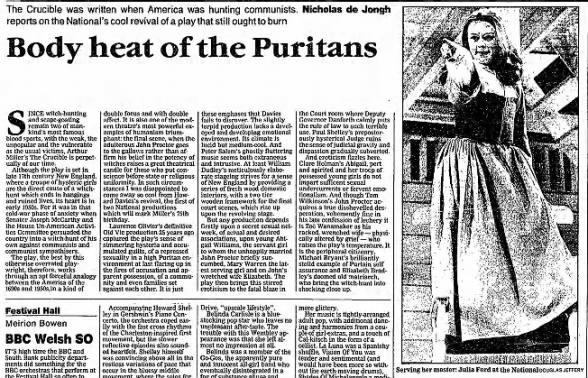
Howard Davies directed this one and gathered an excellent cast. Tom Wilkinson as John Proctor, Zoe Wanamaker as Elizabeth Proctor, Clare Holman as Abigail, plus a top notch RNT ensemble, as was the way at that time.
This production must have been very good, because it is quite a long play and I had “done my back” pretty dramatically the week before. Thus started a period when my back would tell me whether or not I was fully engaged in a theatrical production. For this one, I only recall the superb drama; I don’t recall the pain!
Fair Use of programme art for identification purposes – click here.
This was the third pf a trio of concert visits with “The West End Client” crowd. Again I am sure Rosemarie Whitely and Suan Yap would have been there – I think Rosemarie was a keen Anita fan. Stephen Lee probably organised it.
The other concerts we saw in that first half of 1990 were, in reverse sequence, Luther Vandross…
Anyway, I recall that this Anita Baker concert was very good indeed. Possibly, in truth, suffering from the same problem I nearly always felt at Wembley Arena – too big a venue for that act. I guess I got spoilt at Keele seeing great act in a venue for 1,000 people. Wembley Arena is more than 10 times that capacity.
Sadly this was the last concert I saw with that group, as I did my catastrophic back knack just a week later. But I wasn’t to know that while listening to the sweet tones of Anita Baker’s voice.
I cannot find any video of Anita performing live on that tour. But here is one of the tracks from her Compositions album which she did perform on that tour:
Here is a short clip of her performing live perhaps three or four years earlier:
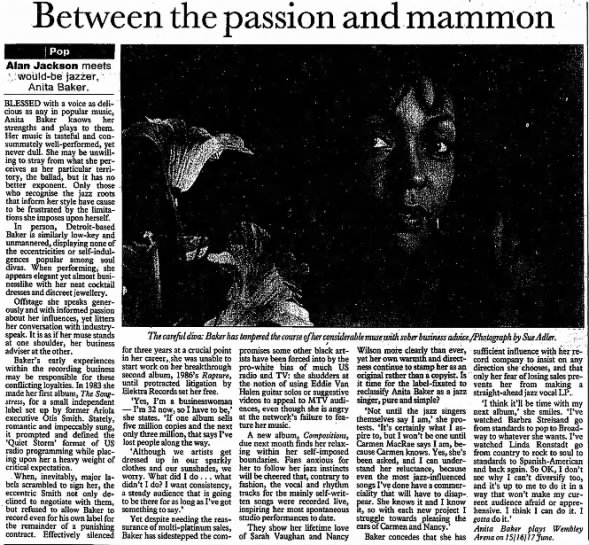
Here is an excellent piece about Anita from the Observer a few days before the show:
I got to know Wendy Jacobi through my workplace, BDO Consulting. We became pals. She was on some sort of placement/exchange thing with BDO, although I recall she stuck around in the UK for a few years and actually became quite good friends with Janie once Janie and I found each other a couple of years after this short trip.
Wendy wanted to see a bit more of England and I had a yearning to see the Derbyshire peaks again, not least because my largest client tended to name a lot of its subsidiaries and initiatives after Derbyshire towns, so I had constant reminders of the place. I had happy memories of that part of England from my Keele days.
My diary is booked out for the Friday and the only thing written in it is 9.30, so I suspect that was the hour at which I picked up Wendy from her temporary digs on Shroton Street in Marylebone, just across the way from The Seashell Of Lisson Grove. As I write 30 years after the event, June 2020, I’ll be doing a FoodCycle delivery run across the way from there tomorrow – small world.
On the Friday, we stopped off to look at the light peaks and in particular Chatsworth House along the way.
But our mission was to walk the dark peaks. I don’t think we had actually booked anywhere; we just ventured in hope. Indeed we ventured to Hope. We ended up basing ourselves in Hope, at Underleigh, where I ended up again with Janie about three years later:
Wendy and I really liked Underleigh and the walking we did around there. It was to be my last walking break for some time; just three weeks later I was struck down with my multipally prolapsed discs and was hardly able to walk again for quite some time.
But my most abiding memory of this short break was a cassette that Wendy brought with her for the drive. It contained (rather poor quality) recordings of a couple of Allan Sherman albums, which I enjoyed very much. I’m sure those recordings helped to inspire my NewsRevue lyric writing career when that burgeoned a year or two later.
The earworm that really stuck in my head for that whole trip was a parody of Harry Belafonte’s song Matilda Matilda, entitled My Zelda:
Wendy and I sang it most of the way up to the dark peaks…
…and pretty much all the way back again on the Monday.
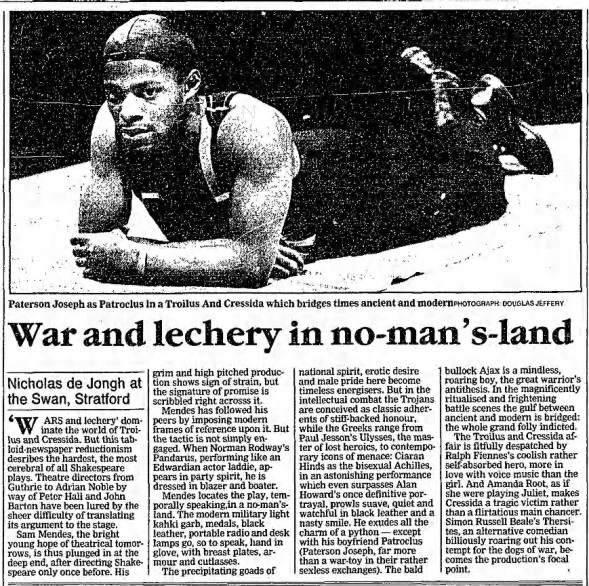
Writing this one up more than 30 years later, I am a bit confused about when I saw it and with whom, if indeed anyone else. I do know for sure that I saw this production at The Swan and was very taken with it.
I took a week off work just after Easter that year, visiting various friends about the place. I’ll write that up as best I can in due course. But in my appointments diary it clearly states “Troilus” 19 April.
Roll the clock forward to November, I saw Much Ado at the Royal Shakespeare Memorial with Moose. Tucked in with the Much Ado programme is the Troilus programme.
So did I simply pick up the programme in November having seen a preview of Troilus on my tod in April, or did I duck out in April and see this in the autumn with Moose? I think the former, but I’ll see if Moose can help me unpick this one.
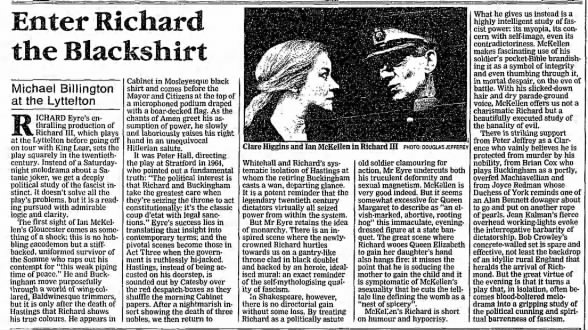
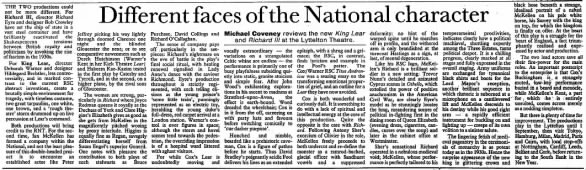
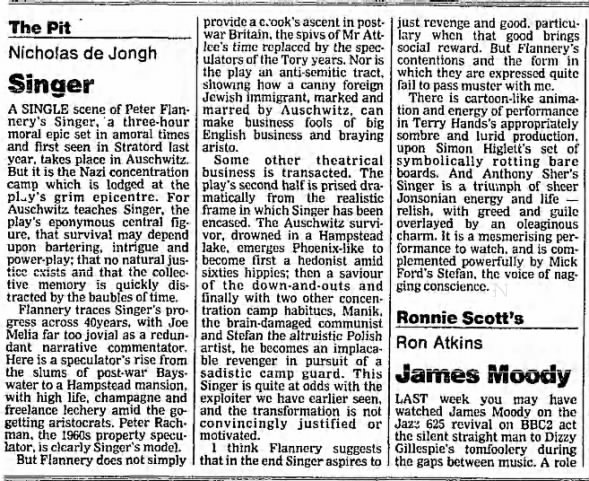
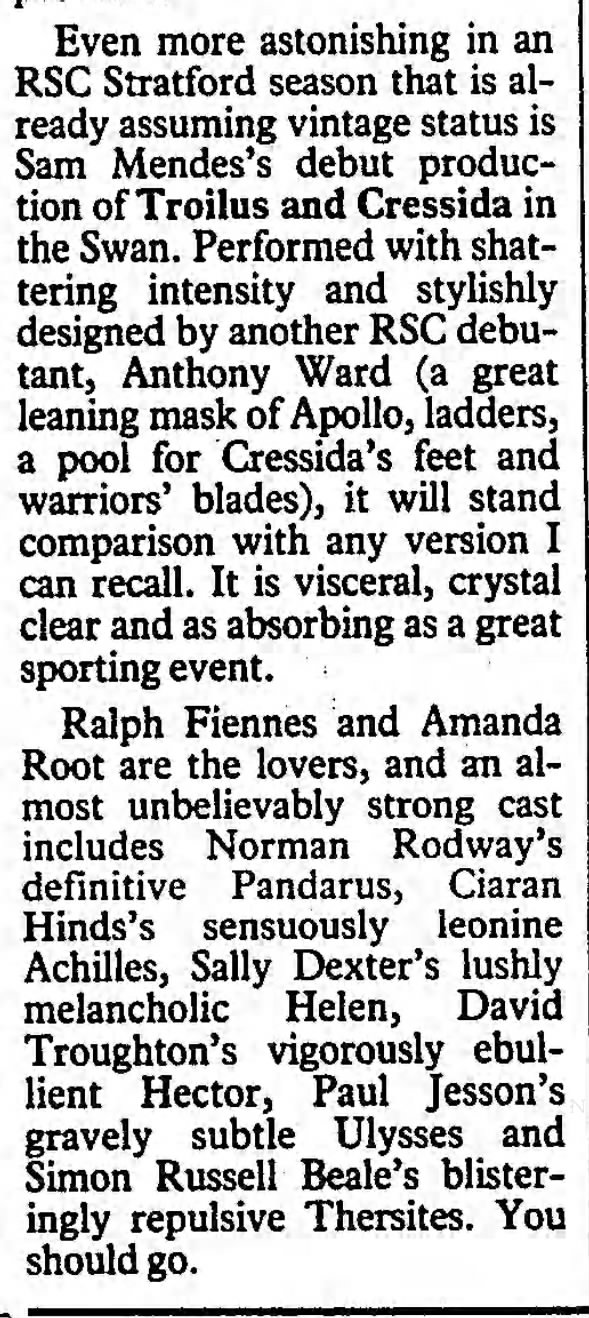
Anyway, what a cast and what a fine production I recall. Ralph Fiennes was Troilus and I think it might have been a conversation with him at Lambton Place (my health club, latterly BWW) that encouraged me to see a preview of this production at Stratford.
Amanda Root played Cressida very well and David Troughton was a top notch Hector, Paterson Joseph a fine Patroclus. Wonderful supporting cast full of names that latterly became big. Sam Mendes was a bit of a Shakespeare novice back then.
I think this Luther one might have been Rosemarie Whiteley’s idea, although it might have been Stephen Lee. I think it was Stephen who acted as ringleader for gathering names and booking tickets for this sort of thing.
The diary merely says “Luther” which suggests that we met at Wembley and didn’t arrange any pre-concert gathering.
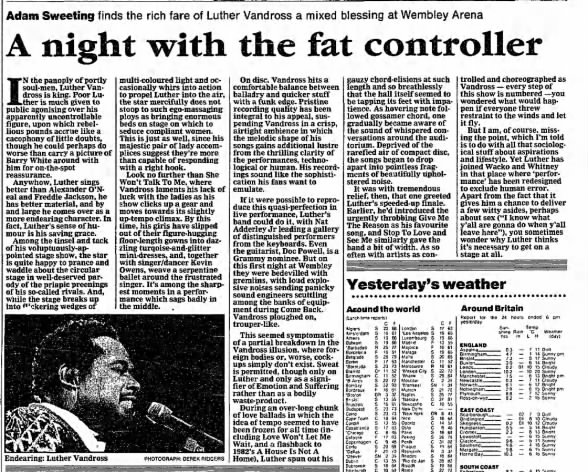
I do recall lots of chat, especially among the females in our group, as to whether we were going to get Fat Luther, Thin Luther or “Some Weight In-between” Luther. They were convinced that his weight was “a thing”. The Guardian review below from Luther’s previous visit in 1989 does suggest that his weight was very much “a thing”.
If I recall correctly we got “In-between” Luther.
I was not a huge fan of Wembley Arena for gigs – insufficiently intimate for my taste – but I remember that this concert worked really well there. Quite a big sound, Luther’s live act.
It was actually a very good concert. I remember thoroughly enjoying it. I had Luther’s Greatest Hits by that time so was familiar with most of the numbers we saw that night; it was pretty much the standard Luther fare I think. I believe his 1989 concerts had been vastly over-subscribed, hence the return in 1990 to do several more.
The video below shows you what he looked like at Wembley, but the live footage was shot the previous year, 1989, with Big Luther:


 Hough Prom Telegraph Hayes 06 Aug 1990, Mon The Daily Telegraph (London, Greater London, England) Newspapers.com