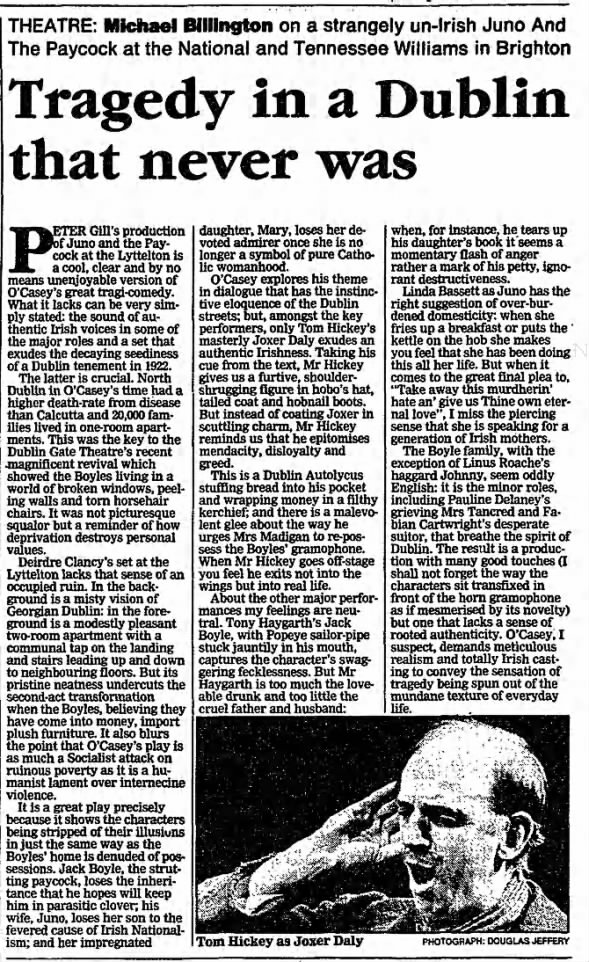
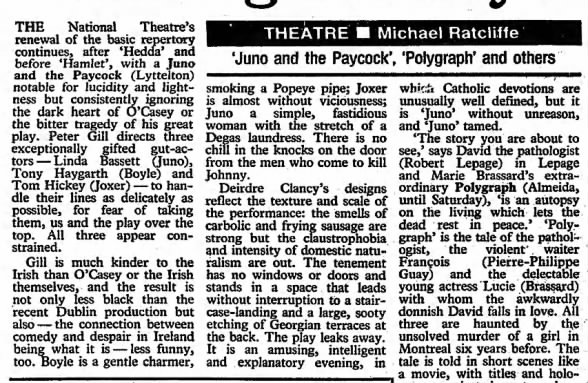
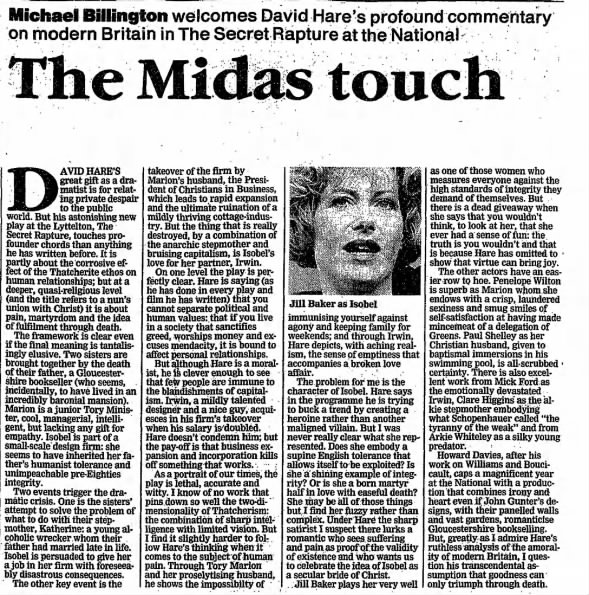
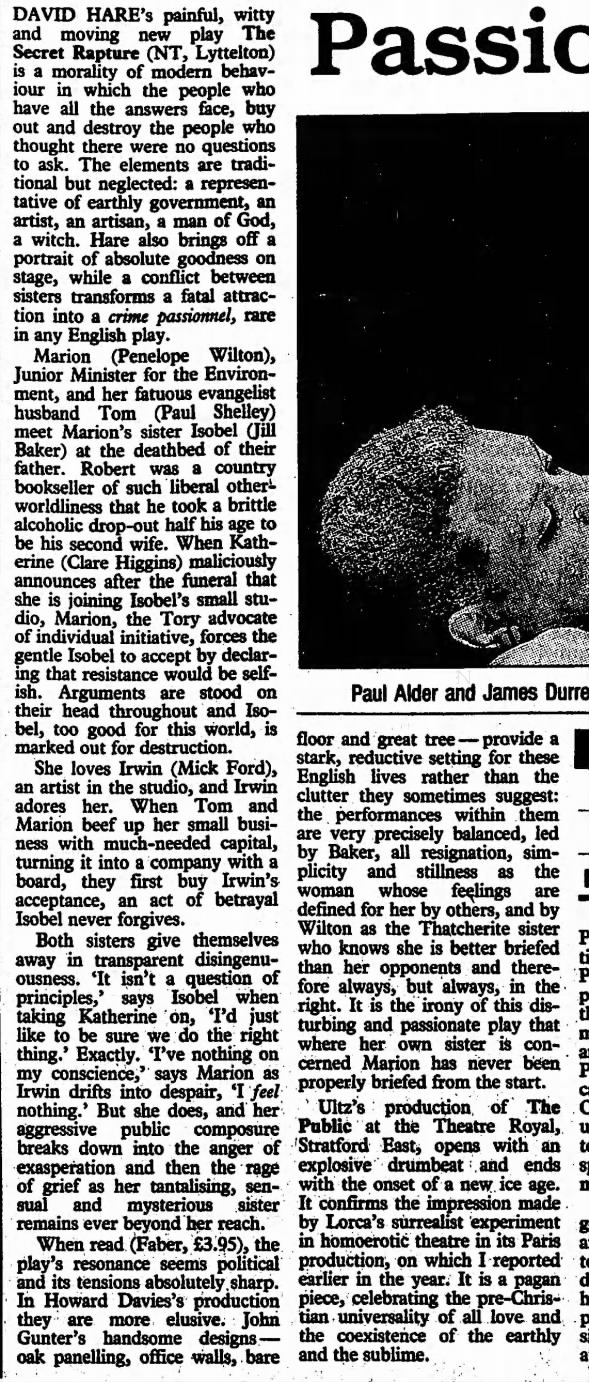
This was the famous (or perhaps infamous) National Theatre production of Hamlet which took Daniel Day-Lewis to the very edge of reason and from which he quit part way through the run.
I went very early in the run – in fact it might even have been a preview – with Annalisa. I suspect that I had booked the thing with Bobbie in mind, but so long before the appointed date that Bobbie could no longer make it.
Let’s just say that, back then, I thought of Shakespeare as more Bobbie’s thing than Annalisa’s thing. Annalisa has latterly assured me that theatre, including Shakespeare, was very much her thing.
Anyway, I recall that we sat right at the front of one of those side wedges in the Olivier – you are very close to the action there, especially when the action is on your side of the stage.
I also recall that Daniel Day Lewis was a very wet Hamlet – by which I mean sweating and spitting his lines. Annalisa remarked afterwards that we should have taken umbrellas with us had we known.
It was a superb production, with a great many big names and several names that weren’t big then but went on to be big. National productions were a bit like that in those days – some still are I suspect.
I was motivated to write up this theatre visit while sitting at Lord’s in September 2018 watching, for the first time, Ethan Bamber bowl live. His father, David, was Horatio in this Hamlet production, nearly 30 years earlier.
Other big names/fine performances included Judi Dench, John Castle, Michael Bryant, Oliver Ford Davies & Stella Gonet. A young Jeremy Northam had a small part in the version we saw but stepped up to the plate when Daniel Day-Lewis walked out. Later in the run, Ian Charleson took on the role to much acclaim, just before he died.
I think this was still quite early in Richard Eyre’s tenure at the National and he directed this one himself, extremely well.
My only other recollection is a quote that Annalisa picked up from an American visitor to the National, who told his wife that he didn’t think all that much of the play – “too many of the lines were clichés”. I guess you can’t please everybody.
Postscript: An Enthusiast From Across The Pond Sought Help…
…in March 2024 I received some unusual correspondence from a gentleman in the USA, wondering whether I still had the programme (or playbill in his terms) as he was keen to see Daniel Day-Lewis’s biography notes from that production.
I have mentioned before that Ogblog serves as a fifth emergency service on occasions and this felt like such an occasion. No sirens or speeding vehicles through the streets of London needed, but I fortuitously was able to lay my hands on this particular programme with relative ease, having not yet returned that batch to deep storage.
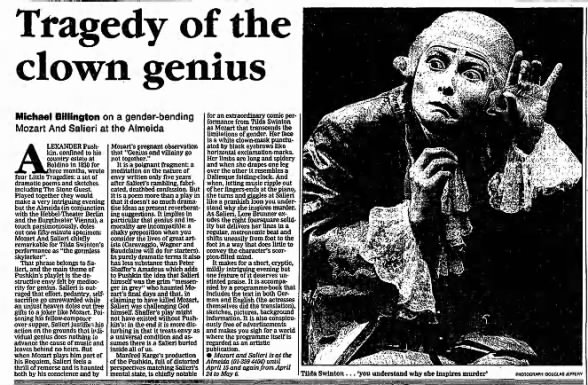
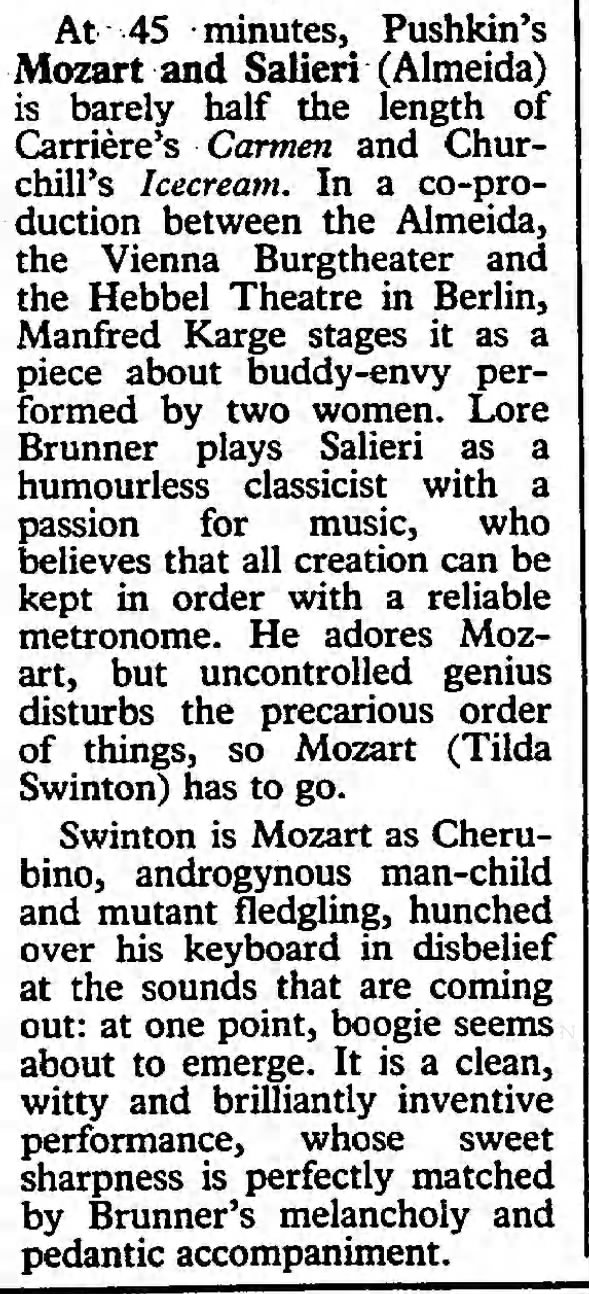
I went to see this production at the Almeida with Kate (previously and latterly Susan) Fricker. I rated it as very good and I’m pretty sure that Kate really enjoyed this production too.
It was an adaptation of a short Pushkin play about the interaction/rivalry between the two composers. This play inspired Peter Shaffer to write Amadeus on the same topic but the pieces are quite different other than the core topic. Here is the Wikipedia entry about the play.
The dates on these reviews imply that Kate and I attended a preview in March 1989.
The diary is silent about what Kate and I did before or after the show; I’m sure we will have eaten something or at least taken some refreshment and had a chat. Perhaps Kate remembers.
My memory isn’t brilliant on this one. I would have sworn that we saw Stella Gonet opposite Tilda Swinton in this, but all the evidence says we saw Lore Brunner. I can see no sign of ever having seen those two (Swinton and Gonet) on stage together, although both were prominent in the leading roles we were seeing at that time.
In any case, I believe this was only my second visit to the Almeida, the first having been some six months earlier, to see Hello And Goodbye. I do recall falling for the Almeida as a place itself on this second visit – whereas that first visit I was simply bowled over by the production and didn’t especially associate that visit with the Almeida. That was partly, I think, because Kate was especially taken with what they seemed to be doing at the Almeida in terms of restoring an old theatre for modern use.
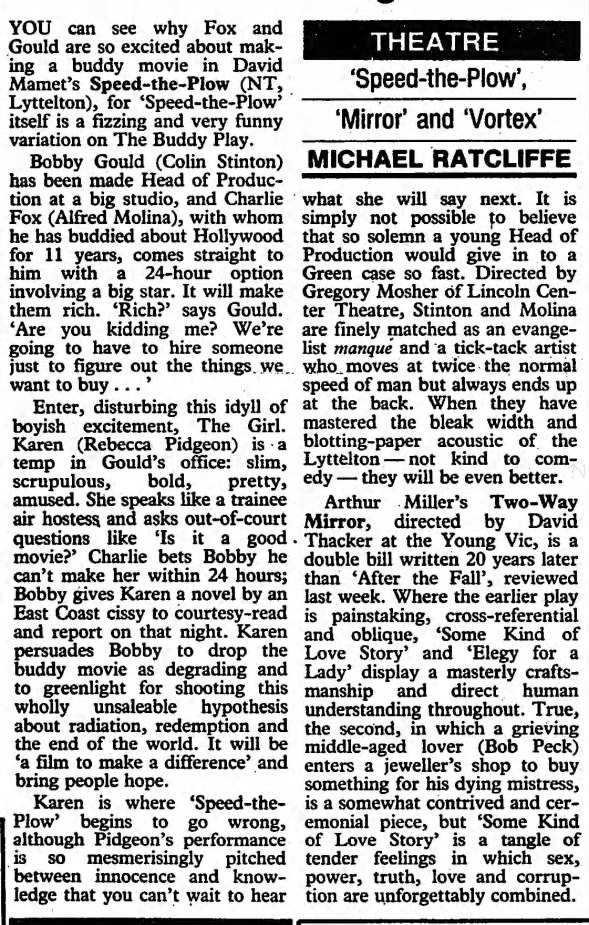
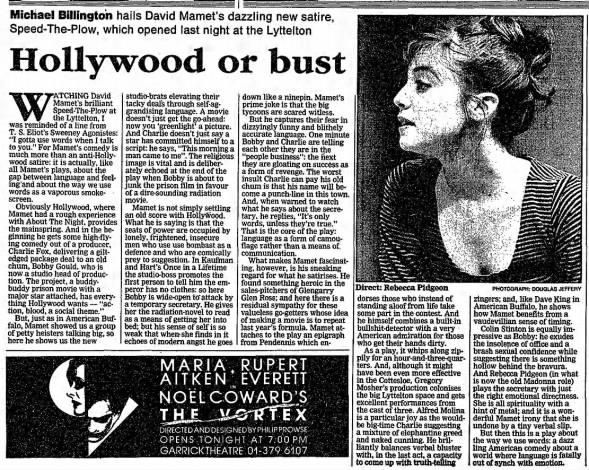
I liked this play/production a lot. I don’t think I’d seen Alfred Molina before and was very taken with his acting. Colin Stinton was excellent too, as was Rebecca Pidgeon.
It’s a play about the movie business. As is often the case with Mamet plays about the world of work, Mamet captures the pressure-cooker atmosphere of the work place extremely well – an aspect that is often lacking in plays – perhaps because playwrights haven’t spent much of their lives in the actual hard-nosed world of work.
Theatricalia has an entry for this one – click here.
There are some #MeToo elements to this play that, obviously, weren’t perceived as #MeToo at the time because #MeToo hadn’t been invented – although movie business males belittling movie business females had been invented.
A midweek visit to the theatre with Bobbie. How on earth we ended up at the National for a major production on press night I have no idea – perhaps a couple of Bobbie’s journalist friends/colleagues had to divest themselves of a pair of tickets at short notice.
Midweek theatre was a habit we had acquired during my quieter months in late 1988 but this was not a sensible idea once my Binders career got going, as I might be deadline-ridden or out of town at the drop of a hat in my new career – so such mideweek jaunts became rare.
I don’t recall being quiet at work, though, so I must have been immersed in something or things that didn’t require meetings. I think I ran a tendering process or two, got involved with some proposal writing and helped out on a few projects staffed by people who didn’t really “get” accounting.
One thing I most certainly wasn’t doing was strutting around the office like a “paycock”. Which brings us back neatly to the matter at hand – a Wednesday evening visit to the National to see Juno and the Paycock with Bobbie.
It is hard to find any information on-line about the 1989 production, although some of the 2011 reviews hark back to the earlier production. But take my word for it that the 1989 production was good. I’m pretty sure it got good notices. Bobbie might remember yet more about it than I do. I’ll ask her.
David Hare plays have a tendency to irritate me, especially those plays that seem to come at moral and/or political issues with some preachy certainty – even if I agree with Hare’s position, which often I do.
I recall The Secret Rapture having enough moral dilemma and ambiguity about Thatcherism to keep the thought and concentration going throughout the play and for some time afterwards too.
They made a movie of this play a few years later…mostly different cast…
…I don’t really recognise the play I saw from this trailer at all:
In short, I remember thinking the play/production that we saw was very good. I went with Bobbie.
I’m not sure what we did afterwards; perhaps we ate out or perhaps I prepared some food for afterwards, as I was in the mode to do that in those early days at Clanricarde Gardens.
No-one said it was going to be easy, switching from freshly qualified Chartered Accountant to hot shot management consultant as soon as I qualified.
But there was one low point towards the end of my first consultancy assignment for Binder Hamlyn, trying to resolve a seemingly irreconcilable problem for Save The Children Fund (SCF), thus named back then, when I spread all of my hand-written notes and attempted spaghetti-looking work flow and data flow diagrams all over the living room of my little then-rented flat in Clanricarde Gardens…
…and burst into tears.
Quite a lengthy burst if I remember correctly. Four minutes, possibly, which you might choose to time by listening to the following while reading on:
Why hadn’t I listened to the recruitment agent who said that I needed a lot more work experience before I’d be ready for management consultancy?
Why didn’t I walk out of the job on day one, when I learnt that I had been recruited as part of a turf war and that the person who was now to be my boss, Michael Mainelli, had been angered by other partners recruiting me while Michael was away on a short break?
And of all the tough “sink or swim” assignments Michael might have allocated me to at the very start of this seemingly-soon-to-be-foreshortened career, why did it have to be something my heart really was in – a project that might, if successful, substantially help SCF, one of the most important charities in the world?
Of course, you realise, the story has a happy enough ending. Michael and I are still working together thirty years later (as I write in January 2019) – for most of that time in the business we founded together in 1994: Z/ Yen:
I also met Ian Theodoreson, then a young, up-and-coming Finance Director at SCF. Ian continued to be a client on and off throughout the decades and we have remained in touch even since he gave up on major charity roles – e.g. this get together last year.
Yes, somehow the project did turn out to be a success. After the tears, I realised that I needed to focus the report on the evidence-based conclusions I had reached and the single bright idea I had come up with in the several weeks I had spent with SCF.
Little did I know back then that:
having even one bright idea during a 20 day assignment is a significant success if that idea is helpful/valuable enough and finds enough favour to be implemented;
the seemingly irreconcilable problem I encountered at SCF was an example of a perennial problem in all organisations that have potentially complex relationships with their customers, members or donors. If you can even partially solve or make progress despite that “natural fault line”, you’ve done well;
this single assignment would prove to be career-defining for me in so many ways. In part because it cemented my place at Binder Hamlyn working with Michael as well as other partners. In part because I still spend much of my working time with charities and membership organisations (albeit looking at wider issues). In part because many of the things I learnt on that challenging assignment stood me in good stead for later challenges in the subsequent decades.
Ogblog is primarily a “life” retroblog, not a “work” one, so this piece is a rarity – perhaps even a one-off – being more work than life. But this period was such a major change for me, not least in shifting my work-life balance substantially towards work for several decades, that I feel bound to write it up. I also spotted some intriguing notes on the diary pages for those first few weeks of January 1989.
Compared with late 1988, this is almost all work, not much life.That meeting with Ian Theodoreson on 10 January will have been my first formal meeting with Ian and possibly even the first time I met him at all, although we might have had a “canteen chat” in Mary Datchelor House (the SCF offices back then) before we met formally. I was making a point of being visible in the canteen for informal chats throughout the project; a technique I had leaned from my Student Union sabbatical experience just a few years earlier. I also note that I had spelt Ian’s surname incorrectly back in 1989, a mistake I was to repeat (differently) on the acknowledgements page of the hard cover edition of Price of Fish. Sorry, again, Ian. Again, lots of work, not all that much life there. A second meeting with Ian, now mis-spelling his name in the same way as The Price of Fish error – at least some sort of consistency set in. Hannah and Peter on the Thursday evening are my neighbours from downstairs. Peter is still downstairs – Hannah (Peter’s mum) returned to Germany some years ago and is spending her dotage there. I cannot remember the evening of 22 January 1989 with Caroline – I’ll guess that I cooked Caroline dinner at Clanricarde given the time and lack of other information in the diary. Caroline has reciprocated – most recently at the time of writing a week or so ago!The amusing entry on this page is the morning of 25 January. Someone suggested that I visit Barnardo’s by way of comparison with SCF. I’m not sure who provided the above assistance for my journey, but it reads:
Barkingside St. [Station] Church – beside it c60s US “Prison”
Anyone who has visited the Barnardo’s campus would recognise that “1960s US Prison” description and it should make them smile. It would be ironic if it had been Ian Theodoreson who provided that helpful description for my journey, as he subsequently spent many years as Director of Corporate Services there and I did several assignments at that Barnardo’s campus, in the late 1990s and early years of this century.
Please also note “G Jenny” in small writing for 26th evening and then again on the Saturday afternoon. I know that I deferred my visit to Grandma Jenny 26th because I had a report deadline looming…
…in fact the “evening of tears” might have been 26th not 27th…
…but I also know that the report deadline was really for the Monday morning, when I needed to go into the office with the report ready for review. So I also remember postponing Grandma Jenny again on the Saturday, while dinner with Jilly I think went ahead after I finished my draft report on the Saturday.
I put Grandma Jenny back into the book for the following Tuesday and I’m sure I will have gone that evening. She forgave me for the multiple rescheduling I’m sure, especially when she learnt that I was doing work for a charity in which she believed strongly. I also remember her imparting the following worldly advice to me several times during that era:
all work and no joy makes Jack a dull boy.
Well of course there was joy as well as work during those “hard yards” weeks and months at the start of my consultancy career. But I don’t suppose there was much joy inside my tears on that evening, when I thought it was all going horribly wrong.
Maybe I even cried for the six-and-a-half minutes it takes to listen to this Dowland-ish Stevie Wonder song.
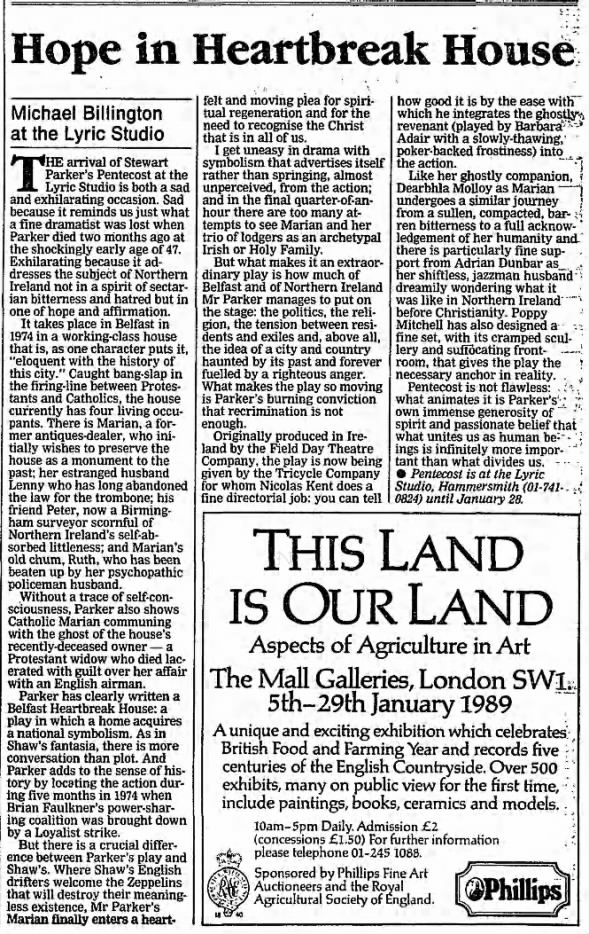
An after work visit to the theatre with Bobbie on a Wednesday evening. The Lyric Studio did really high quality fringe stuff back then. This cast included Adrian Dunbar, Dearbhla Molloy and Michelle Fairley would you believe?
This production was actually the Tricycle Theatre (or do I now have to say “Kiln” even when discussing productions gone by?) in exile at the Lyric Studio. Hence Nicholas Kent directing.
I don’t remember all that much about this play/production, other than it being pretty impressive for a small studio production and being very Northern Irish in tone and subject matter. The acting and directing was top notch.
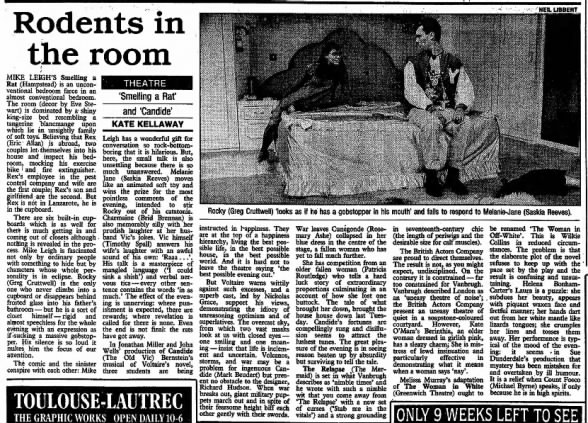
This was at the old Hampstead Theatre – the portacabin-like place quite near the new Hampstead (i.e. also Swiss Cottage). The place had a proud tradition by 1989, not least in the matter of Mike Leigh plays.
What a fine cast – as always with Mike Leigh who seems to be a magnet for talent – including Timothy Spall, Saskia Reeves and Brid Brennan.
I do remember really liking this play/production. It was, in some ways, the sort of cheesy farce I tend not to like. But being Mike Leigh, it was sort-of an antidote to such farces, much as Noises Off by Michael Frayn is sort-of farce, sort-of antidote.
I went to see this one with Bobbie – I wonder whether or not she remembers much about it…
…or whether Bobbie remembers much about Jilly’s party at the latter’s Nether Street residence?
I think it was at this particular Jilly party that I had a long conversation with one of Jilly’s scientist friends about nuclear fusion technologies, which we reprised some 20-25 years later at a subsequent Jilly gathering.
John’s a good fellow. John will be able to read my hieroglyphics.
If John is unable to read my hieroglyphics, he will nevertheless remember the occasion vividly and remind me where we went that evening and what we did/ate.
Or if by some fluke John cannot remember exactly what we did a mere 29 years ago, I’m sure his diary will reveal more secrets about the evening than mine.
We met at 6:30 in the evening. I can say that with authority.
I didn’t stumble across this page while looking for something else and think “wtf does that say”…I really did, very specifically want to write up that particular evening…honest guv.
The preceding week, the only item of note was my visit to mum and dad’s place for dinner on the Saturday. My surge of social activity between completing my accountancy finals and settling down at Binders replaced by a more austere “work hard” lifestyle. Not least because I didn’t have that much spare dosh at first, with most of my pay going on rent and driving lessons to pay for. Must have done something for new years eve I’d have thought, but it’s not recorded, so lost in the mists of time.



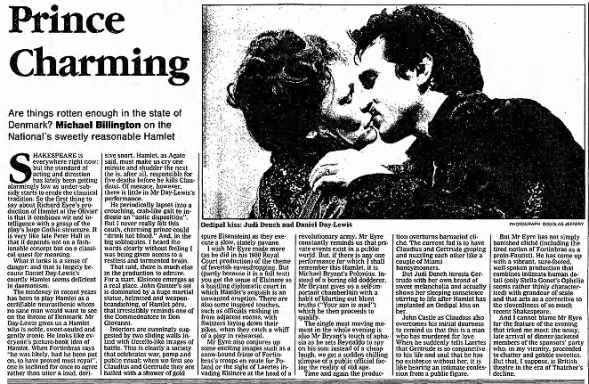 Billington on Hamlet Sat, Mar 18, 1989 – 21 · The Guardian (London, Greater London, England) · Newspapers.com
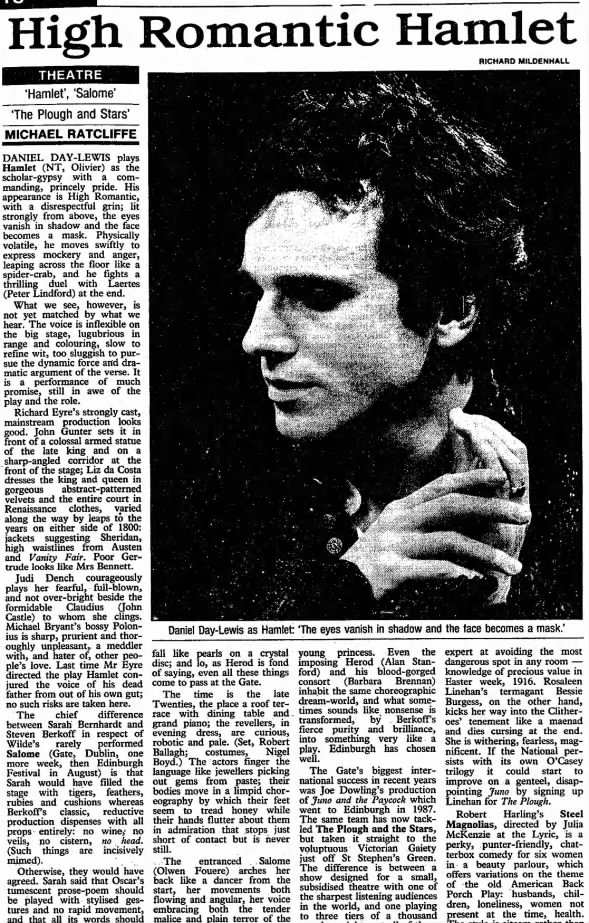 Ratcliffe on Hamlet Sun, Mar 19, 1989 – 46 · The Observer (London, Greater London, England) · Newspapers.com