David Hare is very good at burrowing around all manner of interesting topics, but I suspect he was too far away from his spheres of knowledge and understanding with the financial crisis.
Hare almost admits as much, as the narrator of the play is a somewhat perplexed author.
So to me, Hare was making the obvious points about the financial crisis well enough, but there was little dramatic tension and no new insight in the piece.
Janie liked it a bit more than i did, but I suspect that she got more out of it, being less steeped in the financial crisis in the first place.
I’m glad we saw it, but this is second division work from a first division playwright. There was little a good cast and production could do to save it.
Janie and I really like a bit of Ibsen. In some ways that is odd, in Janie’s case, as she tends to prefer modern plays and eschew classics. But she makes an exception for some classics; not least Ibsen, Strindberg and to some extent Chekhov.
Anyway, Rosmersholm is rarely performed and here was a production at one of our favourite theatres with a stellar cast and production team.
It’s hard to explain why this play is so rarely performed. In some ways Rosmersholm is über-Ibsen; it seems to throw in a lot of Ibsen’s favourite political, social and moral themes all at once. But then most of his great plays do that. Perhaps it is über-gloomy.
So although this was a superb night at the theatre, with wonderful performances and a truly top-notch production, we didn’t end up thinking that “everyone should see a great production of Rosmersholm” in the same way that we might say that about Hedda Gabler, Ghosts or A Dolls House, for example.
Still, a great theatrical event and right up our street.
We pushed the boat out to see this one. Friday night at the National Theatre – we both had busy Friday schedules well into the afternoon.
Was it worth it, I hear you cry.
So dull, we walked at half time
Seemingly not.
I have a feeling this was the occasion when we bumped into my friends from Lambton Place, Bryan Rostron & Sunny, with their pal Paul Foot. You don’t mess with investigative journalists like Bryan and Paul – we confessed to the fact that we were going to sneak away after the drinks interval.
We wanted to like this play/production. We are partial to John Osborne, although well aware of the fact that his good is very very good, but not all of his drama is of the highest quality. This one felt like a history lesson in a rather dull (to us) aspect of history.
I also felt badly about walking out on Timothy West. He had, after all, sat through hours of dull stuff with me in it on more than one occasion without walking out at half time:
Returning to Luther, it was, of course, a fine cast and a fine production. Rufus Sewell in the title role. Richard Griffiths, Timothy West, and Maxine Peake in supporting roles, Peter Gill directing with a young Josie Rourke assisting.
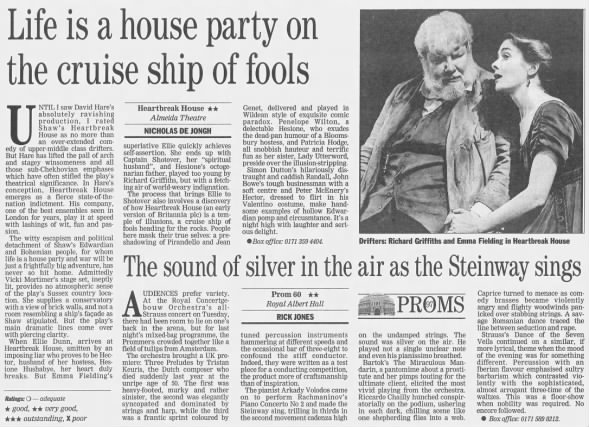
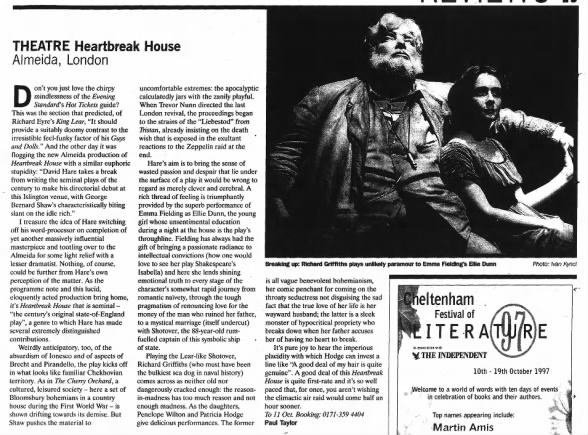
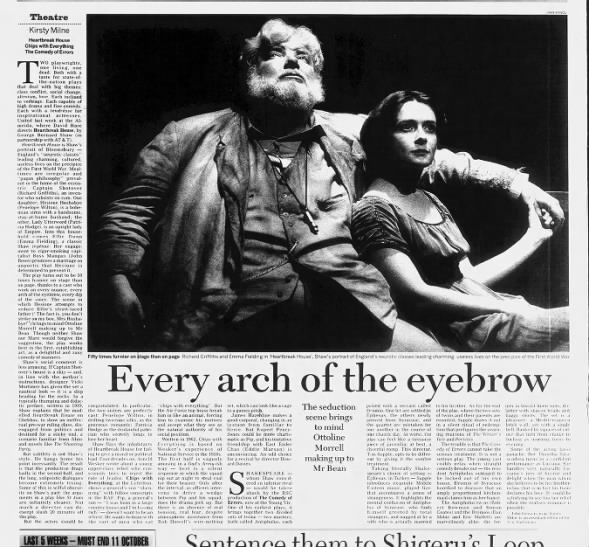
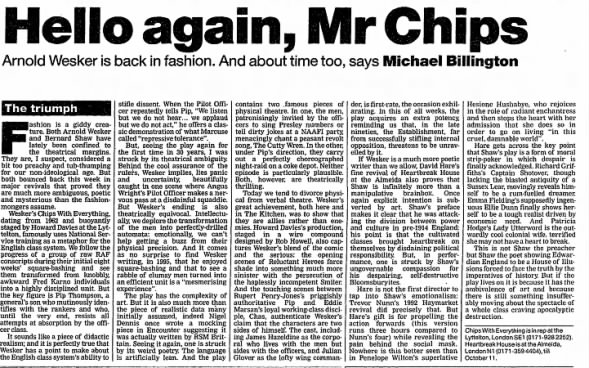
I’ve never been sure about Shaw, but we thought we’d give this a try because it was The Almeida and because top flight Shaw productions were few and far between at that time.
Great cast and crew – see Theatricalia entry – including Emma Fielding, Richard Griffiths, Patricia Hodge, Penelope Wilton, Malcolm Sinclair and Peter McEnery, with David Hare in the director’s chair.
Despite all those good people, this one added to my/our sense of interminability, which had already been piqued by Suzanna Andler the previous week, which was soon followed by wall-to-wall coverage of Princess Diana’s tragic demise, which took ceaselessness to new levels.
Anyway, my contemporaneous words on Heartbreak House, speaking for both me and Janie:
Seemed interminable in the second half. Had “moments”, but all too few.