I have little recollection of this particular production and midweek evening at the theatre with Bobbie.
Starry cast, we saw, with Paul Eddington and Dorothy Tutin as the Crocker-Harris couple in The Browning Version. The same cast and crew performed/produced both plays.
I think I concluded that Rattigan isn’t really my thing when I saw these plays. It all seemed rather old-fashioned in style, although I do also recall that there were interesting themes and the plays were well written.
A superb run of seeing amazing productions started to break down just a little with this one.
Again a Saturday evening, again with Bobbie. My log says the production was good. It also says:
Suzan Sylvester was indisposed that day, so we saw Michelle Evans understudy the lead
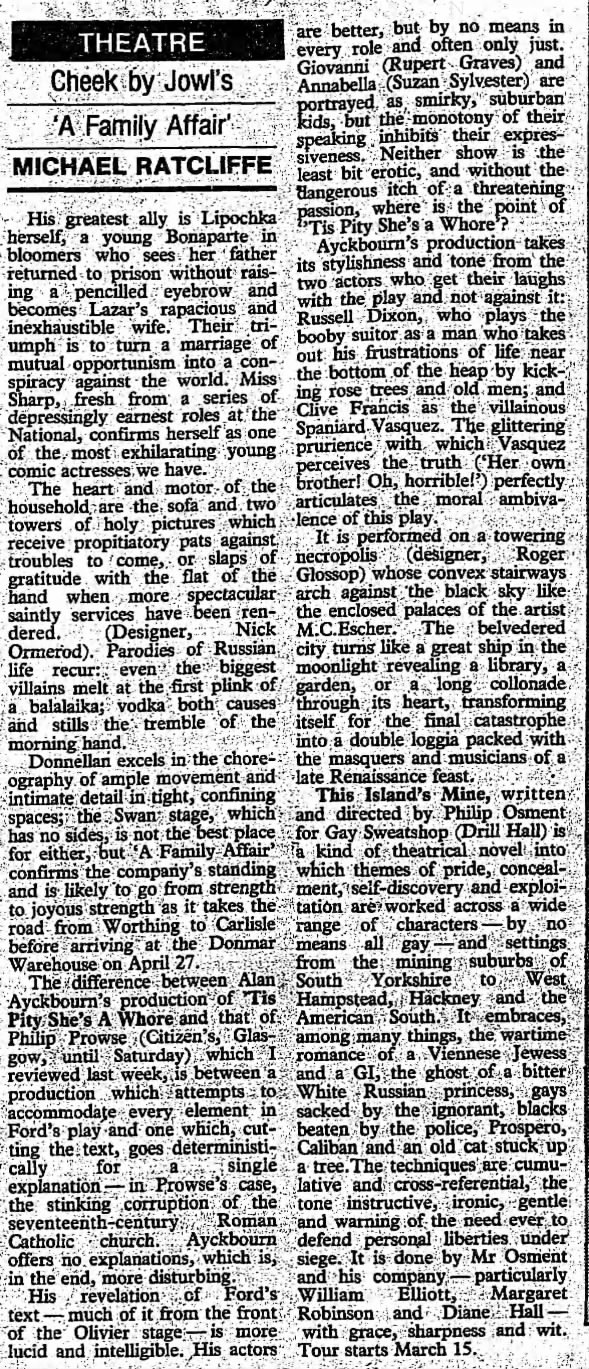
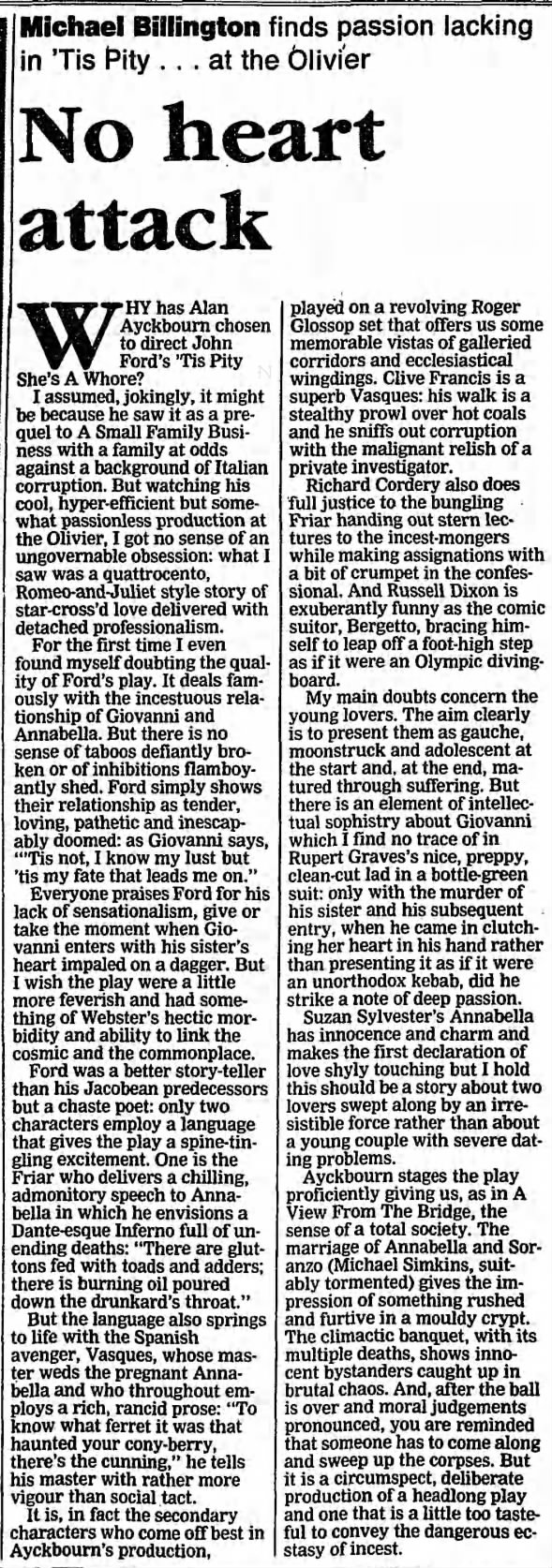
Tis pity that, as I think Suzan Sylvester must have been a very good Annabella opposite Rupert Graves as Giovanni. I do remember Bobbie and I feeling that the understudy did well, though.
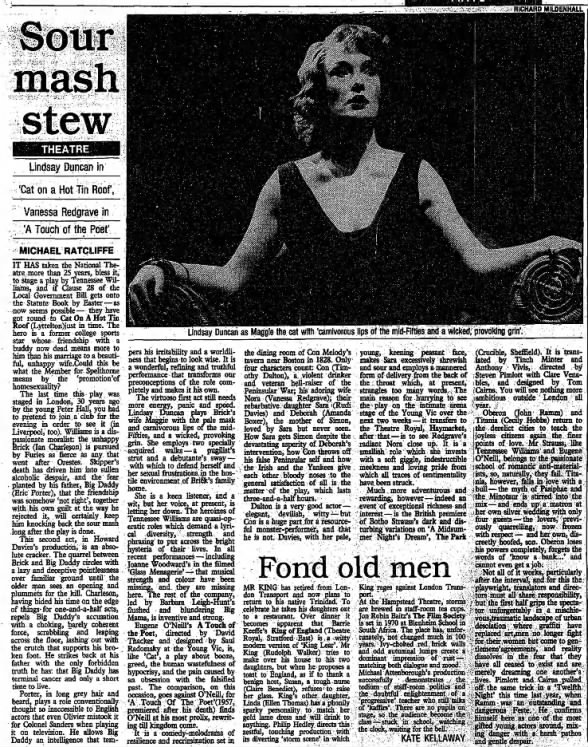
Not one of Eugene O’Neill’s greatest plays, but my log suggests that Bobbie and I both found this production very good…
…and why shouldn’t we. Vanessa Redgrave & Timothy Dalton, with support from Amanda Boxer, Malcolm Tierney and several other good names. David Thacker directed it.
This was, in fact, a West End transfer of a much-lauded Young Vic production; the UK premier of this play. Bobbie and I couldn’t get in at the Young Vic but got in early during the transfer, so saw the original Young Vic cast/production.
Bobbie and I were on a bit of a roll, theatre-wise, at the start of that year, seeing some great productions. This was certainly one of them.
Lindsay Duncan was a most memorable Maggie The Cat and Ian Charleson was superb as Brick; tragically Charleson died just a couple of years after this production. The cast also included Eric Porter, Alison Steadman, Henry Goodman…plus many other fine performers. Howard Davies directed.
The Lyttelton is not my favourite place for this sort of play, but somehow this one seemed to work in that space. I seem to recall it received superb notices and for good reason.
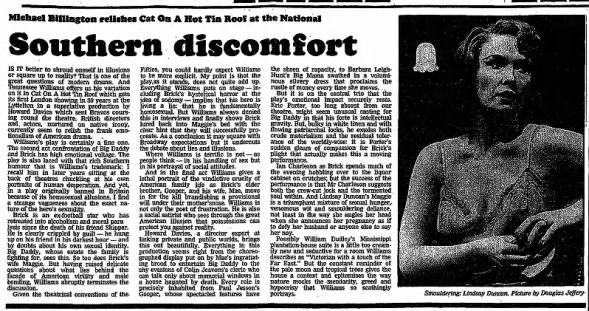
Michael Billington loved this production – his review clipped below:
There’s little on-line about this particular production, given its antiquity, but if you have no idea even what the piece looks/feels like, here is a clip of Paul Newman and Elisabeth Taylor from the 1950’s film version:
…while the following clip is from a subsequent National theatre production of Cat:
Anyway, the Lindsay Duncan & Ian Charleson version will live long in my memory. Bobbie’s too, I’ll guess. I’d better ask her.
I rated this play/production superb in my log – I remember it well and fondly.
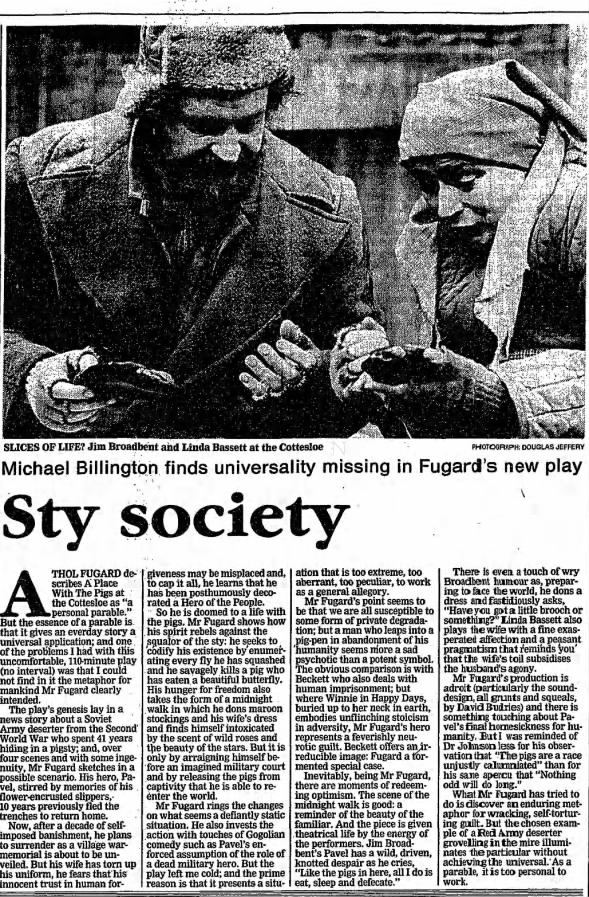
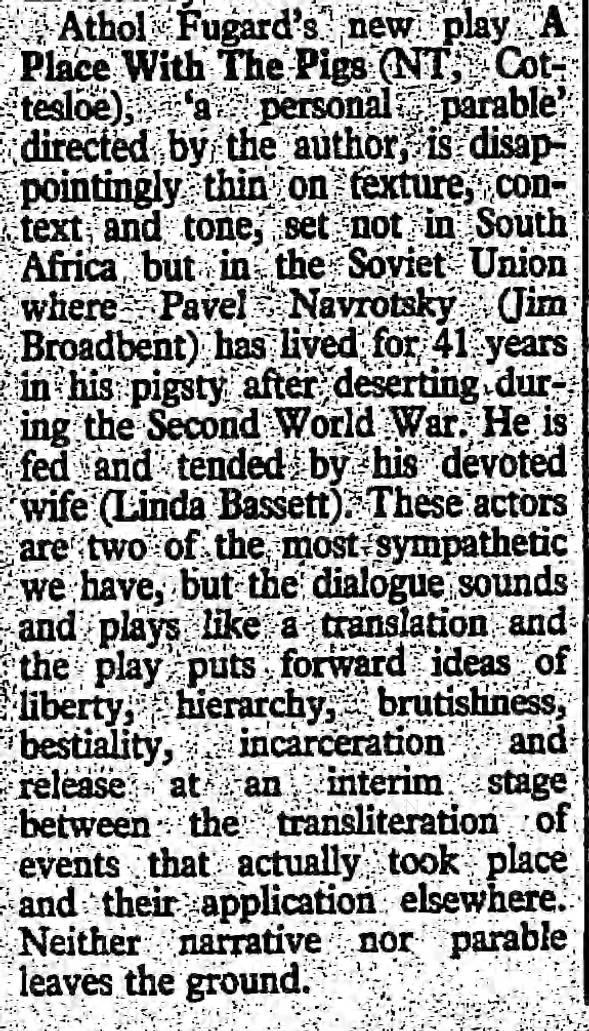
Jim Broadbent and Linda Bassett were both outstanding – I think this might have been the first time I saw either of them in the theatre and it was, I think, my first experience of seeing an Athol Fugard play performed. If so, it was the first of many in all three cases.
The play is about a Russian soldier hiding in a pig sty for many years after the war and possible recriminations for his desertion are over. No doubt it is meant to be a parable with relevance to the Afrikaner position in South Africa.
Frankly, I found it hard to engage too deeply with the parable at the time, but did think it was an interesting and entertaining play, especially in the hands of the talented cast.
Unusually for productions that please me so much, Fugard himself directed this one – I’m not keen on the idea of playwrights directing their own work and usually detect some untrammelled egotism in such productions, but I think Fugard might be an exception to the “don’t direct your own plays” rule of thumb.
Did Bobbie enjoy this one as much as I did? I think so, at the time, but whether it stuck so long in her memory as it did mine is a question I’ll have to ask her.
I’ve either mislaid or never had the programme for this one, sadly, so I needed to do a bit of on-line searching.
The log makes it clear that i went to see this play with Bobbie and that we both thought it was “really good”.
I do remember enjoying it and I especially remember an early scene in which Maggie Smith, as a tour guide, starts making up the history when her memory fails her and/or the reality doesn’t seem interesting enough.
These days I quite often hear the Lord’s tour guides explaining the history of real tennis to a tour group while I play. Sometimes they are pretty accurate and sometimes they indeed dwell into fiction. On one recent occasion (February 2019) they told the group that the charming woman I was playing against, whose handicap is some 10 points less impressive than my modest handicap, is a former open champion and one of the finest players in the world. We both lifted our performances a little to try and impress.
“Fantasy floods in where fact leaves a vacuum”, as Lettice puts it in the play, Lettice and Lovage, which is the very thing I am digressing away from writing about here.
Apparently it opened in October 1987 so we got in fairly early in its long West End run. It was at the Globe Theatre – i.e. the West End Globe, not the Shakespeare facsimile thing that didn’t yet exist in 1988…obvs.
By all accounts it was a big hit – hence the long run and subsequent Broadway run too.
Maggie Smith was terrific as was Margaret Tyzack as her foil/nemesis. I don’t in truth remember what the supporting cast was like – probably just fine. Michael Blakemore directed it, which is usually a very good sign.
By all accounts, including his own, Shaffer wrote the Lettice part with Maggie Smith in mind, which makes sense:
I recall that the play was both funny and thought-provoking about issues of conservation, history and the grey areas between historical fact and fiction.
What is it about visits to theatres named Theatre Royal with Bobbie Scully, I wondered?
My log records the following from our 1986 visit to the Theatre Royal Haymarket:
This production was notable for the overlapping dialog to speed it up. Despite that mercy, we attended on one of the hottest days of the year and the air conditioning was poor or non existent. Quite literally, a fight broke out in the audience (just in front of us) at one point. Luvvie rage?
Ah yes, I remember it well.
I liked Jonathan Miller’s idea to use overlapping dialogue. While Long Day’s Journey is regarded as a great play, it is normally incredibly long for a play in which pretty much nothing happens. The overlapping dialogue shortens the play a fair bit. Further, it added a sense of realism to the drama. A family pretty much at war with itself probably would comprise people speaking a lot without really listening to anything the others are saying.
This was a Broadway production on transfer to the West End – the Haymarket was doing quite a few of those back then.
Jack Lemmon played the lead in this production and I thought he was very good.
A young unknown (to us) named Kevin Spacey played James Jr – I thought he overacted a fair bit, but then what do I know. In fairness, when Janie and I saw him 10-12 years later play the lead, Hicky, in The Iceman Cometh, I felt he had come on leaps and bounds as an actor.
As for the heat and the poor air conditioning and the flight – that for sure is my most abiding memory of the Long Day’s Journey evening.
The fight broke out towards the end of the interval. I think someone simply stepped on someone’s foot while trying to get back to their seat. So much so normal in those poorly designed, ludicrously-expensive-yet-space-restricted-seats in theatres housed in illustrious 19th century buildings such as the Theatre Royal Haymarket.
I seem to recall that both of the combatants were Americans. Perhaps the stomper was belatedly or insufficiently apologetic to the stompee, but anyway they actually stood there fighting for a while.
I especially remember a rather camp usher rushing to the end of the offending row, waving his arms and shouting,
Stop it! Stop it at once! Please stop fighting!…
…as if arm waving and pleas were likely to stop a couple of audience rage pugilists at that stage of the dispute.
I don’t suppose the fight lasted all that long, nor was anyone seriosuly hurt. Nor did either of the antagonists refuse to sit close to the other once they had calmed down – I think they were only two or three seats away from each other. Far enough, I suppose.
I do recall Bobbie and I deciding that the fight was the most action-packed dramatic incident of the evening. Long Day’s Journey is, in truth, a play in which almost nothing happens.
I had logged this incorrectly as 4 August but actually we went 16 August.
My diary also reminds me that Bobbie and I went to Inigo Jones for a pre-theatre meal, which I describe as:
…fab nouvelle cuisine meal.
Remember Inigo Jones restaurant in Covent Garden? Remember nouvelle cuisine?
I also note that we…
…had coffee at Swiss…
…[i..e. The Swiss Centre] after the show.
Bobbie might now remember some or all about the evening, but last time I asked (17 February 2020) she drew a blank, other than remembering having seen this production with me.
Here’s the diary extract for that weekend starting with Friday:
Friday 3 January 1986 – Went in to the office this morning – finished Ashley’s files. Met Caroline for lunch – went to Effes [meaning Efes] – v pleasant. Had a lazy evening at home + a fairly early night.
I’d forgotten that I sometimes treated Efes in Great Titchfield Street as a lunch place in the Newman Harris Cavendish Square days. My recollection was as a “soak up the beer after work” place, as I said in my write up of the Z/Yen Seasonal Party there, many years after the 1986 visit:
Update: Caroline remembers Efes as a lunch place more comprehensively than I do – even recalling that her luncheon of choice was No 13- chicken shish. Extraordinary powers of recall, that.
Saturday 4 January 1986 – Lazyish day – went to the high road in afternoon to library etc after lazing for most of the morning. Petra came over late afternoon – went up to town – saw Noises Off – very funny evening, went for late Italian meal. Came back to stay + late night.
Despite having been going for best part of four years, Noises Off was still filling houses and still had an excellent cast: Christopher Godwin, Stephanie Cole, Hugh Paddick, Michael Cochrane, Colette Gleeson, Timothy Carlton, and others too numerous to make it onto the newspaper classifieds at the time. Probably my first sighting of those people and probably my first sight of a Michael Blakemore directed piece too.
I do recall finding the play very funny – especially the middle act. I am really glad to have seen the original production of Noises Off, albeit not the very first cast.
Sunday 5 January 1986 – Saw Petra off this morning – had a big Italian lunch with folks – watched an old movie in the afternoon and had a generally lazy time at home reading etc.
I went to see this one with Marianne Gilmour. Unfortunately I didn’t get/keep a programme, but I do remember it being a long, but very entertaining, evening of theatre.
My first sighting of Antony Sher live, no doubt. I vaguely recall that the idea of going to see this show was entirely predicated on the notion that both Marianne and I wanted to see Anthony Sher on stage.
Here’s my diary entry for that day:
Thursday 2 January 1986 – Went to Finsbury Park to do stocktake at Sam Phillips – ok – spent most of day there + then went back to office. Met Marianne – went round shops -> Chinese food meal -> Torch Song Trilogy (Antony Sher) – V. good indeed. Went back to Stanmore with Marianne & stayed there.
There was more to it than Anthony Sher. My sense is that the whole cast and production was very good, although I found the musical element of it a bit camp and shmaltzy. But you can hardly complain about that if you go to see a show named Torch Song Trilogy, can you?


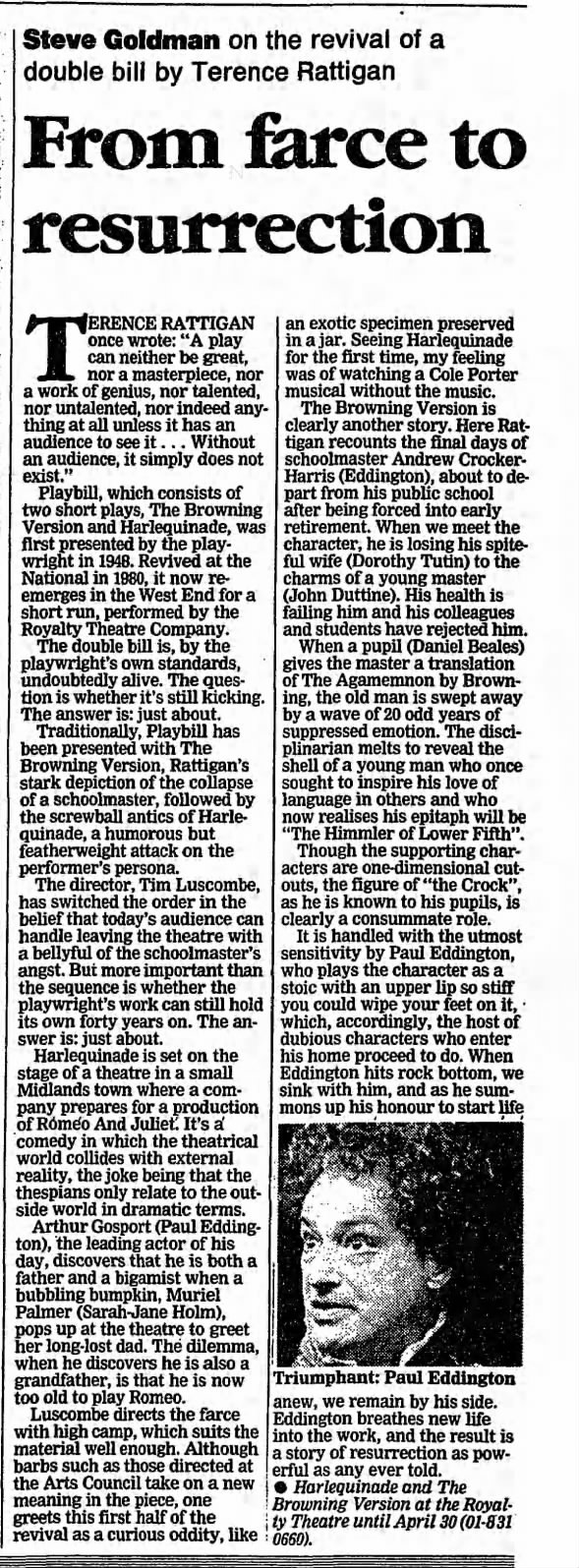 Steve Goldman on Rattigan Mon, Mar 21, 1988 – 32 · The Guardian (London, Greater London, England) · Newspapers.com
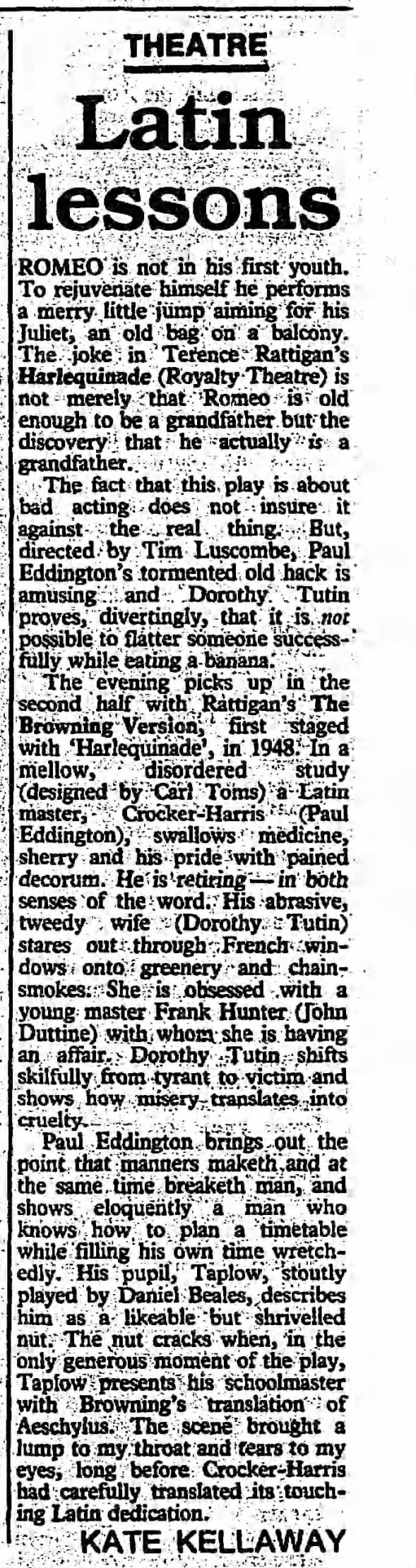 Kate Kellaway on Rattigan Sun, Mar 20, 1988 – 40 · The Observer (London, Greater London, England) · Newspapers.com