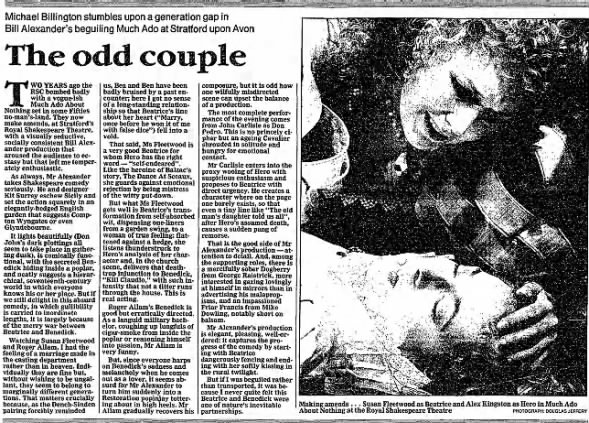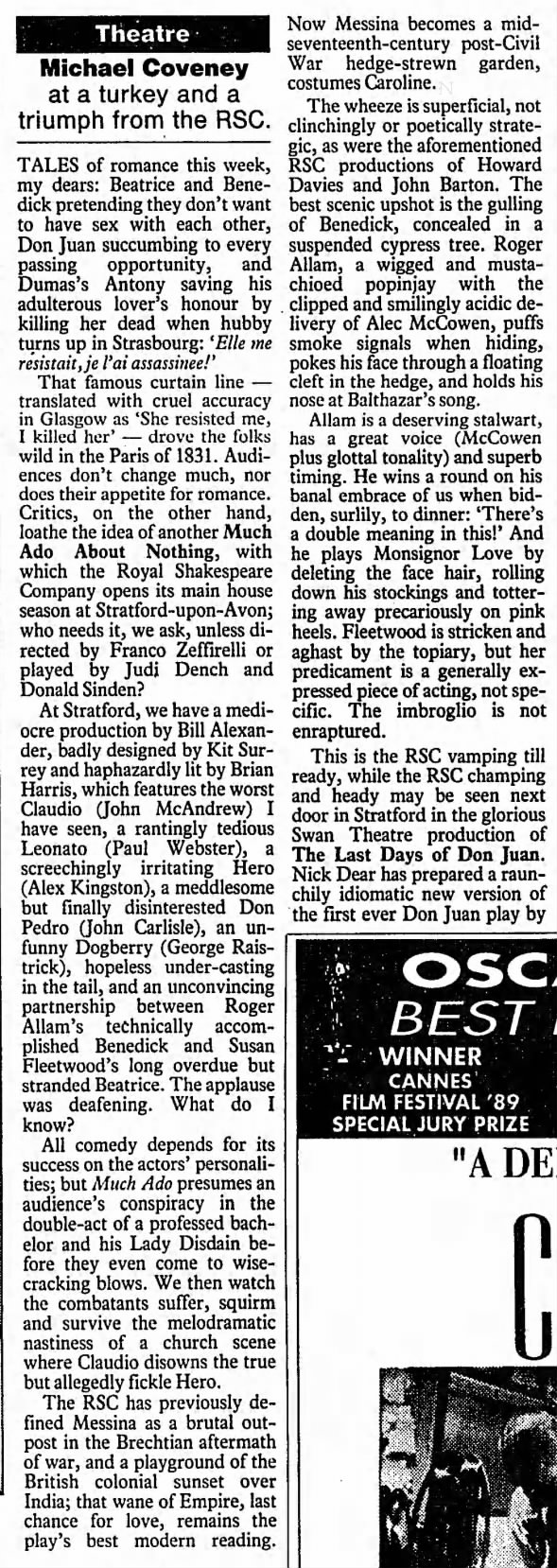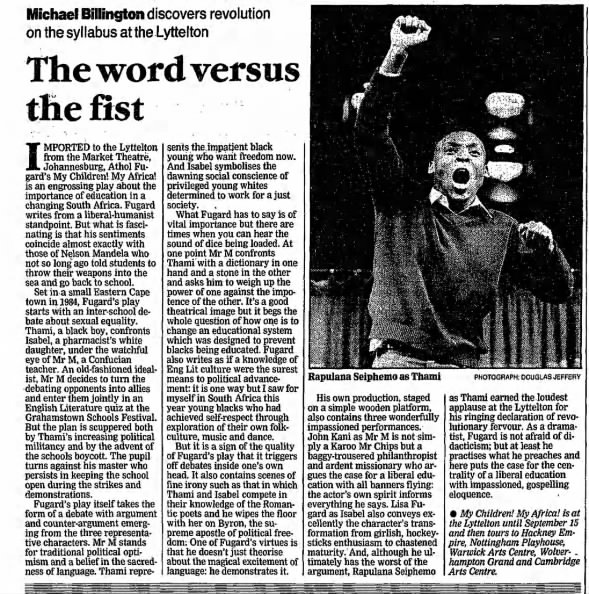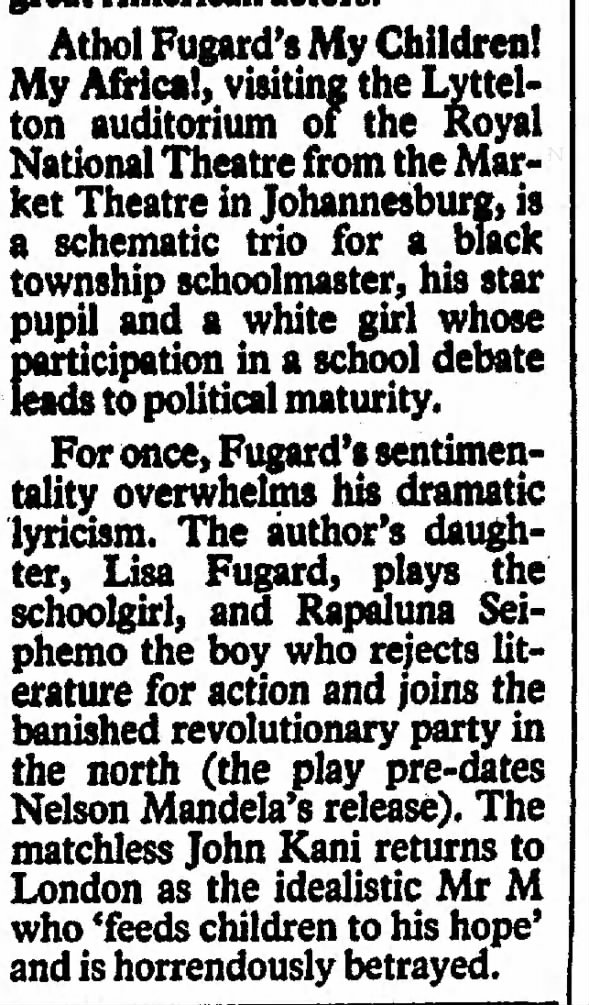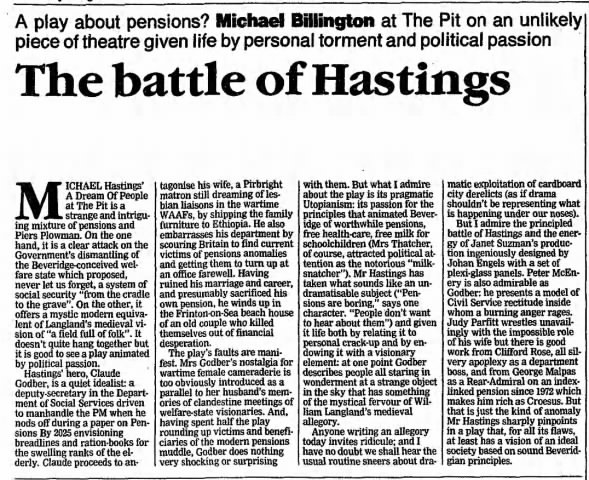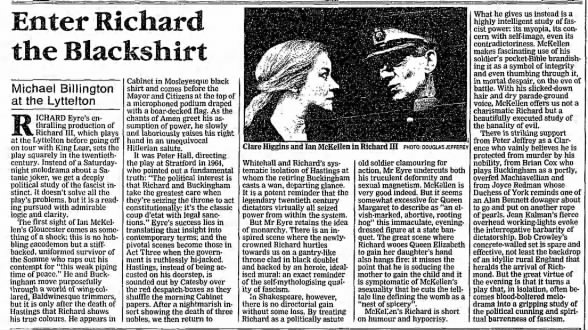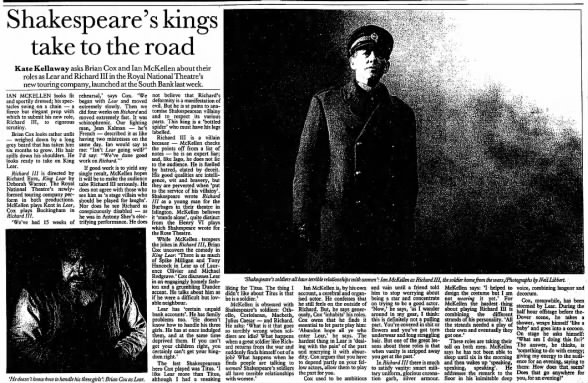
My log says that this was a transfer from The Other Place in Stratford and that I (possibly we – Bobbie was with me) was/were not 100% sure about it.
What was there not to be sure about? Splendid cast: Willard White as Othello, Ian McKellen as Iago, Imogen Stubbs as Desdemona, Zoe Wannamaker as Emilia…Trevor Nunn directing.
I also have a feeling that the 1989 RSC production felt a little over-theatrical to me. There is a certain Trevor Nunn style. Little did I know then that Janie and I would meet Trevor and Imogen – strangely around about the time we saw the 1997 RNT Othello.
My log says “little recollection” for this one, so I guess it didn’t make a big impression. Bobbie was with me.
Pirandello is one of those playwrights whose work I want to like more than actually do like. Or perhaps it is more accurate to say that I tend to enjoy reading his plays, because the ideas are fascinating, but many of them are difficult to produce in an entertaining way – at least to the eyes of the modern audience.
Man, Beast And Virtue is an early Pirandello, written in 1919 (100 years ago as I write in 2019), about two years before his breakthrough play, Six Characters In Search Of An Author.
I don’t recall much about this one and the diary is a mess for it. I suspect that the mention of Bobbie on the Friday and The Wonder on the Saturday ended up being one and the same evening. So I’m guessing that I saw this production with Bobbie on one of those evenings.
There’s the diary page for that week. If any of my friends can help me to unpick all of that, may I just thank you profoundly in advance.
The Wonder. To the extent that I remember it, I think the production and acting was very good but that we didn’t much like the play.
An interesting but now rarely performed playwright from the late Restoration/early Hanoverian period, I’m not sure that Susanna Centilivre‘s plays have dated well. But that’s not her fault. I don’t suppose she even faintly imagined The Wonder being revived in 1989 when she dedicated it to the new king, George I, in 1714.
The Escapade Theatre Company (confusingly not the company that now bears that name) was a group dedicated to reviving plays written by or mostly about women.
Anna Mazzotti played the female lead role Isabella, with great poise and confidence I recall. I managed to track her down in 2019 as someone who did/does many Italian language programmes for the BBC and theatre in Rome -still listing The Wonder on her theatrical cv. Strangely (as she only lists two), she also lists Dealing With Clair at the Orange Tree, which Janie and I saw when the Orange Tree revived it (recently at the time of writing):
The male lead, Don Felix, was played by a young Christopher Eccleston – possibly only his second professional gig. His cv is no longer talking about this one, but it does still mention, amongst many other things, Dr Who.
Any further intelligence on this one will need to come from others, e.g. Bobbie!…
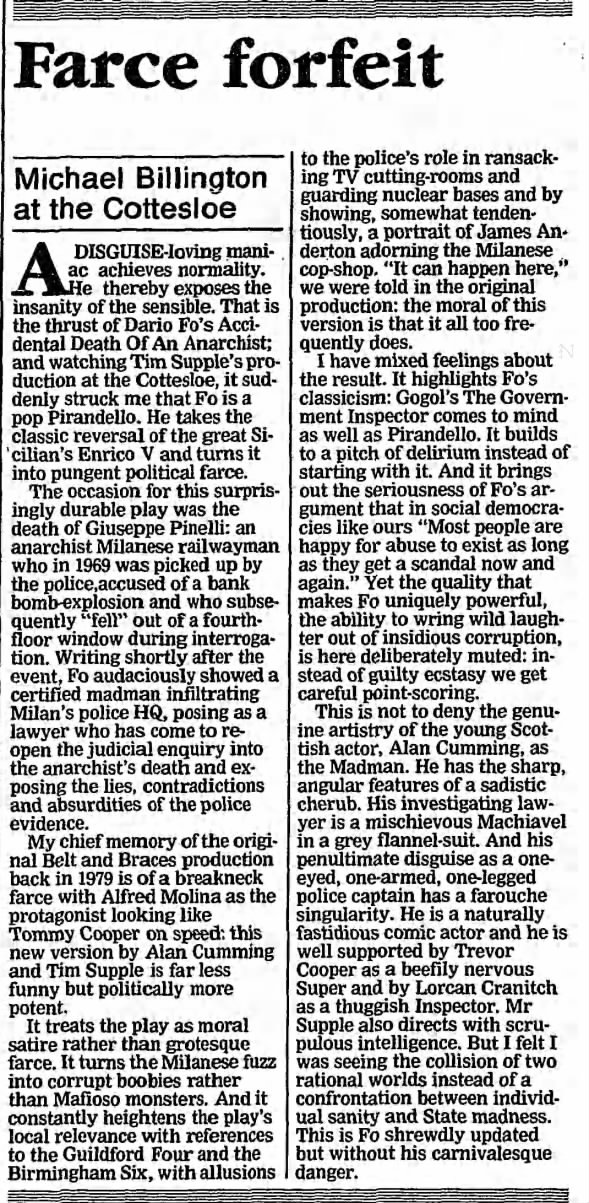
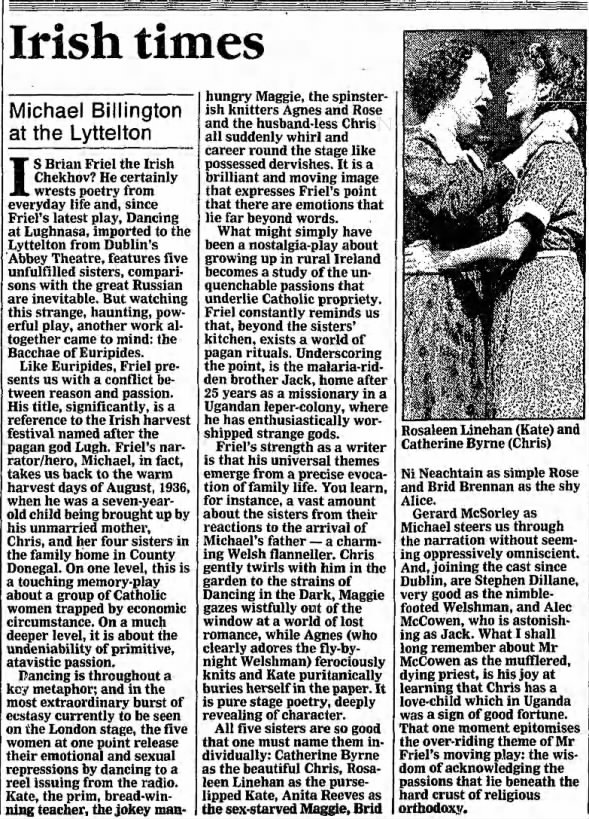
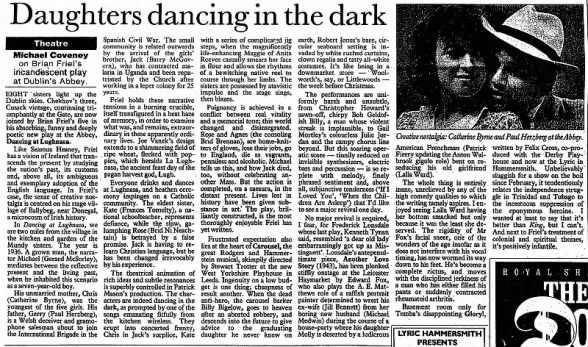
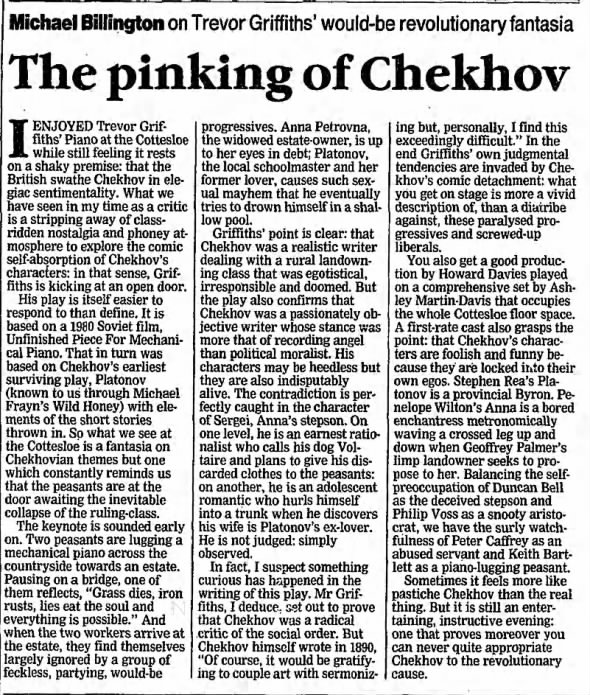
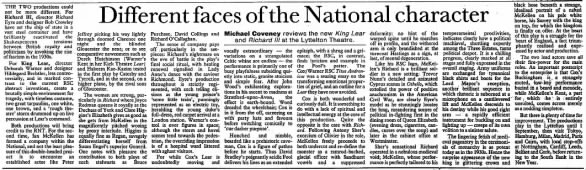
…or Michael Billington! Good old Billy – he reviewed the production in The Guardian:
I saw this production of The Merchant Of Venice with Bobbie. I don’t think either of us was overly enamoured of it. I registered “quite good” in my log, which is faint praise from me.
There was a lot of hype about this production because Dustin Hoffman was playing Shylock. I recall that Bobbie’s friend May Lamb referred to that actor as “Dustbin Hoffman” – I must admit that I have never been able to process his name the same way since.
There were other good folk in this production; Geraldine James as Portia for a start. Michael Sibbery as Gratiano, Ian Lavender as Solanio, Leigh Lawson as Antonio, Peter-Hugo Daly as Launcelot Gobbo and many other good names. Peter Hall directed it.
Sometimes a collection of big names is not, in itself, enough.
Also, I have a feeling that this is not really a great play; that’s my opinion anyway. Technically it is a comedy in the Shakespeare canon, but well short of laughs for the modern audience, even by Shakespeare comedy standards.
John White loves a bit of existential angst, so what could be a better choice for a Saturday night out than Huis Clos? Mandy was up for it. Annalisa was up for it. Off we went to the Lyric Hammersmith – the small Studio theatre there.
The play is set in hell, which is said to be a hot place.
It really was o-t ‘ot that evening. Clammy August and naturally the air conditioning system in the Studio wasn’t working.
Here’s my database/diary note for this evening:
The air conditioning had broken down on one of the hottest days of the year. The Lyric gave us all free squash in the interval because it was so bad. It did make the play about hell truly multi-sensory. The line “it’s so hot in here” had the whole audience in stitches.
I seem to remember the Rose Bruford mob doing a decent job of Andorra although in truth I remember little about this production.
I’m sure I secretly felt that my school production was just as good if not better but would have been far too polite to say so…
…actually that’s nonsense. I probably secretly realised that our school production was properly “kids amateur” whereas the Rose Bruford production would have been close to professional quality.
The diary is silent about what we did afterwards – I suspect that some eating and drinking was involved, quite possibly with some of the cast.
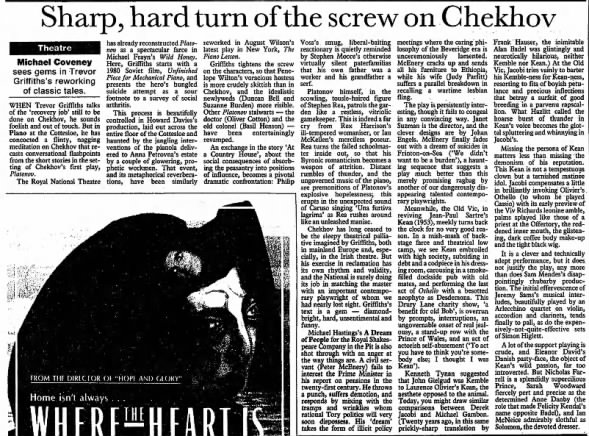
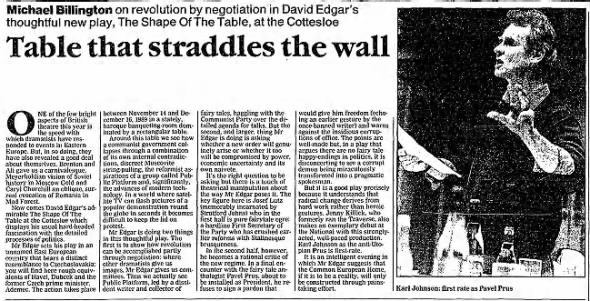
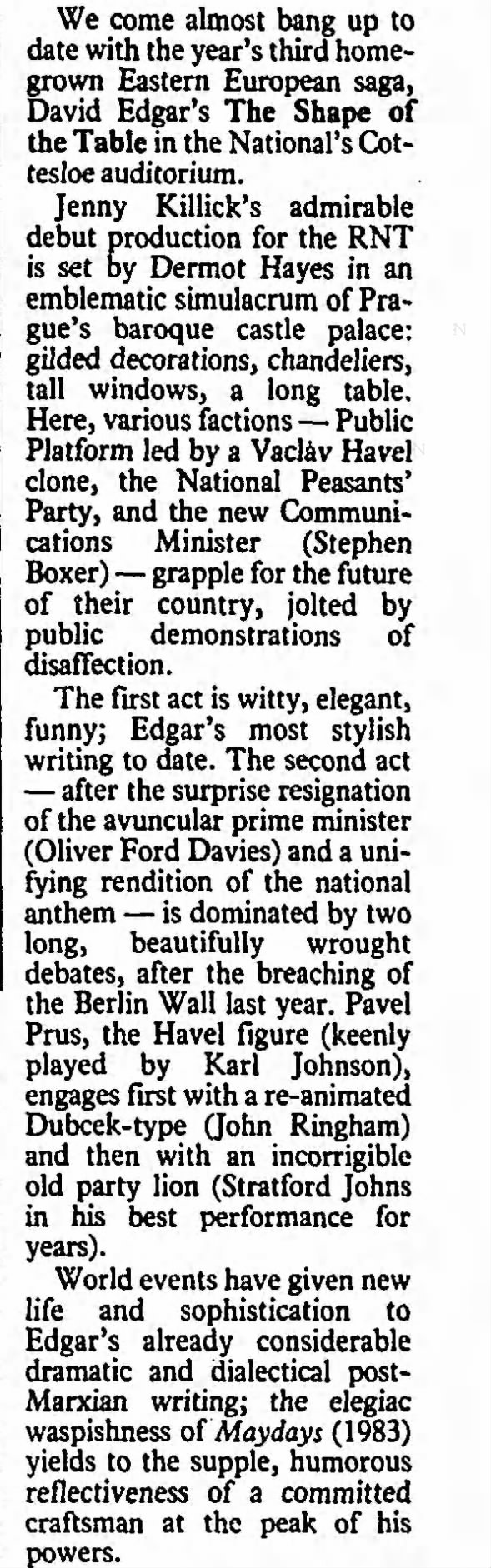
…but for sure I got back to London in time to see this preview at the Cottesloe.
Bobbie might say, “more’s the pity”, as my log notes that Bobbie absolutely hated it. I merely found it long and hard to follow. That’s how I remember it and that is exactly what I wrote in my log.
Super cast – Tilda Swinton is always very watchable but does often do weird stuff. Also Aidan Gillen, latterly very well known indeed. David Bamber was in it too – thirty years on I tend to watch his son, Ethan, bowling for Middlesex instead.
The play is described as a dramatic poem in the English language text and/but it was basically a family drama.
I wrote the above piece on 14 February 2019, basically because it had been on my mind after writing up Music At Oxford a few days earlier. By strange coincidence, Bobbie Scully turned up at the Gresham Society Dinner that evening, as Iain Sutherland’s guest.
I mentioned the coincidence. Bobbie started to quiver with indignation:
I’d forgotten the name of that darned thing, but it was surely the very worst thing I have ever seen at the theatre…I think we walked out at half time…
…she said. Actually I don’t think we did walk out at half time. I’m sure I would have recorded that fact in my log whereas instead I recorded that the play was long and impenetrable.
I think we stuck it out tho the bitter end…
…I said. I also volunteered to dig deeper into the programme to see if there were in fact two halves.
Yes, there were two halves and they added up to a whopping three hours of hurt for Bobbie.
I’m not sure why we did stick it out. Perhaps I was still wet enough behind the ears to imagine t hat such a piece might yield in the second half all the answers it withheld in the first. I know not to do that now. Perhaps I was so tired and hungover from the joys of Oxford the night before I was reluctant to move on yet.
More likely, we had booked a late night eatery and jointly thought we might as well see the thing through rather than kick our heels somewhere.
Anyway, the whole experience clearly had a profound effect on Bobbie who was shaking with the trauma of recalling that evening and remembered it so well she even said…
…I seem to recall it was only on for a short run…
…which indeed it was.
Nearly 30 years on, Bobbie might wish to read the short essay from the programme too. The least I can do, upload the material, after all I put poor Bobbie through with regard to this play/production.
Postscript Two: Bobbie Chimes In With A Recovered Memory
An e-mail from Bobbie 24 hours after our encounter at the Gresham Society:
I was casting my mind back to that dreadful so-called play (it wasn’t, it was a string of tedious monologues) and had a recollection of being there after the interval in a (suddenly) half empty theatre. So I reckon that, although we did not leave at half time, about half the audience did.
And, indeed, I think that is why we stayed. We came out at the interval, intending to leave, but had pre-booked interval drinks to consume. As we did so, we watched more than half the audience exit the building. I think we went back out of sympathy/solidarity/courtesy towards the cast.
Does this ring any bells with you? Did we really watch the second half because we felt sorry for the actors? Personally, I can think of no other reason …
My response to Bobbie’s considered recollection was as follows:
Yes, we were young and foolish back then. We might well have stayed on for compassionate reasons. There’d be no such snowflake nonsense from this quarter these days. I do recall the second half seeming to drag to an even greater extent than the first half. I also remember an incredible sense of relief when the ordeal ended.
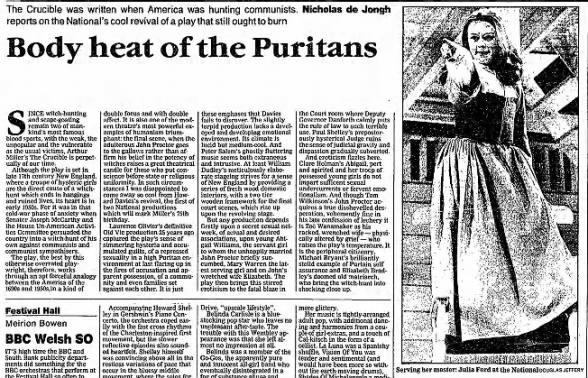
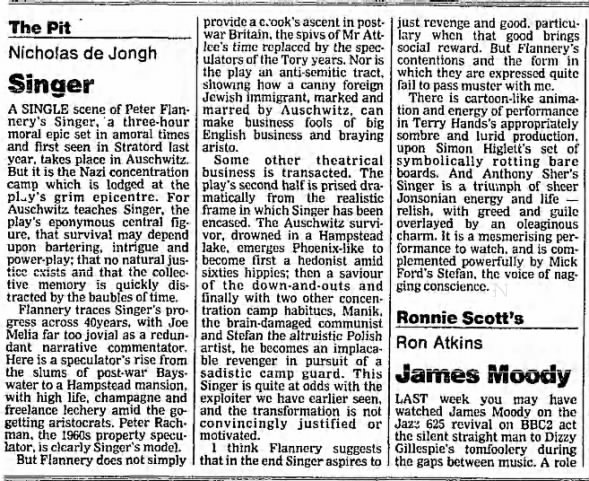
Postscript Three: Here’s a professional view…I don’t think Nicholas de Jongh in the Guardian exactly liked it either:
I noted that this was a very good production and I’m sure that was true. Richard Eyre in charge of an infeasibly good cast in that intimate little Cottesloe Theatre.
…David Burke, Michael Bryant, Jeremy Northam, Graham Crowden, Sarah Winman, Stella Gonet, Selina Cadell, Suzanne Burden, Wendy Nottingham… it was difficult to work out which names from the cast list to leave out from this highlights version of the list.
In truth I don’t think Granville-Barker is really for me. I find his plays stylised and very Edwardian – which is, after all, what they are.
This one is at least replete with interesting moral dilemmas but in truth it’s not Ibsen.
But I do recall really enjoying this particular evening in the theatre and I suspect that this is the best Granville-Barker experience I have ever had and ever will.
I don’t recall exactly what Bobbie thought of it but I think she, like me, was much taken with the production. I also don’t recall what we did (i.e. where we ate) afterwards. Bobbie might just remember.
I don’t remember all that much about this one, which probably means that I found it somewhat impenetrable, as is sometimes the case with Caryl Churchill plays.
I have the play text, so perhaps I should have a read to refresh my memory about this play/production. Or perhaps Bobbie can help.
Postscript
I have now reverted to the text and it sort-of comes back to me. The diary also tells me that we sat in seats D9 & D10 and that they were £10 tickets that Saturday. Good value, I suppose.
My log suggests that we thought this production was good. I’m not a huge fan of Wesker’s plays; in fact this one sticks in my memory as probably the most interesting of all those I have seen and read.